

Introduction – Real Plant Observation
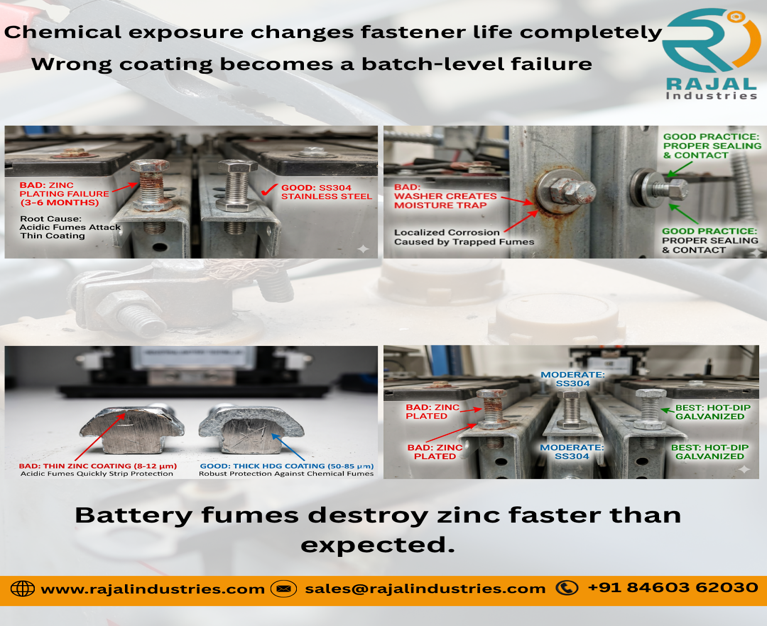
In a battery manufacturing unit, zinc-plated M10 bolts showed visible rust within 3–6 months of installation.
Conditions:
👉 Indoor environment
👉 Controlled temperature
👉 No direct water exposure
Yet corrosion started early.
Root cause:
👉 Zinc coating degraded under chemical exposure
👉 Acidic fumes attacked protective layer
👉 Base steel exposed
Battery manufacturing areas are not “normal indoor environments.” They involve chemical vapors, humidity, and reactive conditions.
In OEM production setups, these fasteners are used in 50,000–200,000 pcs batches, where wrong coating selection leads to large-scale failures.
Quick Answer
Why does zinc plating fail in battery manufacturing areas?
Zinc plating fails due to its thin coating (8–12 microns), which cannot withstand chemical fumes and humidity present in battery plants, leading to rapid corrosion.
What is Zinc Plating Failure?
Zinc plating failure is the breakdown of the protective zinc coating on fasteners, exposing the base steel to corrosion due to environmental factors.
5 Reasons Zinc Plating Fails in Battery Plants
- Thin coating thickness (8–12 microns)
- Exposure to acidic fumes
- High humidity conditions
- Chemical reactions with battery materials
- Lack of corrosion-resistant alternatives
Why Zinc Plating is Not Suitable for Battery Environments
Zinc plating is designed for:
✔ Indoor storage
✔ Short-term protection
Not for:
❌ Chemical exposure
❌ Acidic environments
❌ Long-term industrial use
Failure Mechanism
- Chemical fumes attack zinc layer
- Coating deteriorates
- Steel substrate exposed
- Corrosion begins
SS304 vs HDG vs Zinc – Comparison
| Parameter | Zinc Plated Bolt | SS304 Fastener | HDG Bolt |
| Coating Thickness | 8–12 µm | Solid material | 50–85 µm |
| Corrosion Resistance | Low | Moderate | High |
| Chemical Resistance | Low | Moderate | High |
| Battery Plant Use | Not recommended | Moderate | Recommended |
When to Use Each Fastener
Use Zinc Plated Bolts
✔ Temporary applications
✔ Dry indoor storage
Use SS304 Fasteners
✔ Moderate humidity
✔ Controlled indoor battery areas
Use HDG Bolts
✔ High humidity zones
✔ Outdoor battery installations
✔ Chemical exposure areas
Role of Flat Washer in Corrosion
Flat washers often create:
👉 Moisture traps
👉 Surface gaps
Result:
❌ Localized corrosion
❌ Faster coating failure
Correct Practice
- Use corrosion-resistant washers
- Ensure proper contact
- Avoid water retention
Typical OEM Production Scenario
In battery manufacturing plants:
- Large-scale fastener usage across racks and assemblies
- Typical requirement: 50,000–200,000 pcs per batch
- Inconsistent coating leads to uneven corrosion
OEMs prioritize:
✔ Coating selection based on environment
✔ Supplier consistency
✔ Long-term durability
Common Mistakes in Battery Plants
- Using zinc-plated bolts for cost saving
- Mixing materials in same assembly
- Ignoring environmental conditions
- Using low-quality coatings
👉 These cause premature failure
Key Takeaways
• Zinc plating is not suitable for battery environments
• Thin coating fails under chemical exposure
• SS304 works in moderate conditions
• HDG provides better long-term protection
• Material selection must match environment
FAQ
Q1: Why do zinc-plated bolts corrode in battery plants?
Zinc plating is thin and cannot resist chemical fumes and humidity, leading to rapid corrosion.
Q2: Is SS304 better than zinc plating for battery applications?
Yes. SS304 offers better corrosion resistance, especially in moderately aggressive environments.
Q3: When should HDG bolts be used instead of SS304?
HDG bolts are preferred in high-humidity or outdoor conditions where stronger corrosion protection is required.
Q4: Can zinc plating be used in battery manufacturing areas?
Only for temporary or non-critical applications. It is not recommended for long-term use.
Q5: Do washers affect corrosion performance?
Yes. Improper washers can trap moisture and accelerate corrosion at joints.
Conclusion
Zinc plating failure in battery manufacturing areas is not unexpected—it is a result of wrong material selection for the environment.
In high-volume production, incorrect coating leads to batch-level corrosion issues across thousands of fasteners.
👉 We work with OEMs and production-scale orders (MOQ 50,000+ pcs) for battery and industrial applications.
Facing corrosion issues in battery plants or selecting fasteners for new production lines?
Share your drawing or production requirement (50,000+ pcs), and our engineering team will recommend the right corrosion-resistant solution.
References
- ASTM B633 – Zinc plating standards
- ASTM A153 – HDG coating standard
- ISO corrosion resistance guidelines