
Introduction
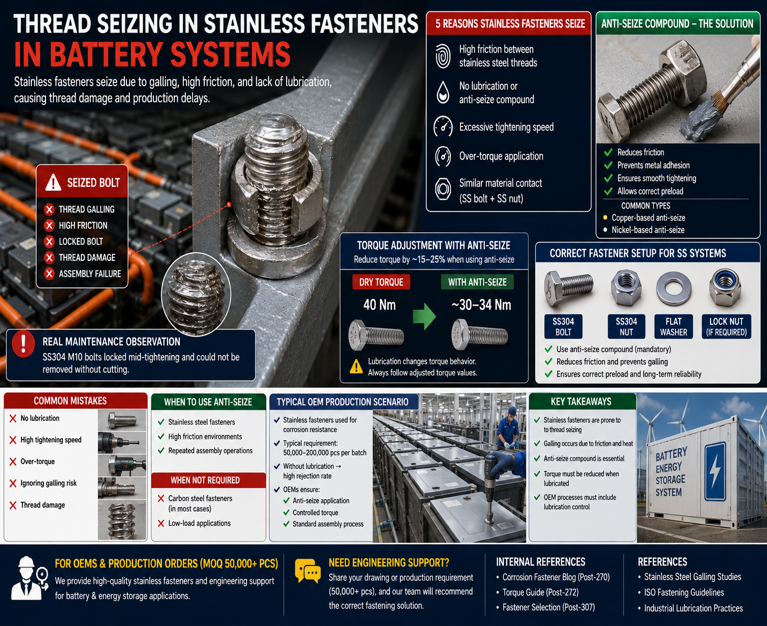
During assembly of a battery enclosure, several SS304 M10 bolts locked mid-tightening. The bolts could not be removed without cutting.
Failure type:
👉 Thread seizing (galling)
👉 High friction during tightening
👉 Permanent thread damage
This is a common issue with stainless fasteners—especially in battery systems where corrosion resistance is required.
In OEM environments using 50,000–200,000 pcs per batch, even a small percentage of seized bolts creates serious production delays and rejection.
Quick Answer
Why do stainless fasteners seize in battery systems?
Stainless fasteners seize due to galling—a friction-induced welding of threads caused by high pressure, heat, and lack of lubrication during tightening.
What is Thread Seizing (Galling)?
Thread seizing, also known as galling, is the adhesion and tearing of metal surfaces under friction, causing threads to lock and fail during tightening.
5 Reasons Stainless Fasteners Seize
- High friction between stainless steel threads
- No lubrication or anti-seize compound
- Excessive tightening speed
- Over-torque application
- Similar material contact (SS bolt + SS nut)
Why Stainless Steel is Prone to Seizing
Unlike carbon steel, stainless steel:
👉 Has higher friction coefficient
👉 Tends to “stick” under pressure
What Happens During Tightening
- Threads slide under load
- Friction generates heat
- Surface bonds form
- Threads weld together
👉 Result: Bolt locks permanently
Role of Anti-Seize Compound
Anti-seize is essential for stainless fasteners.
Function
- Reduces friction
- Prevents metal adhesion
- Ensures smooth tightening
- Allows correct preload
Common Types
- Copper-based anti-seize
- Nickel-based anti-seize
Torque Adjustment with Anti-Seize
Lubrication changes torque behavior.
Important Rule
👉 Reduce torque by ~15–25% when using anti-seize
Example
- Dry torque: 40 Nm
- With anti-seize: ~30–34 Nm
Correct Fastener Setup for Stainless Systems
Recommended configuration:
- SS304 bolt
- SS304 nut (with lubrication)
- Anti-seize compound (mandatory)
- Flat washer (to reduce surface friction)
- Lock nut (if required)
Role of Flat Washer
✔ Reduce friction at surface
✔ Prevent surface damage
✔ Improve torque consistency
Typical OEM Production Scenario
In battery systems:
- Stainless fasteners used for corrosion resistance
- Typical requirement: 50,000–200,000 pcs per batch
- Without lubrication → high rejection rate
OEMs ensure:
✔ Anti-seize application
✔ Controlled torque
✔ Standard assembly process
Common Mistakes
- Using stainless bolts without lubrication
- Tightening at high speed (power tools)
- Over-torque application
- Ignoring galling risk
👉 These lead to thread failure and assembly stoppage
When to Use Anti-Seize
✔ Stainless steel fasteners
✔ High friction environments
✔ Repeated assembly operations
When Not Required
- Carbon steel fasteners (in most cases)
- Low-load applications
Key Takeaways
• Stainless fasteners are prone to thread seizing
• Galling occurs due to friction and heat
• Anti-seize compound is essential
• Torque must be reduced when lubricated
• OEM processes must include lubrication control
FAQ
Q1: Why do SS304 bolts seize during tightening?
They seize due to galling caused by friction, heat, and lack of lubrication between threads.
Q2: How can thread seizing be prevented?
Using anti-seize compound, reducing torque, and controlling tightening speed can prevent seizing.
Q3: Is lubrication necessary for stainless fasteners?
Yes. Lubrication is essential to prevent galling and ensure smooth tightening.
Q4: Should torque be reduced when using anti-seize?
Yes. Torque should be reduced by approximately 15–25% to maintain correct preload.
Q5: Can seized bolts be reused?
No. Once threads are damaged, the fastener should be replaced.
Conclusion
Thread seizing in stainless fasteners is not a rare issue—it is a known material behavior.
Without proper lubrication and torque control, even high-quality SS304 fasteners will fail during assembly.
In large-scale production, this leads to delays, rework, and increased cost.
👉 We work with OEMs and production-scale orders (MOQ 50,000+ pcs) for stainless and industrial fasteners.
Facing thread seizing issues or planning stainless fastener use in battery systems?
Share your drawing or production requirement (50,000+ pcs), and our engineering team will recommend the correct fastening approach.
References
- Stainless steel galling studies
- ISO fastening guidelines
- Industrial lubrication practices