

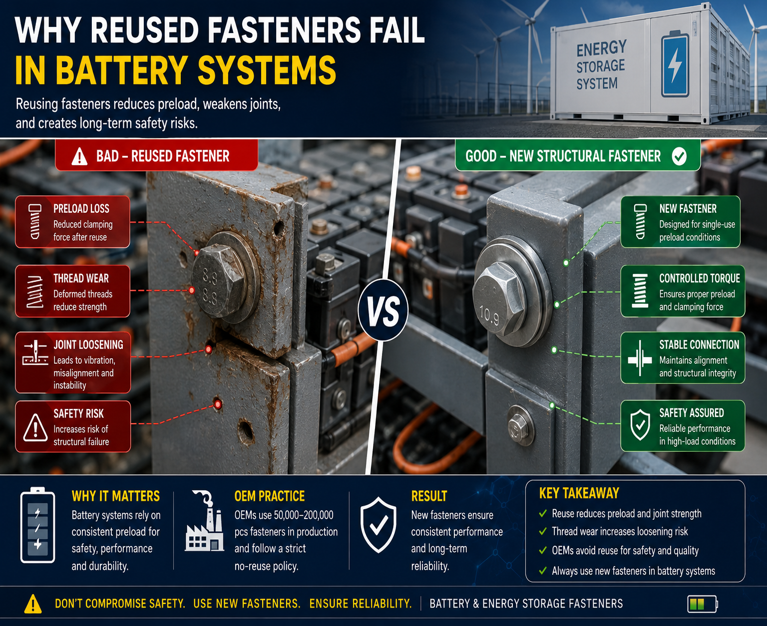
Introduction – Real Maintenance Observation
During maintenance of a battery rack system, bolts were removed and reinstalled after inspection. Within weeks, several joints showed:
👉 Loosening
👉 Reduced preload
👉 Minor structural instability
No new bolts were used.
Root cause:
👉 Reused M10 fasteners
👉 Loss of thread integrity
👉 Reduced clamping force
In battery systems, fasteners are not just holding parts—they maintain preload, alignment, and safety.
In OEM environments, fasteners are used in 50,000–200,000 pcs production batches, and reuse is strictly avoided to maintain reliability.
Quick Answer
Why do reused fasteners fail in battery systems?
Reused fasteners fail due to loss of preload, thread wear, and fatigue damage, leading to reduced clamping force and increased risk of loosening.
What is Reused Fastener Failure?
Reused fastener failure refers to the degradation of bolt performance after removal and reinstallation, resulting in reduced strength, preload, and reliability.
5 Reasons Reused Fasteners Fail
- Loss of preload after initial tightening
- Thread wear and deformation
- Fatigue damage from previous loading cycles
- Surface coating damage
- Reduced locking effectiveness (nylock or threads)
Why Reuse Reduces Fastener Performance
Fasteners are designed for:
👉 Single-use preload conditions
After tightening:
- Threads undergo stress
- Micro deformation occurs
- Friction characteristics change
When reused:
❌ Same torque does not produce same preload
❌ Joint reliability decreases
Fatigue Failure Mechanism
Repeated loading causes:
- Micro cracks in bolt material
- Progressive weakening
- Sudden failure under load
Simplified Insight
More reuse cycles → higher failure risk
Impact on Battery Systems
In battery structures:
- Fasteners maintain alignment
- Support load distribution
- Ensure electrical and structural integrity
Failure Results
- Joint loosening
- Frame misalignment
- Increased vibration
- Safety risks
Role of Lock Nut and Threaded Rod
Lock Nut
✔ Provides locking function
❌ Loses effectiveness after reuse
Threaded Rod
✔ Used in structural connections
❌ Threads wear with reuse
OEM Practice – No Reuse Policy
OEM manufacturers follow:
👉 Strict no-reuse policy for critical fasteners
Why?
✔ Ensures consistent preload
✔ Reduces failure risk
✔ Maintains quality standards
Typical OEM Production Scenario
In battery manufacturing and maintenance:
- Large number of fasteners used
- Typical requirement: 50,000–200,000 pcs
- Reuse leads to inconsistent performance
OEMs ensure:
✔ New fasteners for each installation
✔ Controlled torque
✔ Quality inspection
Common Mistakes in Maintenance
- Reusing bolts to reduce cost
- Mixing old and new fasteners
- Reusing lock nuts
- Ignoring thread condition
👉 These lead to hidden failures
When Can Fasteners Be Reused?
✔ Non-critical applications
✔ Temporary fixtures
Should NOT be reused
- Structural joints
- Battery systems
- High-load connections
Key Takeaways
• Reused fasteners lose preload and reliability
• Thread wear reduces clamping force
• Fatigue damage increases failure risk
• OEMs avoid reuse for safety
• New fasteners ensure consistent performance
FAQ
Q1: Why should fasteners not be reused in battery systems?
Reusing fasteners reduces preload and increases the risk of loosening and failure.
Q2: Do reused bolts lose strength?
Yes. Repeated loading and tightening cause fatigue and reduce structural integrity.
Q3: Can lock nuts be reused?
No. Lock nuts lose their locking capability after first use.
Q4: What is the risk of reused fasteners?
Risks include loosening, misalignment, and sudden failure under load.
Q5: Are there any cases where reuse is acceptable?
Only in non-critical or temporary applications, not in OEM or structural systems.
Conclusion
Reusing fasteners in battery systems may seem cost-effective—but it leads to higher long-term risk and failure.
OEM manufacturers avoid reuse to maintain consistent performance and safety.
In large-scale production, even small compromises result in system-wide issues.
👉 We work with OEMs and production-scale orders (MOQ 50,000+ pcs) for battery and industrial applications.
Planning maintenance or production for battery systems?
Share your drawing or production requirement (50,000+ pcs), and our engineering team will recommend the correct fastener strategy.
References
- ISO fastener usage guidelines
- Fatigue failure principles
- Industrial maintenance practices