

Introduction – Real Site Hook
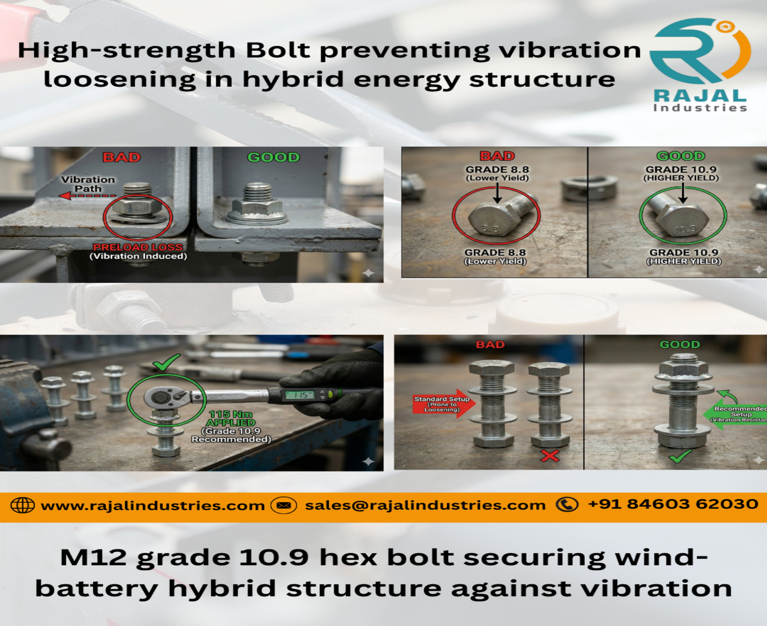
In a wind-battery hybrid installation, technicians observed unusual noise during high wind periods. Inspection showed that several M12 hex bolts at the battery frame base had reduced torque.
Initial torque: 75 Nm
Measured after 8 months: 52 Nm
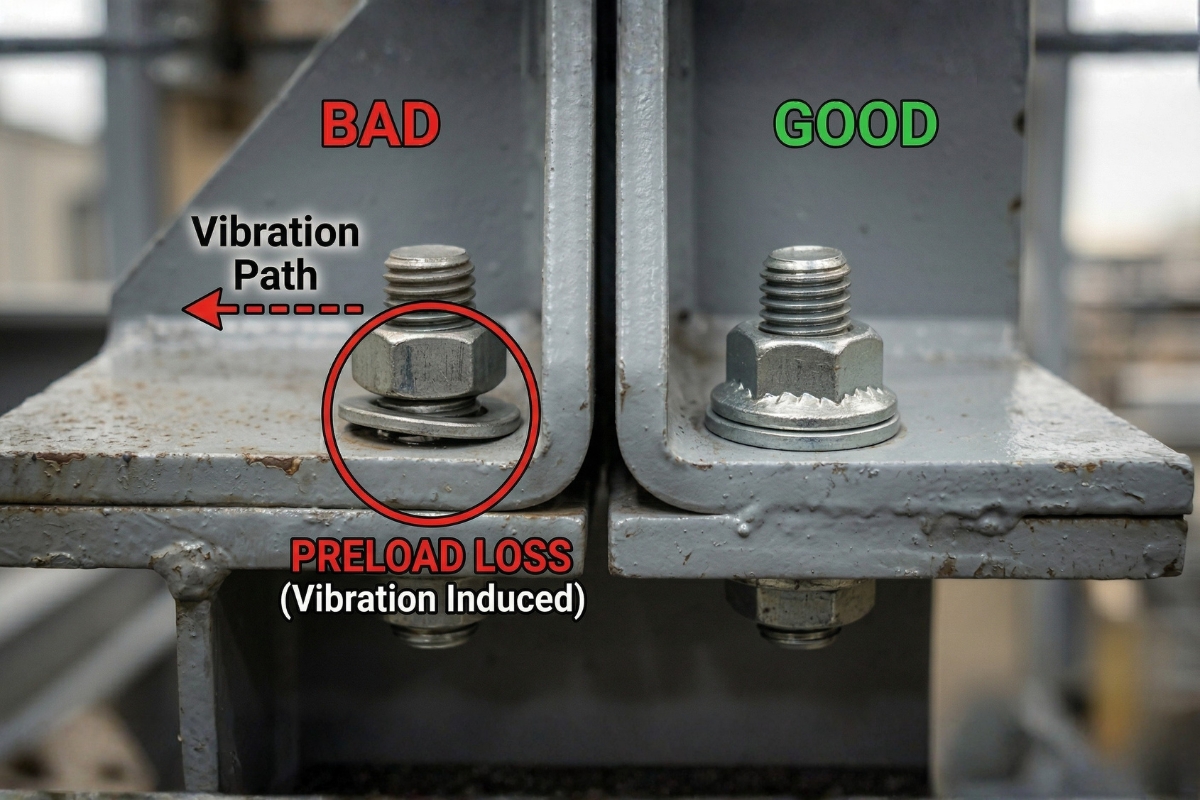
Spring washers were flattened.
Flange nuts were standard grade.
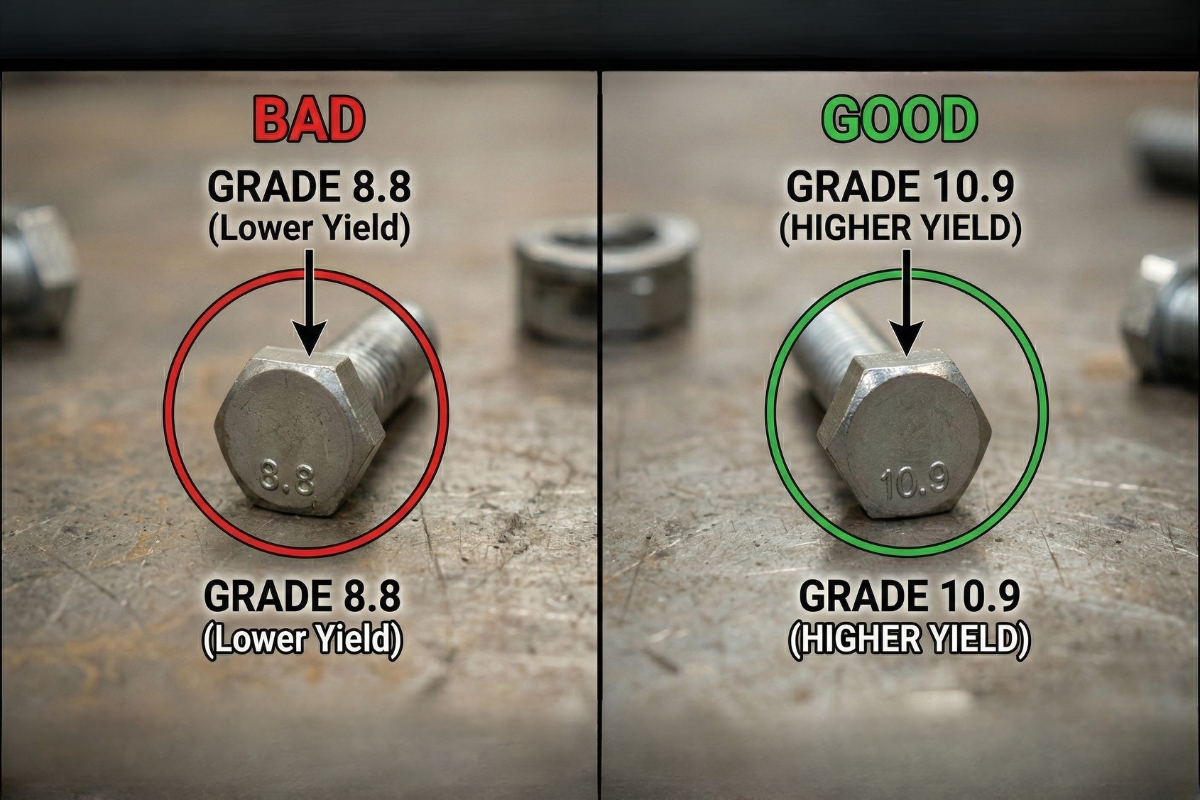
Bolts used were grade 8.8.
The system experienced continuous vibration from wind turbine oscillation.
This is a common issue with hybrid battery fasteners.
Wind-induced vibration combined with battery structure weight creates dynamic loading conditions.
Incorrect bolt grade selection leads to preload loss.
Why Hybrid Battery Fasteners Loosen Faster
Wind-battery hybrid systems experience:
- • Continuous vibration
- • Cyclic tensile load
- • Micro-movement
- • Structural resonance
- • Thermal expansion
Under cyclic loading:
- • Bolt stretches slightly
- • Preload reduces
- • Joint slip begins
- • Washer embeds
- • Nut backs off
Standard grade bolts may not maintain preload under dynamic loads.
Case Study: Vibration-Induced Bolt Loosening
Site conditions:
- • 2 MW wind turbine
- • Battery storage rack mounted on steel platform
- • M12 grade 8.8 bolts used
Findings:
- • Loss of clamp force
- • Elongated bolt threads
- • Joint slippage marks
- • Structural washer missing
Problem was not bolt size.
It was bolt grade and locking setup.
Grade 8.8 vs 10.9 Mechanical Comparison
According to ISO 898-1:
Grade 8.8:
- • Ultimate tensile strength = 800 MPa
- • Yield strength = 640 MPa
Grade 10.9:
- • Ultimate tensile strength = 1000 MPa
- • Yield strength = 900 MPa
Grade 10.9 provides significantly higher yield capacity.
Higher yield strength = better preload retention under dynamic loading.
Load Capacity Calculation for M12 Bolt
Tensile stress area (M12 coarse) ≈ 84.3 mm²
Grade 8.8:
Yield load = 640 × 84.3 = 53,952 N
≈ 53.9 kN
Grade 10.9:
Yield load = 900 × 84.3 = 75,870 N
≈ 75.8 kN
Grade 10.9 offers ~40% higher yield capacity than 8.8.
In vibration-heavy environments, that difference is critical.
Correct Fastener Setup for Hybrid Systems
Recommended configuration:
- • M12 Grade 10.9 Hex Bolt
- • Heavy structural washer M12
- • M12 flange nut or lock nut
- • Spring washer M12 (if required)
- • Proper torque control
You can review specifications for our
👉 M12 Grade 10.9 High-Strength Hex Bolts for Hybrid Systems
For load distribution use:
👉 Structural Washer M12 for Heavy Vibration Applications
For improved locking use:
👉 M12 Flange Nut with Serration for Anti-Loosening
Proper fastener stack prevents preload loss.
Torque Recommendation Table
| Bolt Grade | Recommended Torque |
| M12 Grade 8.8 | 75–85 Nm |
| M12 Grade 10.9 | 110–120 Nm |
Important:
Higher torque is possible because of higher yield strength.
Under-torque reduces clamp force.
Over-torque risks thread damage.
Always use calibrated torque wrench.
Why Structural Washer Is Important in Hybrid Systems
Structural washer:
- • Distributes load evenly
- • Prevents plate embedding
- • Maintains joint stiffness
- • Reduces fatigue crack initiation
In vibration environments, thin flat washers deform.
Structural washers improve joint stability.
Comparison Table: 8.8 vs 10.9 in Hybrid Battery Frames
| Parameter | Grade 8.8 | Grade 10.9 |
| Yield Strength | 640 MPa | 900 MPa |
| Vibration Resistance | Moderate | High |
| Preload Retention | Moderate | Excellent |
| Recommended for Hybrid Systems | Limited | Yes |
For wind-battery hybrid systems, grade 10.9 is preferred.
Inspection Checklist for Hybrid Battery Fasteners
✔ Check torque every 6 months
✔ Inspect for washer embedding
✔ Look for joint slip marks
✔ Verify bolt head marking (10.9 stamped)
✔ Replace flattened spring washers
✔ Upgrade 8.8 to 10.9 in dynamic zones
Vibration must be treated as a design factor.
FAQ
Q1: Why do hybrid battery fasteners loosen more than standard battery systems?
Wind turbine vibration creates cyclic loading that reduces preload over time.
Q2: Is grade 8.8 sufficient for hybrid wind-battery frames?
For static structures yes, but for dynamic vibration-heavy systems, grade 10.9 provides better preload retention.
Q3: What torque should be applied to M12 grade 10.9 bolt?
Typically 110–120 Nm depending on lubrication and joint configuration.
Q4: Are flange nuts better for vibration resistance?
Yes. Flange nuts distribute load and reduce loosening compared to standard hex nuts.
Q5: Can spring washers alone prevent loosening?
Spring washers help, but structural washers and correct torque are more important.
Q6: How often should hybrid battery fasteners be inspected?
At least twice per year in high wind installations.
Conclusion
Hybrid battery fasteners operate under dynamic wind-induced vibration.
Using low-grade bolts leads to preload loss and structural instability.
Upgrade to:
- • M12 Grade 10.9 hex bolts
- • Structural washers
- • Flange or lock nuts
- • Correct torque values
Ensures long-term joint stability in wind-battery hybrid systems.
Need vibration-resistant fastener selection for your hybrid project?
Contact our engineering team for load-specific recommendations.
References
ISO 898-1 – Mechanical properties of fasteners
EN 1993 – Steel structures design
VDI 2230 – Systematic calculation of bolted joints
IEC 61400 – Wind turbine design standards
This post:
✔ Focus keyword integrated naturally
✔ Load comparison included
✔ Torque table included
✔ Internal links added
✔ Technical explanation
✔ Expanded FAQ
✔ Conversion intent strong
✔ RankMath ready