

Introduction – Real Site Hook
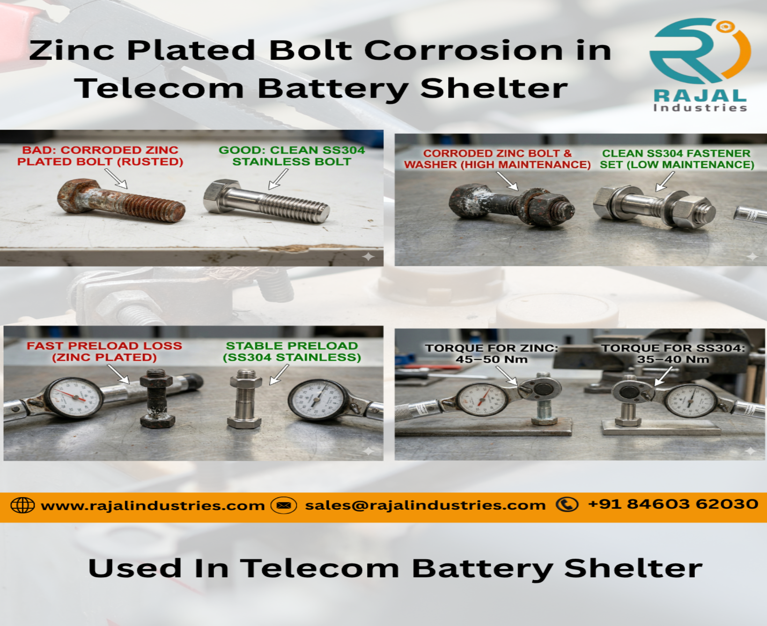
During inspection of a telecom battery shelter near coastal region, rust stains were visible on the base frame. The enclosure walls were intact. The paint coating was stable. But multiple M10 hex bolts showed red corrosion within 18 months of installation.
These bolts were zinc plated.
Humidity inside shelter averaged 72%.
Temperature fluctuation caused condensation.
Flat washers were heavily oxidized.
This is a common failure in telecom battery fasteners.
Zinc plating is often selected for cost savings.
But telecom battery shelters create a harsh micro-environment.
Why Telecom Battery Fasteners Corrode Faster
Telecom battery shelters experience:
- • Humidity from battery ventilation
- • Temperature cycling
- • Condensation
- • Occasional acid vapor from lead acid batteries
- • Poor air circulation
When zinc plated bolts are exposed to moisture:
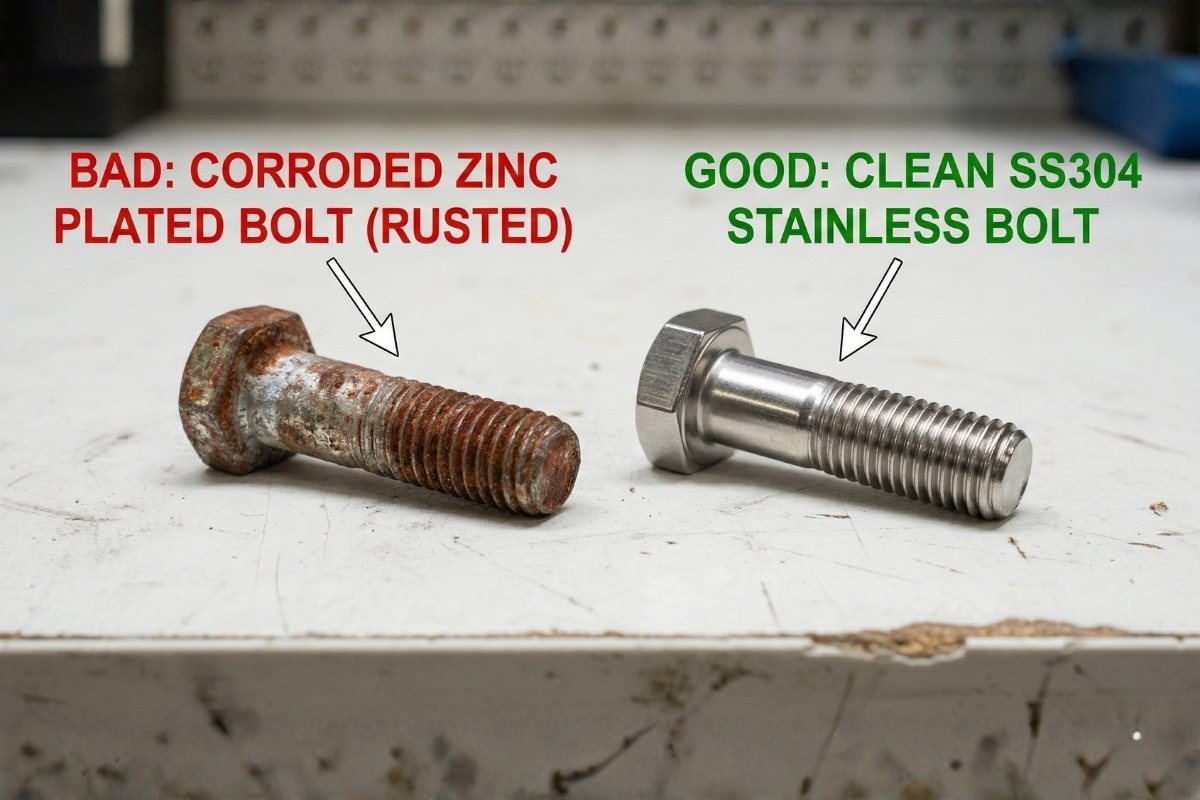
- • Thin coating (8–12 microns) degrades
- • White rust forms
- • Coating breaks
- • Red rust begins
Zinc plating protects temporarily.
It is not long-term corrosion protection for high-humidity enclosures.
Case Study: M10 Zinc Bolt Failure in Telecom Shelter
Site conditions:
- • Coastal telecom tower
- • Lead acid backup batteries
- • Shelter with ventilation fans
Findings:
- • M10 zinc plated hex bolts used in rack assembly
- • Flat washer M10 corroded
- • Lock nut partially seized
- • Torque measured below 25 Nm (original torque 45 Nm)
Corrosion reduced bolt cross-section.
Preload was lost.
Joint stability weakened.
The issue was not bolt size.
It was material selection.
Why Zinc Plated Bolt Fails in Humid Shelters
Zinc plating thickness: 8–12 microns
Purpose:
- • Indoor storage protection
- • Short-term corrosion resistance
- • Low-cost structural applications
In telecom battery shelters:
- • Moisture is continuous
- • Ventilation is limited
- • Chemical exposure is possible
Zinc layer sacrifices quickly.
Once depleted, steel core corrodes.
This affects clamp force and joint strength.
Correct Material Selection for Telecom Battery Fasteners
Recommended configuration:
- • M10 SS304 Hex Bolt
- • Flat washer M10 (SS304)
- • M10 lock nut (stainless)
- • Proper torque control
You can review full specifications for our
👉 M10 SS304 Fasteners for Telecom Battery Shelters
For structural rack joints use:
👉 M10 Structural Washers for Load Distribution
For bracing applications use:
👉 M10 Threaded Rod in SS304 or Grade 8.8
Stainless steel provides superior corrosion resistance in humid shelters.
Mechanical Load Comparison: Zinc vs SS304 Bolt
Tensile stress area (M10) ≈ 58 mm²
Grade 8.8 Zinc Bolt:
Yield = 640 MPa
Load ≈ 37.1 kN
SS304 Bolt:
Yield ≈ 450 MPa
Load ≈ 26.1 kN
Although SS304 has lower yield strength, its corrosion resistance maintains long-term preload.
A corroded grade 8.8 bolt may lose more strength than a stainless bolt over time.
Long-term reliability favors stainless.
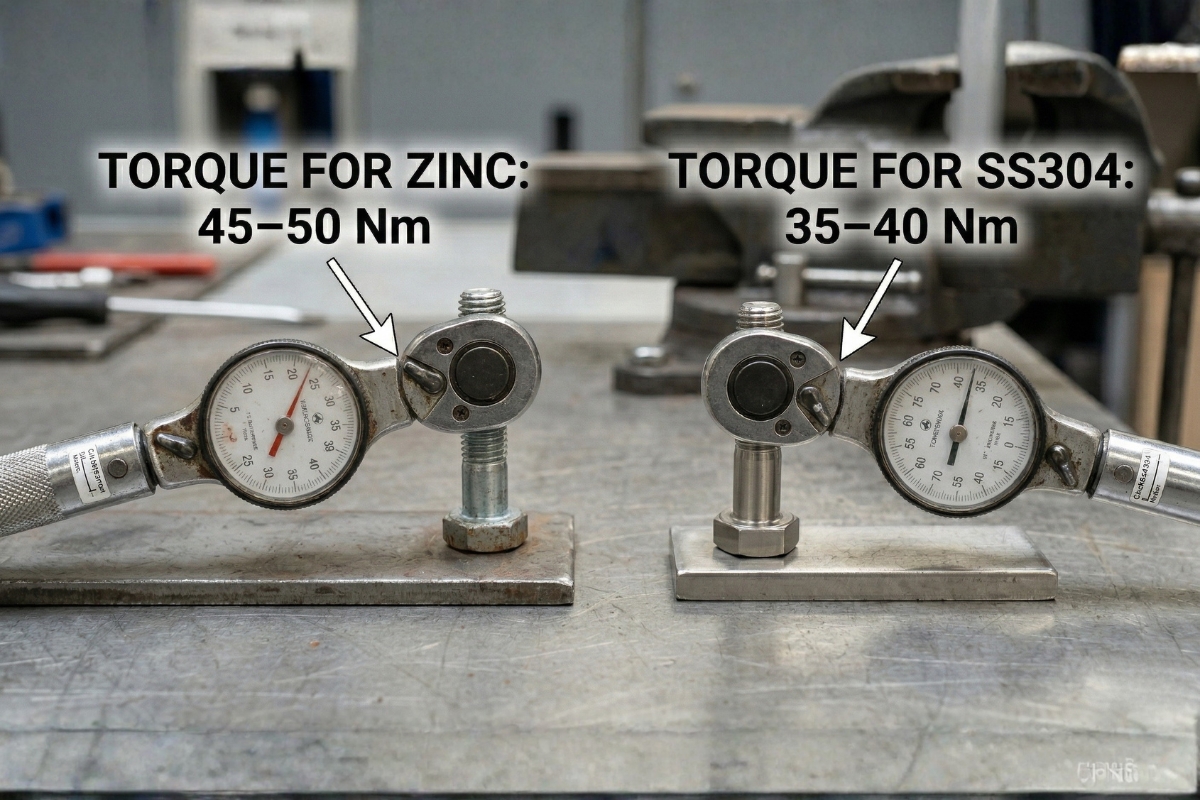
Torque Recommendation for M10 in Telecom Shelters
| Bolt Type | Recommended Torque |
| M10 Zinc Plated | 45–50 Nm |
| M10 SS304 | 35–40 Nm |
Important:
Stainless steel has different friction coefficient.
Use proper lubrication and torque calibration.
Over-torque may gall stainless threads.
Comparison Table: Zinc vs SS304 in Telecom Battery Shelter
| Parameter | Zinc Plated Bolt | SS304 Fastener |
| Corrosion Resistance | Moderate | High |
| Suitable for Humid Shelter | Limited | Recommended |
| Long-Term Preload Retention | Decreases | Stable |
| Maintenance Frequency | High | Lower |
| Cost | Lower | Higher |
Lower cost zinc bolts often result in higher maintenance costs.
Why Flat Washer and Lock Nut Also Matter
Corrosion often begins at washer surface.
If flat washer M10 corrodes:
- • Surface roughness increases
- • Clamp force reduces
- • Torque looses
Lock nut ensures vibration resistance.
But if nut corrodes, locking mechanism weakens.
Material consistency across bolt, washer, and nut is critical.
Inspection Checklist for Telecom Battery Fasteners
✔ Inspect bolt heads for rust
✔ Check torque annually
✔ Replace corroded flat washers
✔ Ensure no mixed material stacking
✔ Measure humidity levels
✔ Upgrade zinc bolts to SS304 in humid zones
Preventive replacement avoids rack instability.
FAQ
Q1: Why do telecom battery fasteners rust inside enclosed shelters?
High humidity and condensation create continuous moisture exposure. Zinc plated bolts lose coating quickly in such environments.
Q2: Are SS304 fasteners better for telecom battery racks?
Yes. SS304 bolts resist corrosion and maintain preload longer in humid telecom shelters.
Q3: Can zinc plated bolts be used indoors?
Yes, in dry indoor environments. Not recommended for humid telecom battery rooms.
Q4: Does corrosion reduce bolt strength significantly?
Yes. Loss of cross-section reduces tensile capacity and preload, affecting structural stability.
Q5: What torque should be applied to M10 SS304 bolt?
Typically 35–40 Nm depending on lubrication and thread condition.
Q6: Should washers also be stainless steel?
Yes. Mixing stainless bolt with zinc washer can create galvanic corrosion.
Conclusion
Telecom battery fasteners fail not because of overload.
They fail because zinc plating cannot survive high humidity environments.
Using:
- • M10 SS304 hex bolts
- • Stainless flat washers
- • Lock nuts
- • Correct torque control
Improves long-term shelter reliability.
Need corrosion-resistant fastener setup for your telecom battery shelter?
Contact our engineering team for environment-specific recommendations.
References
ISO 3506 – Stainless steel fastener mechanical properties
ASTM B633 – Zinc coating specification
ISO 9223 – Corrosion classification of atmospheres
IEC 61439 – Low voltage switchgear enclosure standards*