

Introduction – Real Site Hook
At a coastal BESS installation located in a 150 km/h wind zone, inspection revealed slight uplift marks on one container corner. The foundation was intact. The container structure was strong. But two M16 anchor bolts showed elongation and corrosion near the threads.
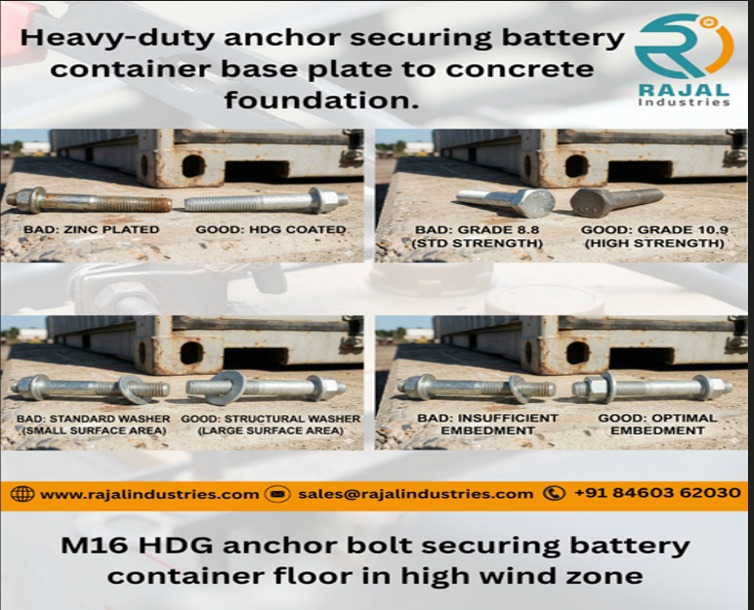
Original bolt type: zinc plated M16 anchor bolt.
Measured torque: reduced by 20%.
Wind uplift load had exceeded expected design margin.
This is a common failure with battery container fasteners in high wind regions.
Wind does not only push containers sideways.
It also creates uplift and cyclic tension.
If anchor selection is weak, failure begins at the bolt.
Why High Wind Zones Stress Battery Container Fasteners
Battery containers in BESS projects face:
- • Lateral wind pressure
- • Uplift force
- • Cyclic load
- • Seismic effect
- • Temperature expansion
Anchor bolts must resist:
- • Shear load
- • Tensile load
- • Pull-out force
- • Fatigue stress
If anchor grade or diameter is insufficient, preload reduces and movement begins.
Case Study: M16 Anchor Bolt Elongation
Site findings:
- • Zinc-plated M16 wedge anchor used
- • No structural washer
- • Standard hex nut used
- • Corrosion visible after 14 months
Under high wind:
- • Bolt stretched near yield
- • Preload dropped
- • Base plate gap observed
The issue was not container design.
It was anchor bolt selection and coating.
M16 Anchor Bolt Load Calculation
Tensile stress area (M16 coarse) ≈ 157 mm²
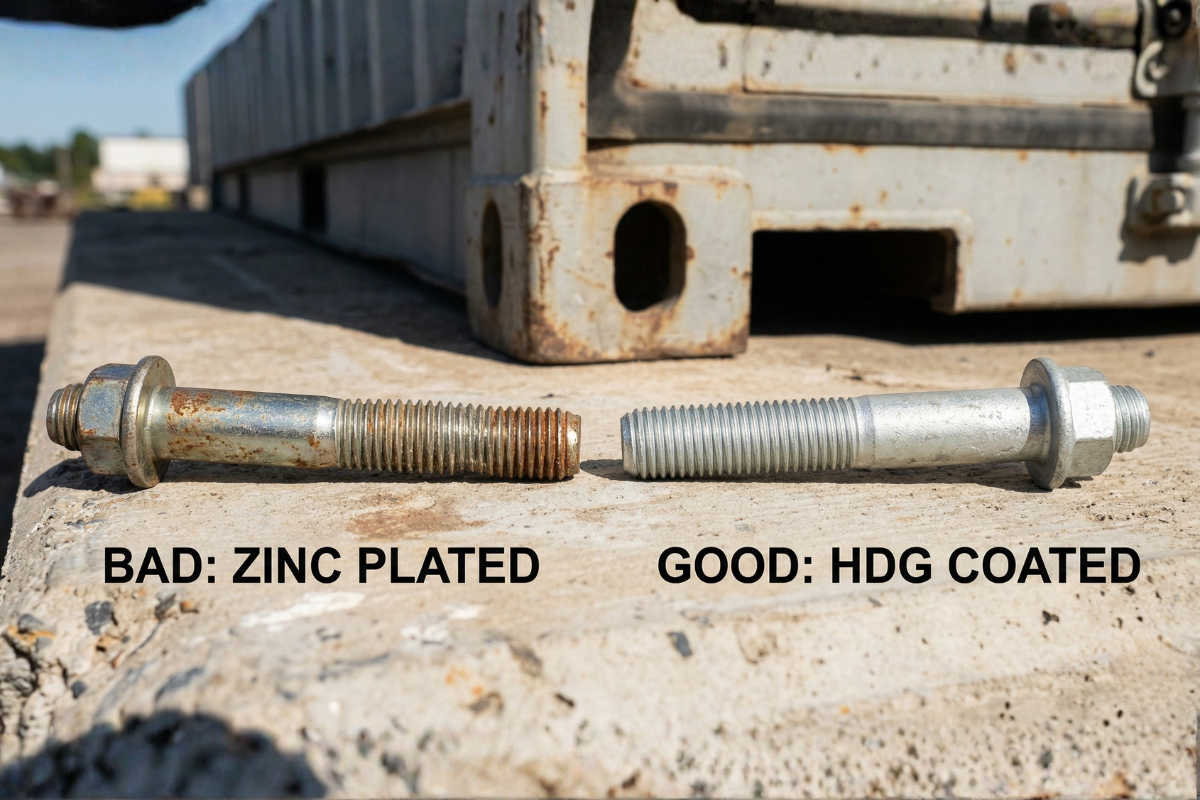
Grade 8.8:
Yield strength = 640 MPa
Yield load = 640 × 157
= 100,480 N
≈ 100.5 kN
Grade 10.9 (if used):
Yield strength = 900 MPa
Yield load = 900 × 157
= 141,300 N
≈ 141.3 kN
In high wind zones, uplift forces can approach 70–90 kN per anchor depending on container size.
Using correct grade is critical.
Why HDG Fasteners Are Required in Outdoor Foundations
High wind zones often coincide with coastal or humid environments.
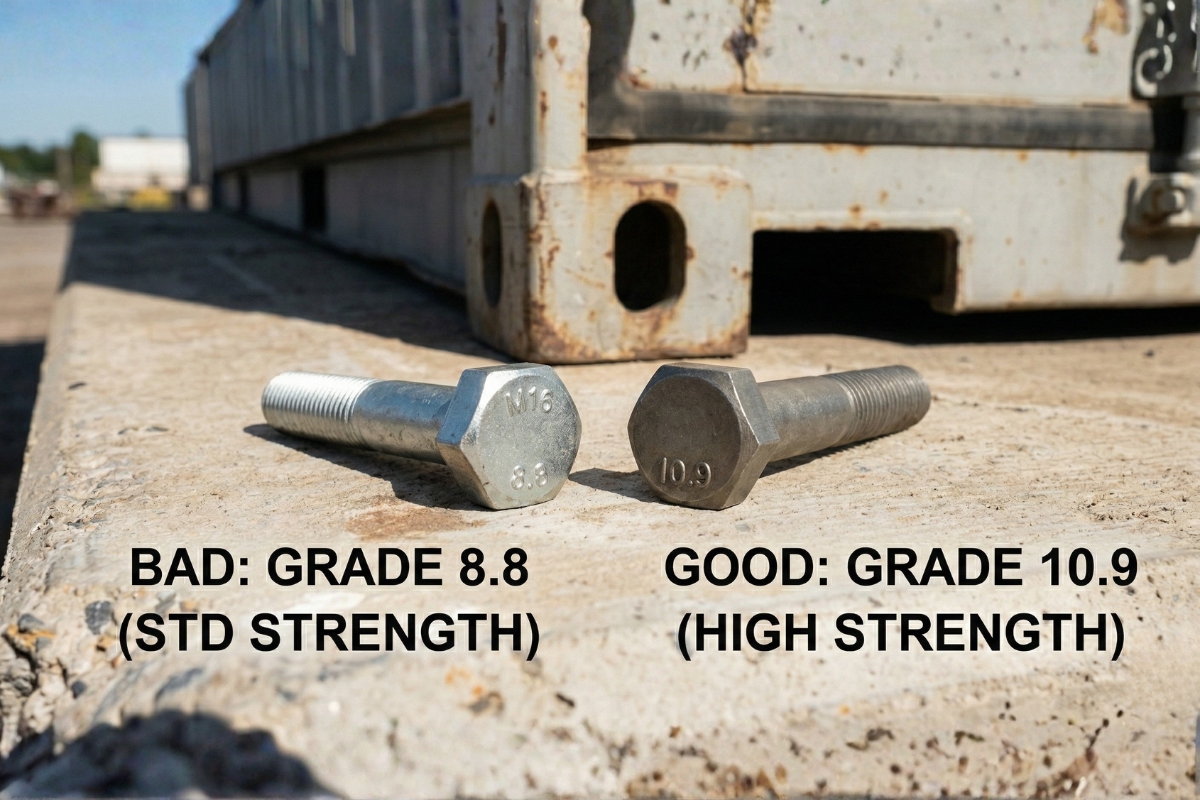
Zinc plating thickness: 8–12 micron
HDG coating thickness: 50–85 micron
HDG provides:
- • Long-term corrosion protection
- • Reduced thread weakening
- • Better preload retention
For outdoor BESS containers, always use
👉 M16 HDG Wedge Anchor for Battery Container Foundations
Correct Anchor Stack for High Wind Zones
Recommended setup:
- M16 HDG Anchor Bolt (Grade 8.8 or 10.9)
- Heavy structural washer
- Heavy hex nut
- Correct embedment depth (≥ 120–140 mm depending on load)
- Proper torque application
For heavy-duty applications, use
👉 Heavy Hex Nut M16 for Structural Anchoring
Structural washer is mandatory to prevent plate embedding.
Torque Recommendation Table
| Bolt Type | Recommended Torque |
| M16 Grade 8.8 | 190–210 Nm |
| M16 Grade 10.9 | 280–300 Nm |
Important:
Torque must match bolt grade and lubrication condition.
Under-torque reduces clamp force.
Over-torque risks yielding the bolt.
Always verify embedment depth and concrete strength.
Comparison: Zinc vs HDG in Wind Zones
| Parameter | Zinc Plated | HDG |
| Corrosion Resistance | Moderate | High |
| Outdoor Durability | Limited | Excellent |
| Wind Zone Suitability | Not Recommended | Recommended |
| Long-Term Preload Retention | Low | High |
High wind zones require corrosion resistance + strength.
Shear & Pull-Out Consideration
Anchor bolt design must consider:
- • Concrete compressive strength
- • Edge distance
- • Embedment depth
- • Spacing
Pull-out resistance depends on embedment and concrete quality.
For M16 wedge anchor:
Typical embedment depth = 120–160 mm
Shallow embedment increases failure risk under uplift.
Inspection Checklist for Battery Container Anchors
✔ Check torque annually
✔ Inspect for corrosion
✔ Verify embedment depth
✔ Look for uplift marks
✔ Inspect structural washer condition
✔ Replace zinc anchors with HDG in coastal zones
Wind load inspection should be part of annual maintenance.
FAQ
Q1: Why do battery container fasteners fail in high wind zones?
High wind creates uplift and cyclic tensile forces. If anchor bolt grade or coating is insufficient, preload reduces and failure begins.
Q2: Is M16 anchor bolt sufficient for BESS containers?
M16 is common, but grade and embedment depth must match wind load design.
Q3: Should HDG fasteners be used for outdoor containers?
Yes. HDG fasteners provide long-term corrosion resistance for outdoor BESS installations.
Q4: What torque is required for M16 anchor bolts?
Grade 8.8: 190–210 Nm
Grade 10.9: 280–300 Nm
Q5: Can zinc plated anchors be used temporarily?
They may perform short-term but are not suitable for long-term high wind outdoor applications.
Q6: Why is structural washer important in anchor setup?
It distributes clamp force and prevents base plate embedding.
Conclusion
Battery container fasteners in high wind zones face severe tensile and uplift forces.
Using:
- • M16 HDG anchor bolts
- • Proper embedment depth
- • Heavy hex nuts
- • Structural washers
- • Correct torque
Ensures long-term stability and wind resistance.
Need wind-load-specific anchor selection for your BESS container project?
Contact our engineering team for foundation fastener recommendations.
References
ISO 898-1 – Mechanical properties of fasteners
EN 1991 – Wind load calculation
ACI 318 – Concrete anchor design
ASTM A153 – Hot dip galvanizing specification