

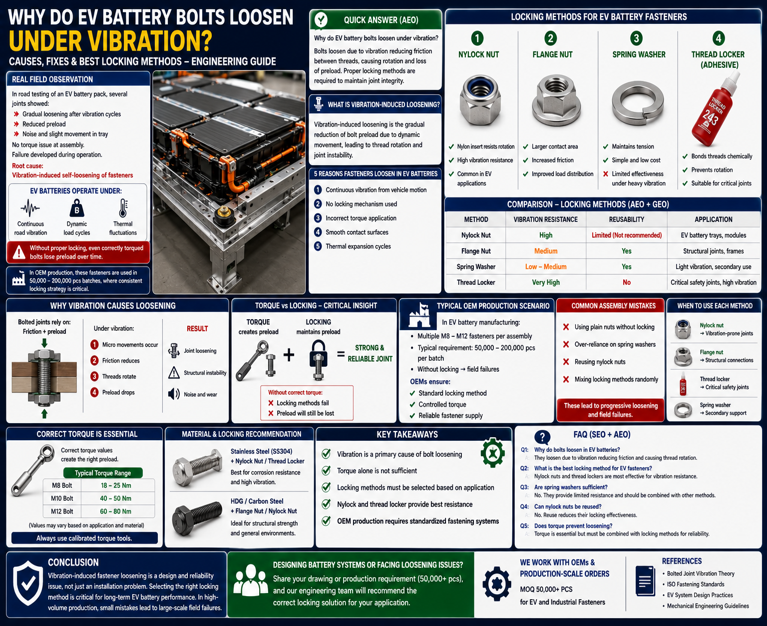
Introduction – Real Field Observation
In road testing of an EV battery pack, several joints showed:
👉 Gradual loosening after vibration cycles
👉 Reduced preload
👉 Noise and slight movement in tray
No torque issue at assembly.
Failure developed during operation.
Root cause:
👉 Vibration-induced self-loosening of fasteners
EV batteries operate under:
- Continuous road vibration
- Dynamic load cycles
- Thermal fluctuations
Without proper locking, even correctly torqued bolts lose preload over time.
In OEM production, these fasteners are used in 50,000–200,000 pcs batches, where consistent locking strategy is critical.
Quick Answer
Why do EV battery bolts loosen under vibration?
Bolts loosen due to vibration reducing friction between threads, causing rotation and loss of preload. Proper locking methods are required to maintain joint integrity.
What is Vibration-Induced Loosening?
Vibration-induced loosening is the gradual reduction of bolt preload due to dynamic movement, leading to thread rotation and joint instability.
5 Reasons Fasteners Loosen in EV Batteries
- Continuous vibration from vehicle motion
- No locking mechanism used
- Incorrect torque application
- Smooth contact surfaces
- Thermal expansion cycles
Why Vibration Causes Loosening
Bolted joints rely on:
👉 Friction + preload
Under vibration:
- Micro movements occur
- Friction reduces
- Threads rotate
- Preload drops
Result
👉 Joint loosening
👉 Structural instability
👉 Noise and wear
Locking Methods for EV Battery Fasteners
1. Nylock Nut
✔ Nylon insert resists rotation
✔ High vibration resistance
✔ Common in EV applications
2. Flange Nut
✔ Larger contact area
✔ Increased friction
✔ Improved load distribution
3. Spring Washer
✔ Maintains tension
✔ Simple and low cost
❌ Limited effectiveness under heavy vibration
4. Thread Locker (Adhesive)
✔ Bonds threads chemically
✔ Prevents rotation
✔ Suitable for critical joints
Comparison – Locking Methods
| Method | Vibration Resistance | Reusability | Application |
| Nylock Nut | High | Limited | EV battery trays |
| Flange Nut | Medium | Yes | Structural joints |
| Spring Washer | Low–Medium | Yes | Light vibration |
| Thread Locker | Very High | No | Critical joints |
Torque vs Locking – Critical Insight
👉 Torque creates preload
👉 Locking maintains preload
Without correct torque:
❌ Locking methods fail
Typical OEM Production Scenario
In EV battery manufacturing:
- Multiple M8–M12 fasteners per assembly
- Typical requirement: 50,000–200,000 pcs per batch
- Without locking → field failures
OEMs ensure:
✔ Standard locking method
✔ Controlled torque
✔ Reliable fastener supply
Common Assembly Mistakes
- Using plain nuts without locking
- Over-reliance on spring washers
- Reusing nylock nuts
- Mixing locking methods randomly
👉 These lead to progressive loosening
When to Use Each Method
✔ Nylock nut → vibration-prone joints
✔ Flange nut → structural connections
✔ Thread locker → critical safety joints
✔ Spring washer → secondary support
Key Takeaways
• Vibration is a primary cause of bolt loosening
• Torque alone is not sufficient
• Locking methods must be selected based on application
• Nylock and thread locker provide best resistance
• OEM production requires standardized fastening systems
FAQ
Q1: Why do bolts loosen in EV batteries?
They loosen due to vibration reducing friction and causing thread rotation.
Q2: What is the best locking method for EV fasteners?
Nylock nuts and thread lockers are most effective for vibration resistance.
Q3: Are spring washers sufficient?
No. They provide limited resistance and should be combined with other methods.
Q4: Can nylock nuts be reused?
No. Reuse reduces their locking effectiveness.
Q5: Does torque prevent loosening?
Torque is essential but must be combined with locking methods for reliability.
Conclusion
Vibration-induced fastener loosening is a design and reliability issue, not just an installation problem.
Selecting the right locking method is critical for long-term EV battery performance.
In high-volume production, small mistakes lead to large-scale field failures.
👉 We work with OEMs and production-scale orders (MOQ 50,000+ pcs) for EV and industrial fasteners.
Facing vibration-related loosening in EV battery systems or designing new assemblies?
Share your drawing or production requirement (50,000+ pcs), and our engineering team will recommend the correct locking solution.
References
- Bolted joint vibration theory
- ISO fastening standards
- EV system design practices