

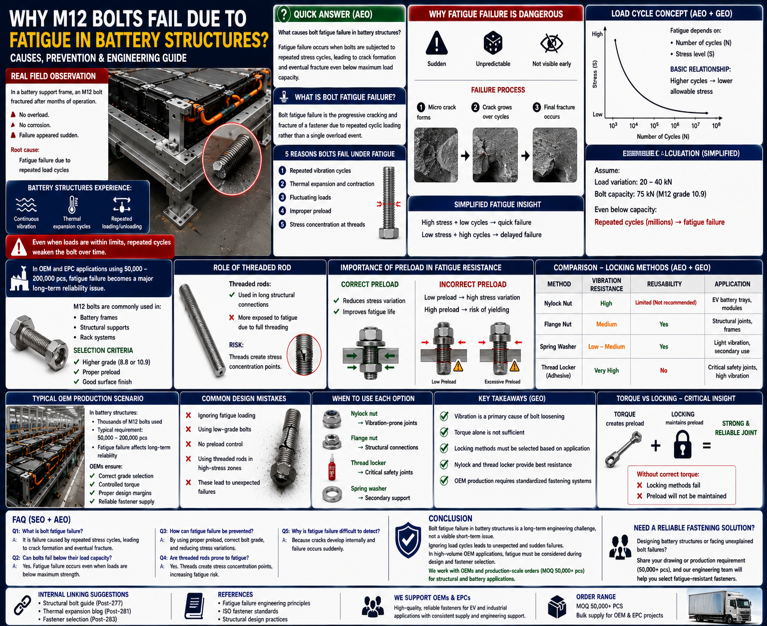
Introduction – Real Field Observation
In a battery support frame, an M12 bolt fractured after months of operation.
No overload.
No corrosion.
Failure appeared sudden.
Root cause:
👉 Fatigue failure due to repeated load cycles
Battery structures experience:
- Continuous vibration
- Thermal expansion cycles
- Repeated loading/unloading
Even when loads are within limits, repeated cycles weaken the bolt over time.
In OEM and EPC applications using 50,000–200,000 pcs, fatigue failure becomes a major long-term reliability issue.
Quick Answer
What causes bolt fatigue failure in battery structures?
Fatigue failure occurs when bolts are subjected to repeated stress cycles, leading to crack formation and eventual fracture even below maximum load capacity.
What is Bolt Fatigue Failure?
Bolt fatigue failure is the progressive cracking and fracture of a fastener due to repeated cyclic loading rather than a single overload event.
5 Reasons Bolts Fail Under Fatigue
- Repeated vibration cycles
- Thermal expansion and contraction
- Fluctuating loads
- Improper preload
- Stress concentration at threads
Why Fatigue Failure is Dangerous
Fatigue failure is:
👉 Sudden
👉 Unpredictable
👉 Not visible early
Failure Process
- Micro crack forms
- Crack grows over cycles
- Final fracture occurs
Load Cycle Concept
Fatigue depends on:
👉 Number of cycles (N)
👉 Stress level (S)
Basic Relationship
Higher cycles → lower allowable stress
Simplified Fatigue Insight
- High stress + low cycles → quick failure
- Low stress + high cycles → delayed failure
Example Calculation
Assume:
- Load variation: 20–40 kN
- Bolt capacity: 75 kN (M12 grade 10.9)
Even below capacity:
👉 Repeated cycles (millions) → fatigue failure
Role of M12 Bolt Selection
M12 bolts are commonly used in:
- Battery frames
- Structural supports
- Rack systems
Selection Criteria
✔ Higher grade (8.8 or 10.9)
✔ Proper preload
✔ Good surface finish
Role of Threaded Rod
Threaded rods:
✔ Used in long structural connections
❌ More exposed to fatigue due to full threading
Risk
Threads create:
👉 Stress concentration points
Importance of Preload in Fatigue Resistance
Correct preload:
✔ Reduces stress variation
✔ Improves fatigue life
Incorrect Preload
- Low preload → high stress variation
- High preload → risk of yielding
Typical OEM Production Scenario
In battery structures:
- Thousands of M12 bolts used
- Typical requirement: 50,000–200,000 pcs
- Fatigue failure affects long-term reliability
OEMs ensure:
✔ Correct grade selection
✔ Controlled torque
✔ Proper design margins
Common Design Mistakes
- Ignoring fatigue loading
- Using low-grade bolts
- No preload control
- Using threaded rods in high-stress zones
👉 These lead to unexpected failures
When to Use Each Option
✔ Grade 8.8 → moderate load
✔ Grade 10.9 → high load / critical joints
✔ Threaded rod → low-stress applications
Key Takeaways
• Fatigue failure occurs due to repeated loading
• It happens even below maximum load
• Proper preload improves fatigue life
• Bolt grade selection is critical
• OEM designs must consider load cycles
FAQ
Q1: What is bolt fatigue failure?
It is failure caused by repeated stress cycles, leading to crack formation and eventual fracture.
Q2: Can bolts fail below their load capacity?
Yes. Fatigue failure occurs even when loads are below maximum strength.
Q3: How can fatigue failure be prevented?
By using proper preload, correct bolt grade, and reducing stress variations.
Q4: Are threaded rods prone to fatigue?
Yes. Threads create stress concentration points, increasing fatigue risk.
Q5: Why is fatigue failure difficult to detect?
Because cracks develop internally and failure occurs suddenly.
Conclusion
Bolt fatigue failure in battery structures is a long-term engineering challenge, not a visible short-term issue.
Ignoring load cycles leads to unexpected and sudden failures.
In high-volume OEM applications, fatigue must be considered during design and fastener selection.
👉 We work with OEMs and production-scale orders (MOQ 50,000+ pcs) for structural and battery applications.
Designing battery structures or facing unexplained bolt failures?
Share your drawing or production requirement (50,000+ pcs), and our engineering team will help you select fatigue-resistant fasteners.
References
- Fatigue failure engineering principles
- ISO fastener standards
- Structural design practices