

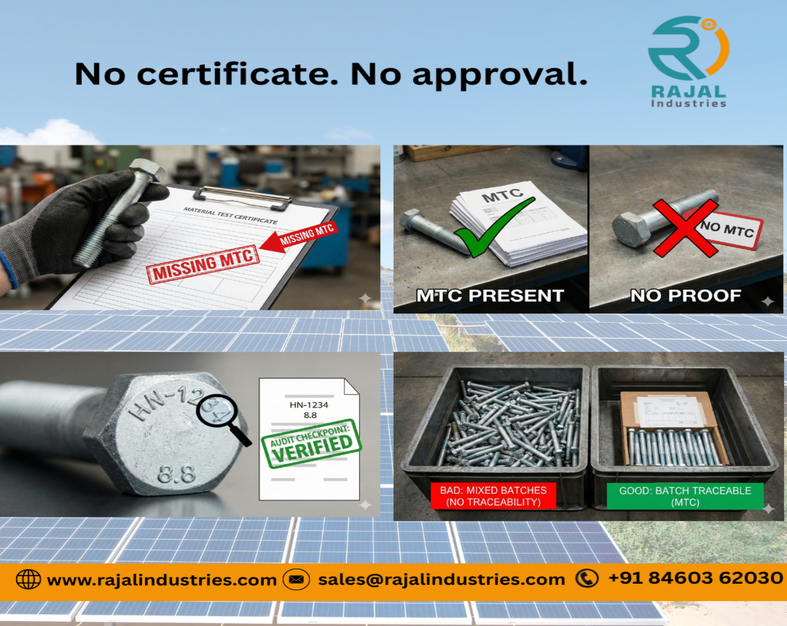
Why HDG bolts without MTC fail audits
On site, everything looks fine.
The bolts fit.
They tighten.
They hold.
Then the audit happens.
“Where is the MTC?”
Silence.
This is how entire projects fail compliance because of missing documentation — not missing hardware.
When HDG bolts have no MTC, auditors cannot verify:
- Material grade
- Mechanical strength
- Coating thickness
- Compliance with standards
So the bolts are rejected.
What an MTC actually proves
A Material Test Certificate confirms:
- Chemical composition
- Mechanical properties
- Heat number traceability
- Manufacturing standard
- Coating process (for HDG)
Without this, there is no proof the bolt meets spec.
Why MTCs are often missing
- Trading-only suppliers
Some vendors source from multiple factories but don’t collect certificates.
- Mixed batches
When batches are mixed, traceability is lost.
- Urgent dispatch
Fast shipping happens before documents are compiled.
- Ignorance of compliance
Some suppliers simply don’t understand audit requirements.
What auditors look for
For HDG bolts, auditors typically check:
- Bolt grade (5.6, 8.8, 10.9)
- Coating standard (ISO 1461, IS 4759)
- Minimum zinc thickness
- Heat number consistency
- Manufacturer identity
What procurement should ask suppliers
MTC with heat number
Mechanical test results
Coating thickness report
Standard references
Batch traceability
What happens if this is ignored
- Project delays
- Material rejection
- Reordering costs
- Reputation damage
- Client distrust
Final thought
A bolt without a certificate is just a piece of metal.
A bolt with an MTC is a verified structural component.
Audits don’t fail on strength — they fail on proof.