

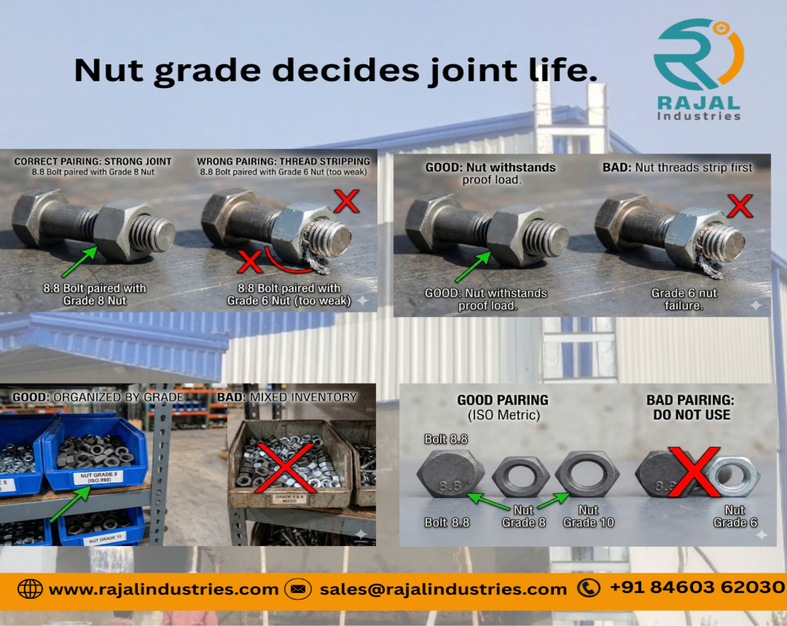
Why nut grade for 8.8 bolts matters more than people think
On many sites, the bolt gets all the attention.
The nut is treated as a generic part.
But pairing the wrong nut grade with an 8.8 bolt is one of the fastest ways to destroy a joint.
Threads strip.
Nuts seize.
Bolts get damaged.
Joints fail.
All because the nut was weaker than the bolt.
How thread stripping actually happens
When tightening an 8.8 bolt:
- The bolt applies high tensile load
- The nut must withstand equal or higher proof load
- If nut strength is lower, its threads deform first
Once the nut threads deform, they shear off.
This is thread stripping.
Correct nut grade for 8.8 bolts
For ISO metric fasteners:
- Bolt grade 8.8 → Nut grade 8 or 10
- Bolt grade 10.9 → Nut grade 10 or 12
Using a grade 6 nut with an 8.8 bolt is unsafe.
Why wrong nuts get used
- Cost pressure
Lower grade nuts are cheaper.
- Lack of awareness
Installers don’t know grade compatibility.
- Mixed inventory
Nuts from different grades get mixed in storage.
- Poor documentation
BOQ specifies bolt grade but not nut grade.
What happens on site
- Threads strip during tightening
- Nuts spin freely
- Bolt threads get damaged
- Joint cannot be clamped
- Parts must be replaced
How to prevent nut grade mismatch
Specify nut grade in BOQ
Store nuts by grade
Train staff to read nut markings
Inspect incoming fasteners
Reject unmarked or wrong-grade nuts
Final thought
A bolt is only as strong as the nut holding it.
Choosing the wrong nut grade for 8.8 bolts turns a structural joint into a failure waiting to happen.