

Why structural bolts fail during tightening
A bolt should not crack while being tightened.
Yet on many sites, installers see this:
The wrench turns.
Torque builds.
Suddenly — a sharp snap.
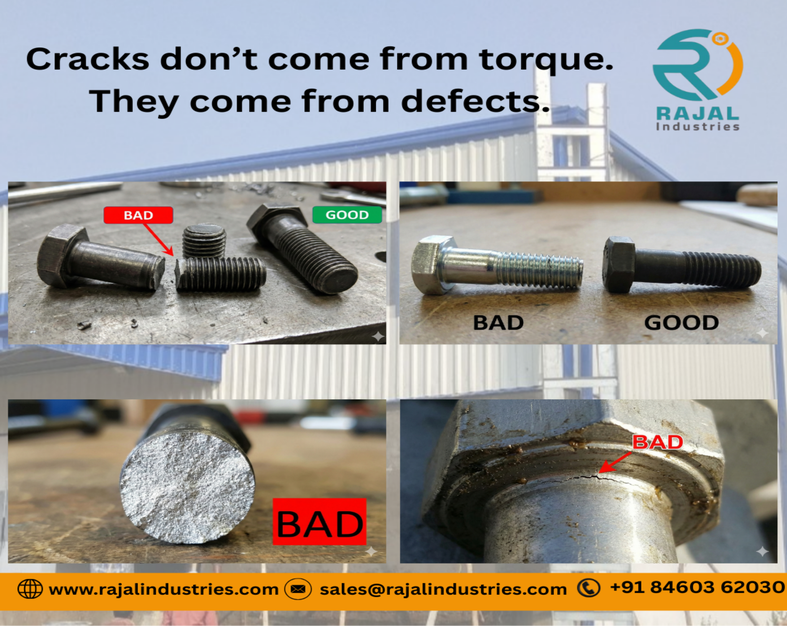
The bolt cracks at the thread root or under the head.
This is a structural bolts failure, and it usually has nothing to do with installer force.
It is almost always a manufacturing or material problem.
Where cracks usually appear
- At the first engaged thread
- At the under-head fillet
- Along the shank near the thread runout
These are high-stress concentration zones.
Any defect here becomes a crack initiation point.
Common root causes
1. Improper heat treatment
Quench and temper must be tightly controlled.
If:
- Quenching is uneven
- Tempering is insufficient
- Microstructure becomes brittle
The bolt becomes prone to cracking under load.
2. Hydrogen embrittlement
Electroplating and pickling introduce hydrogen into steel.
High-strength bolts are especially sensitive.
Delayed cracking can occur even hours after tightening.
3. Poor thread rolling
Threads should be rolled, not cut.
4. Cut threads:
- Have sharp roots
- Create stress risers
- Crack easily under load
5. Material defects
Inclusions, seams, or surface defects act as crack starters.
Why M16 bolts are commonly affected
M16 is widely used in structural joints.
High volume + high stress + tight tolerances make failures visible.
How to prevent structural bolt cracking
Use rolled threads, not cut
Ensure proper quench and temper process
Avoid hydrogen-inducing coatings on high-grade bolts
Demand MTC and heat treatment records
Perform sample torque tests
Reject cracked batches immediately
What happens if this is ignored
- Installation delays
- Rework and replacement
- Structural risk
- Audit and compliance failure
- Client distrust
Final thought
Bolts are supposed to hold structures together.
When they crack during tightening, the problem is not torque.
It’s metallurgy.