

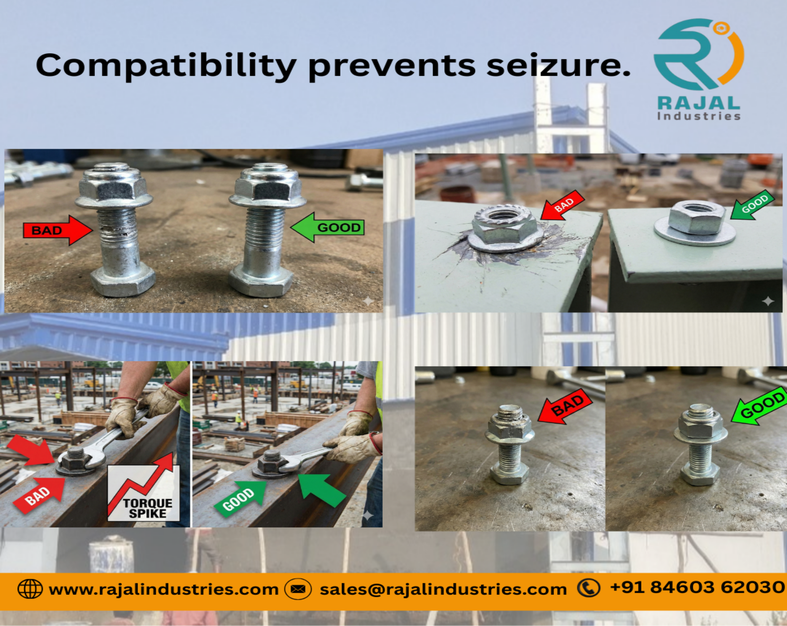
Why flanged nuts seize during installation
Everything looks normal at first.
The bolt goes in.
The flanged nut starts tightening.
Then suddenly it locks up.
The wrench keeps turning.
The torque spikes.
The nut stops moving.
This is flanged nut seizure, and it’s a very common site problem.
It wastes time, damages threads, and often forces replacement mid-erection.
What actually causes nut seizure
Nut seizure usually comes from friction mismatch, not force.
When:
- Nut and bolt coatings are incompatible
- Surfaces are too rough
- No lubrication is present
- Stainless is used on stainless
- Zinc-on-zinc friction is high
The contact points weld microscopically.
This is called galling.
Once galling starts, the nut locks permanently.
Why flanged nuts are more sensitive
Flanged nuts:
- Have a larger bearing surface
- Create more friction
- Often have serrations that dig into steel
- Are commonly zinc-coat
This increases friction and seizure risk, especially when paired with HDG or stainless bolts.
How this shows up on site
- Sudden torque spike
- Nut stops turning
- Threads strip
- Nut must be cut off
- Bolt must be replaced
- Erection stops
Typical combinations that cause problems
- Zinc flanged nut on HDG bolt
- Stainless nut on stainless bolt without lubrication
- Serrated flange nut on painted or coated plate
- High-speed installation without lubrication
How to prevent flanged nut seizure
Match coatings (nut and bolt)
Use controlled lubrication where needed
Avoid stainless-on-stainless dry contact
Use plain nuts with washers for critical joints
Train crews to recognize early galling
Replace seized parts immediately
Final thought
Flanged nuts are convenient.
But convenience is not always compatibility.
If you see seizure on site, it’s not bad luck — it’s physics.