

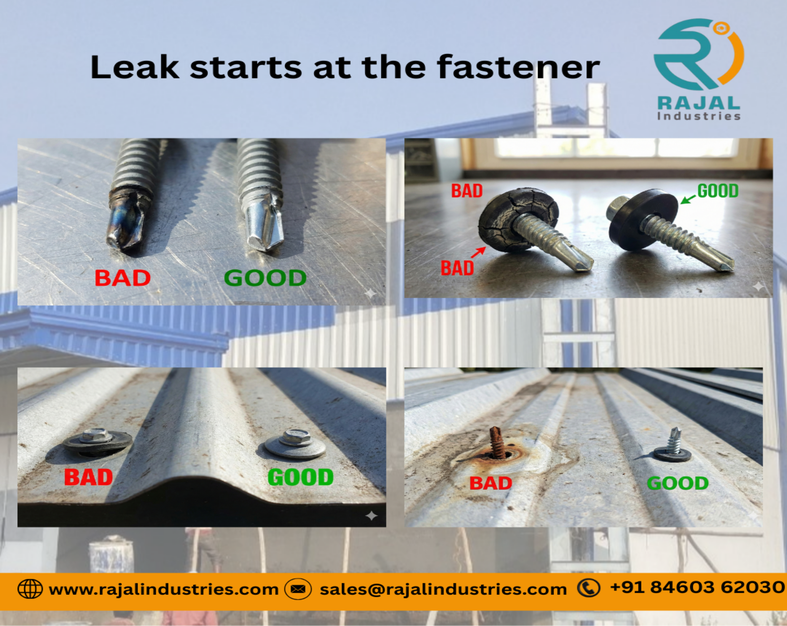
Why self drilling screws cause leaks even when installed correctly
Many roof leaks start at the fastener.
Not the sheet.
Not the sealant.
The screw.
Self drilling screws are designed to drill, fix, and seal in one action.
But when any part of that system fails, water finds a way in.
How leaks actually happen
1. EPDM washer failure
Low-quality EPDM washers:
- Crack under UV
- Harden over time
- Lose elasticity
- Stop sealing
Once the washer stops sealing, water enters around the shank.
2. Drill point failure
Poor drill points:
- Burn the coating
- Create oversized holes
- Tear sheet metal
This damages the sheet and creates leak paths.
3. Overdriving
Excessive torque:
- Flattens the washer
- Pushes EPDM out
- Damages coating
Seal is lost even if washer looks intact.
4. Mismatched materials
Using the wrong screw for sheet thickness or substrate:
- Incomplete drilling
- Excess friction
- Damaged holes
-
Where this shows up
- PEB roof sheeting
- Warehouses
- Cold storage buildings
- Industrial sheds
- Factory roofs
Anywhere water penetration is critical.
How to prevent leaks from self drilling screws
Use UV-stable EPDM washers
Use hardened drill points matched to steel thickness
Avoid overdriving — use torque control
Use correct screw length
Match screw type to substrate
Inspect washers before installation
Typical self drilling screw spec
- Material: carbon steel or stainless
- Coating: zinc plated or organic coated
- Washer: EPDM bonded washer
- Point: drill point matched to sheet + purlin thickness
Final thought
A roof only leaks at its weakest point.
And that point is often a ₹5 screw.