

Introduction – The Charger Failure Wasn’t Electrical
A major EV charging network reported an unusual issue.
Several DC fast chargers required repeated service visits.
The chargers were functioning.
The software was working.
The power electronics were healthy.
Yet maintenance engineers kept finding the same problems:
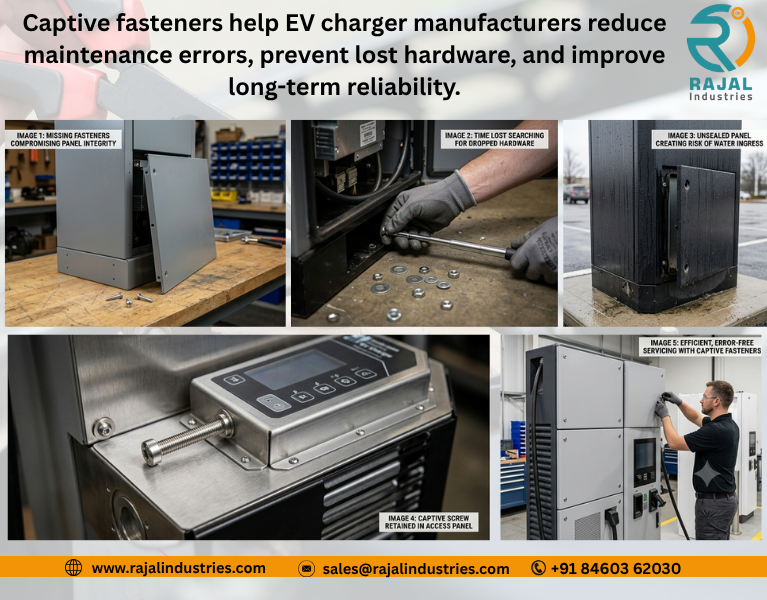
- Missing Screws
- Loose Covers
- Improperly Reinstalled Panels
- Water Ingress
- Damaged Threads
The surprising part?
The root cause was not related to charging technology.
It was related to hardware worth less than ₹10.
Standard Screws
Every time technicians opened the charger for maintenance, there was a risk:
- A screw could be dropped.
- A screw could be lost.
- A wrong screw could be installed.
- A screw could be under-tightened.
- A screw could be forgotten completely.
After reviewing field data, the OEM gradually replaced standard screws with:
Captive Fasteners
Today, many leading EV charger manufacturers consider captive screws a reliability upgrade rather than a convenience feature.
Quick Answer
Why are EV charger OEMs replacing standard screws?
EV charger OEMs are adopting captive screws because they reduce maintenance mistakes, prevent lost hardware, improve serviceability, reduce downtime, and help maintain enclosure integrity throughout the product lifecycle.
What Are Captive Screws?
A captive screw is designed to remain attached to a panel even when fully loosened.
Unlike conventional screws:
The fastener does not separate from the cover.
The screw stays connected to:
- Access Panels
- Maintenance Covers
- Electrical Compartments
- Communication Modules
- Cooling System Covers
This prevents accidental loss during servicing.
Why Standard Screws Create Problems
On paper, a standard machine screw appears simple.
In real-world field service, the situation is different.
Imagine a technician servicing:
- A 60 kW Charger
- A 120 kW Charger
- A 180 kW Charger
- A 240 kW Charger
Multiple panels must be removed.
Each panel may contain:
- M4 Machine Screws
- M5 Machine Screws
- Self-Tapping Screws
- Security Screws
After servicing:
Every screw must be reinstalled correctly.
One missing screw can create future reliability problems.
The Hidden Cost of Lost Screws
Most OEMs calculate:
Fastener Cost
Few calculate:
Maintenance Error Cost
A lost screw can cause:
- Repeat Service Visits
- Water Ingress
- Panel Vibration
- Warranty Claims
- Customer Complaints
The actual cost is rarely the screw itself.
The cost is everything that follows.
Why EV Chargers Are Different from Electrical Panels
Traditional electrical panels may be opened:
Once Every Few Years
EV chargers may be serviced:
- Monthly
- Quarterly
- Annually
depending on:
- Usage
- Location
- Maintenance Requirements
This means access panels are repeatedly opened and closed.
The more service activity, the greater the risk of hardware-related mistakes.
Problem #1 – Missing Fasteners After Maintenance
Field audits frequently reveal:
- Missing Cover Screws
- Missing Grounding Screws
- Missing Internal Fasteners
Why?
Because technicians often manage dozens of screws during maintenance.
Captive fasteners eliminate this risk.
The screw remains attached to the panel.
Problem #2 – Water Ingress
Outdoor EV chargers typically require:
- IP54 Protection
- IP55 Protection
- IP65 Protection
- IP66 Protection
Missing screws can compromise:
- Gasket Compression
- Door Alignment
- Panel Sealing
Even one missing screw can reduce enclosure performance.
This increases the risk of:
- Moisture Entry
- Corrosion
- Electrical Damage
Problem #3 – Longer Service Times
Every maintenance technician knows the frustration of:
Searching for a Missing Screw
Common situations include:
- Dropped Screws
- Lost Washers
- Mixed Hardware
Captive screws simplify maintenance.
The hardware is already attached.
Service becomes faster and more predictable.
Real Charger Service Example
An EV charger OEM reviewed maintenance records from:
500+ Charging Stations
Findings included:
- Lost Hardware
- Incorrect Screw Replacement
- Loose Access Panels
- Missing Fasteners
Many issues occurred after maintenance rather than during operation.
The OEM redesigned several access panels using:
M4 Captive Screws
M5 Captive Screws
Results:
✔ Faster Maintenance
✔ Fewer Repeat Visits
✔ Better Panel Reliability
✔ Reduced Warranty Claims
Problem #4 – Wrong Screw Reinstallation
Large chargers often use multiple fastener types.
Examples:
- M4 Screws
- M5 Screws
- M6 Screws
- Security Screws
- Self-Tapping Screws
Technicians sometimes reinstall:
- Wrong Length
- Wrong Thread Type
- Wrong Material
This creates:
- Thread Damage
- Poor Clamping Force
- Reduced Reliability
Captive fasteners reduce this risk significantly.
Problem #5 – Thread Wear
Repeated maintenance affects:
- Machine Screws
- Self-Tapping Screws
- Sheet Metal Threads
Common problems include:
- Cross Threading
- Stripped Threads
- Loose Panels
Many OEMs combine captive screws with:
Rivet Nuts
Threaded Inserts
to improve service life.
Why Captive Screws Are Growing in EV Chargers
Modern charger manufacturers focus on:
Serviceability Engineering
The objective is not just manufacturing.
The objective is making equipment easier to maintain.
Captive fasteners support this goal.
Benefits include:
✔ Faster Service
✔ Better Reliability
✔ Lower Maintenance Cost
✔ Reduced Human Error
✔ Improved Safety
Common Captive Fasteners Used in EV Chargers
Captive Screws
- M4 Captive Screws
- M5 Captive Screws
- M6 Captive Screws
Security Fasteners
- Torx Captive Screws
- Tamper Resistant Screws
Stainless Steel Fasteners
- SS304 Captive Screws
- SS316 Captive Screws
Installation Hardware
- Rivet Nuts
- Cage Nuts
- Threaded Inserts
These products are becoming standard in premium charging infrastructure.
Captive Screw vs Standard Screw
| Parameter | Standard Screw | Captive Screw |
| Lost Hardware Risk | High | Very Low |
| Maintenance Speed | Medium | High |
| Service Reliability | Medium | High |
| Repeat Service Risk | Higher | Lower |
| Outdoor Charger Usage | Common | Growing Rapidly |
| OEM Preference | Traditional | Modern Standard |
Why Outdoor Chargers Benefit Most
Outdoor charging stations face:
- Rain
- Dust
- Wind
- Public Access
- Frequent Maintenance
Every maintenance event creates an opportunity for assembly mistakes.
Captive screws significantly reduce those risks.
This is one reason why many charger OEMs now specify captive fasteners for:
- Front Covers
- Access Panels
- Service Compartments
- Communication Modules
- Cooling Assemblies
Fasteners Commonly Used in EV Charger Manufacturing
Large EV charger manufacturers regularly purchase:
Cabinet Fasteners
- M4 Machine Screws
- M5 Machine Screws
- M6 Machine Screws
- Captive Screws
- Security Screws
Stainless Steel Hardware
- SS304 Screws
- SS316 Screws
- SS304 Captive Screws
- SS316 Captive Screws
Structural Fasteners
Grounding Hardware
- Grounding Bolts
- Serrated Washers
- Ground Lugs
Installation Hardware
These are among the most searched EV charger fasteners by OEM engineering and purchasing teams.
What Leading EV Charger OEMs Focus On
Modern charger manufacturers increasingly evaluate:
✔ Service Time Reduction
✔ Maintenance Error Reduction
✔ Panel Integrity
✔ Corrosion Resistance
✔ IP Rating Reliability
✔ Lifecycle Cost
✔ Spare Parts Management
✔ Technician Safety
Captive fasteners support all of these objectives.
Industries Most Affected
This trend is common among:
- EV Charger Manufacturers
- DC Fast Charger OEMs
- AC Charger Manufacturers
- Charging Station Integrators
- EV Infrastructure Developers
- Fleet Charging Operators
- Utility Charging Networks
- Outdoor Electrical Cabinet Manufacturers
Inspection Checklist
Before approving charger cabinet hardware:
✔ Review maintenance access points
✔ Evaluate captive screw opportunities
✔ Verify stainless steel grade
✔ Check corrosion resistance
✔ Inspect grounding hardware
✔ Review IP rating requirements
✔ Validate service procedures
✔ Standardize fastener types
✔ Verify supplier capability
Key Takeaways
- Most charger hardware problems occur during maintenance, not manufacturing.
- Missing screws can compromise enclosure performance.
- Captive screws reduce maintenance errors.
- Faster servicing improves charger uptime.
- Rivet nuts and threaded inserts improve long-term thread durability.
- Captive fasteners support better IP protection.
- Many leading charger OEMs now treat captive screws as a reliability upgrade.
FAQ
What is a captive screw?
A captive screw remains attached to a panel even when fully loosened, preventing loss during maintenance.
Why are EV charger manufacturers switching to captive screws?
They reduce maintenance mistakes, prevent lost hardware, improve serviceability, and lower lifecycle costs.
Which captive screw sizes are commonly used?
M4 captive screws, M5 captive screws, and M6 captive screws are widely used in EV charger cabinets.
Are captive screws more expensive?
Yes, the initial cost is higher, but many OEMs find the maintenance savings justify the investment.
Can captive screws improve IP ratings?
Indirectly yes. They help ensure all fasteners remain in place, maintaining proper gasket compression and enclosure sealing.
Which materials are used for captive screws?
SS304 captive screws, SS316 captive screws, carbon steel captive screws, and coated captive fasteners are commonly used.
What hardware is often used with captive screws?
Rivet nuts, cage nuts, threaded inserts, grounding hardware, and stainless steel washers.
Which industries use captive fasteners most?
EV charger manufacturers, telecom cabinet manufacturers, outdoor electrical enclosure manufacturers, and charging infrastructure OEMs.
Conclusion
The future of EV charging infrastructure is not only about faster charging speeds and smarter software.
It is also about reducing small maintenance mistakes that create expensive problems.
A missing screw may seem insignificant.
For a charger OEM managing thousands of charging stations, it can become a reliability issue, a warranty claim, or a service cost.
That is why many EV charger manufacturers no longer trust standard screws for critical access panels and are increasingly adopting captive fasteners as part of their long-term reliability strategy.