
Introduction – The Charger Passed Testing, But Failed in the Field
An EV charger manufacturer launched a new series of outdoor DC fast chargers.
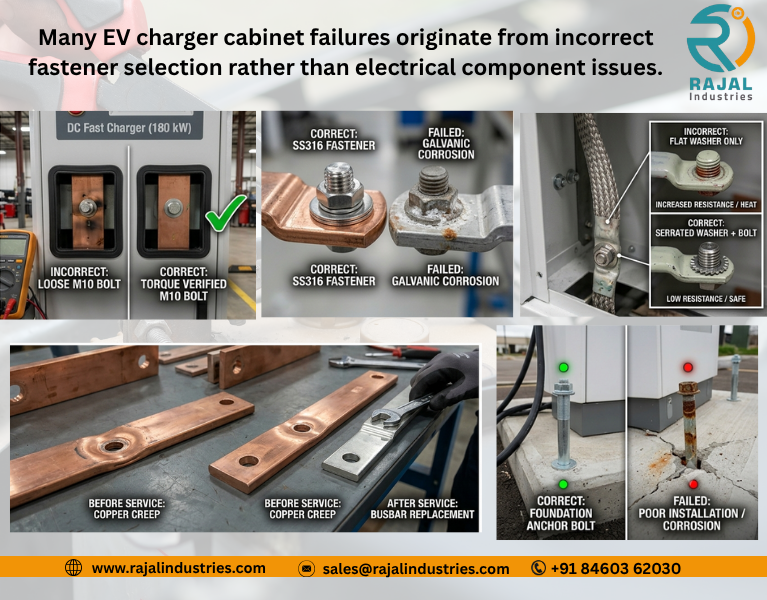
Factory testing showed excellent results.
The chargers successfully passed:
- Environmental Testing
- Electrical Safety Testing
- Thermal Testing
- IP Rating Verification
- Mechanical Inspection
The first installations were deployed across:
- Highway Charging Stations
- Shopping Centers
- Fleet Charging Facilities
- Commercial Parking Areas
Within 18 months, service reports started appearing.
Common complaints included:
- Rust Around Cabinet Screws
- Loose Access Panels
- Corroded Grounding Hardware
- Door Alignment Problems
- Water Ingress Around Fasteners
Engineers initially suspected:
- Seal Design Problems
- Cabinet Design Issues
- Installation Errors
After investigation, the root cause was surprisingly simple.
The problem was not the charger.
The problem was:
Fastener Selection
This issue is becoming increasingly common among:
- DC Fast Charger Manufacturers
- AC Charger Manufacturers
- EV Charger OEMs
- Charging Station Integrators
- Outdoor Cabinet Manufacturers
Quick Answer
What are the most common fastener selection mistakes in EV charger cabinets?
The most common mistakes include choosing the wrong stainless steel grade, ignoring galvanic corrosion, selecting unsuitable screws, overlooking grounding hardware, and failing to standardize fasteners across production.
Why Fasteners Matter in EV Charger Cabinets
A modern EV charger cabinet contains hundreds of fasteners.
These fasteners secure:
- Power Modules
- Charging Electronics
- Cooling Systems
- Access Panels
- Grounding Systems
- Cable Management Components
- Structural Frames
A typical DC fast charger may contain:
200–600 Fasteners
A single poor fastener specification can affect the reliability of the entire charger.
Error #1 – Using SS304 Screws in Highly Corrosive Locations
One of the most common mistakes.
Many charger manufacturers automatically specify:
SS304 Screws
because they offer:
✔ Good Corrosion Resistance
✔ Wide Availability
✔ Competitive Pricing
For many environments, SS304 performs well.
However, chargers installed near:
- Coastal Areas
- Ports
- Chemical Plants
- Industrial Zones
often require:
SS316 Screws
because of higher corrosion exposure.
Real Example
A charging network installed chargers within 5 km of the coastline.
Hardware Used:
- SS304 Machine Screws
- SS304 Washers
- Standard Grounding Hardware
After 16 months:
- Tea Staining Appeared
- Surface Corrosion Developed
- Fastener Replacement Became Necessary
The next project used:
SS316 Screws
and corrosion complaints dropped significantly.
SS304 vs SS316 Screws
| Parameter | SS304 Screws | SS316 Screws |
| Corrosion Resistance | High | Very High |
| Salt Resistance | Moderate | Excellent |
| Coastal Applications | Limited | Preferred |
| Outdoor Service Life | Good | Excellent |
| Cost | Lower | Higher |
Many leading charger OEMs now specify SS316 screws for outdoor charging stations.
Error #2 – Ignoring Galvanic Corrosion
Modern charger cabinets often combine:
- Stainless Steel Screws
- Aluminum Panels
- Copper Busbars
- Zinc-Plated Brackets
When moisture enters the system:
Different metals can react electrochemically.
This creates:
Galvanic Corrosion
The first signs usually appear around:
- Screw Heads
- Washers
- Mounting Holes
Many charger manufacturers discover this issue only after field deployment.
Error #3 – Using Standard Screws Instead of Captive Screws
Many EV charger cabinets require frequent maintenance.
Service engineers routinely remove:
- Power Module Covers
- Communication Panels
- Filter Covers
- Cooling System Access Panels
With standard screws:
Problems include:
- Lost Hardware
- Longer Service Times
- Incorrect Reassembly
Many OEMs now use:
Captive Screws
Benefits:
✔ Faster Maintenance
✔ No Lost Fasteners
✔ Better Field Serviceability
✔ Reduced Maintenance Errors
Standard Screw vs Captive Screw
| Parameter | Standard Screw | Captive Screw |
| Maintenance Speed | Medium | High |
| Risk of Loss | High | Very Low |
| Serviceability | Good | Excellent |
| OEM Preference | Common | Increasing |
Captive screws are becoming standard in premium EV charging equipment.
Error #4 – Treating Grounding Hardware as Ordinary Hardware
Grounding systems are critical safety systems.
Yet many charger manufacturers use:
- Standard Bolts
- Flat Washers
- Painted Contact Surfaces
Common grounding hardware should include:
Grounding Components
- Grounding Bolts
- Serrated Washers
- Ground Lugs
- Copper Ground Straps
Without proper grounding hardware:
Potential issues include:
- Increased Resistance
- Fault Detection Problems
- Electrical Noise
- Safety Risks
Grounding hardware should always receive special engineering attention.
Why Serrated Washers Matter
A grounding bolt alone is not enough.
Serrated washers:
✔ Penetrate Paint
✔ Break Oxidation Layers
✔ Create Metal-to-Metal Contact
✔ Improve Long-Term Ground Reliability
Many OEM grounding failures can be traced to missing serrated washers.
Error #5 – Using Too Many Different Fasteners
A surprising number of charger manufacturers use:
80–150 Fastener Types
across a single product range.
This creates:
- Inventory Complexity
- Procurement Challenges
- Assembly Errors
- Spare Parts Issues
Leading charger OEMs often reduce this to:
20–40 Core Fasteners
Benefits include:
✔ Lower Inventory Cost
✔ Better Purchasing Power
✔ Easier Maintenance
✔ Faster Production
Real OEM Standardization Example
An EV charger manufacturer reviewed its BOM.
Original Situation:
96 Fastener SKUs
After Engineering Review:
31 Fastener SKUs
Results:
✔ Reduced Inventory
✔ Faster Procurement
✔ Improved Assembly Efficiency
✔ Lower Spare Parts Cost
Most Common Fasteners Used in EV Charger Cabinets
Large charger manufacturers regularly purchase:
Cabinet Fasteners
- M4 Machine Screws
- M5 Machine Screws
- M6 Machine Screws
- Captive Screws
- Security Screws
Stainless Steel Hardware
Structural Hardware
- M8 Bolts
- M10 Bolts
- Anchor Bolts
- Foundation Bolts
Grounding Hardware
- Grounding Bolts
- Serrated Washers
- Ground Lugs
- Copper Ground Straps
Installation Hardware
- Rivet Nuts
- Cage Nuts
- Threaded Inserts
These are among the most searched outdoor EV charger fasteners used by OEMs worldwide.
What Leading EV Charger OEMs Focus On
Modern charger manufacturers increasingly evaluate:
✔ Corrosion Resistance
✔ Serviceability
✔ Grounding Reliability
✔ Fastener Standardization
✔ Salt Spray Performance
✔ Maintenance Efficiency
✔ Long-Term Lifecycle Cost
✔ Outdoor Environmental Exposure
The objective is not just building a charger.
The objective is building a charger that survives outdoors for 10–15 years.
Industries Most Affected
These fastener selection mistakes commonly affect:
- EV Charger Manufacturers
- DC Fast Charger Manufacturers
- AC Charger Manufacturers
- Charging Station Integrators
- EV Infrastructure Developers
- Fleet Charging Operators
- Utility Charging Networks
- Outdoor Electrical Cabinet Manufacturers
Inspection Checklist
Before charger production approval:
✔ Verify stainless steel grade
✔ Evaluate corrosion environment
✔ Review grounding hardware
✔ Check galvanic corrosion risks
✔ Standardize fastener selection
✔ Review service access requirements
✔ Validate captive screw usage
✔ Verify salt spray requirements
✔ Confirm supplier quality standards
Key Takeaways
- Many EV charger reliability issues originate from fastener selection mistakes.
- SS304 is not always suitable for aggressive outdoor environments.
- SS316 screws provide better protection in coastal areas.
- Captive screws improve maintenance efficiency.
- Grounding hardware requires special engineering attention.
- Galvanic corrosion is often overlooked.
- Fastener standardization reduces manufacturing complexity and cost.
FAQ
Why do EV charger cabinet screws rust?
Rust usually develops because of environmental exposure, poor material selection, damaged coatings, or galvanic corrosion.
When should SS316 screws be used instead of SS304?
SS316 screws are generally preferred in coastal, industrial, and highly corrosive outdoor environments.
What are captive screws?
Captive screws remain attached to the panel during maintenance, preventing loss and improving serviceability.
Why are serrated washers used in grounding systems?
They improve electrical contact by penetrating paint and oxidation layers, ensuring reliable grounding.
What fasteners are commonly used in EV charger cabinets?
M4 machine screws, M5 machine screws, captive screws, SS304 screws, SS316 screws, grounding bolts, rivet nuts, and threaded inserts.
What is galvanic corrosion?
Galvanic corrosion occurs when different metals are electrically connected in the presence of moisture, causing accelerated corrosion.
Why do OEMs standardize fasteners?
Standardization reduces inventory, purchasing complexity, assembly errors, and maintenance costs.
Which industries commonly face these issues?
EV charger manufacturers, charging station integrators, EV infrastructure developers, and outdoor electrical cabinet manufacturers.
Conclusion
Many EV charger cabinet failures are not caused by software, electronics, or charging technology.
They start with fasteners.
A wrong screw grade, an overlooked grounding connection, or poor corrosion resistance can create years of maintenance headaches.
For EV charger manufacturers, DC fast charger OEMs, and charging infrastructure developers, fastener selection should be treated as a reliability engineering decision, not just a purchasing decision.