
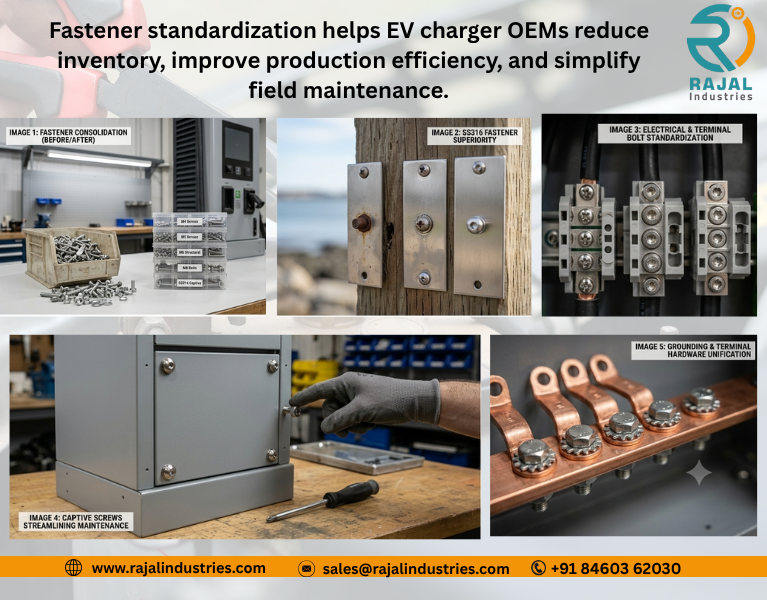
Introduction – One EV Charger OEM Reduced 142 Fasteners to 38 and Cut Procurement Costs by 22%
A DC fast charger manufacturer was expanding production.
The company offered:
- 30 kW Chargers
- 60 kW Chargers
- 120 kW Chargers
- 180 kW Chargers
- 240 kW Chargers
Each product had evolved independently over several years.
Different engineers selected different hardware.
Different suppliers recommended different fasteners.
Different factories purchased different components.
The result?
The company was managing:
142 Different Fastener SKUs
Common problems included:
- Inventory Errors
- Purchasing Delays
- Production Shortages
- Higher Costs
- Assembly Mistakes
- Spare Parts Confusion
After a complete engineering review, the company reduced its fastener count to:
38 Core Fasteners
Results included:
✔ Lower Inventory Cost
✔ Better Supplier Pricing
✔ Faster Assembly
✔ Easier Maintenance
✔ Reduced Procurement Complexity
This is why fastener standardization has become a major focus for leading EV charger OEMs worldwide.
Quick Answer
Why should DC fast charger OEMs standardize fasteners?
Fastener standardization reduces inventory costs, improves production efficiency, simplifies maintenance, increases purchasing power, reduces assembly mistakes, and improves long-term product reliability.
Why Fastener Standardization Matters
Most charger manufacturers focus on:
- Power Electronics
- Charging Software
- Cooling Systems
- Communication Protocols
Few realize how much money is hidden inside fastener management.
Every unique fastener creates:
- Inventory Requirements
- Purchasing Activities
- Storage Space
- Quality Inspections
- Spare Parts Management
Reducing fastener variety improves every stage of manufacturing.
What Is Fastener Standardization?
Fastener standardization means reducing the number of unique hardware items used across products.
Instead of:
100 Different Fasteners
an OEM may use:
20–40 Core Fasteners
across all charger models.
This creates:
✔ Manufacturing Consistency
✔ Easier Training
✔ Lower Purchasing Cost
✔ Better Supply Chain Control
The Hidden Cost of Too Many Fasteners
Many OEMs underestimate the true cost.
Example:
Using:
- 6 Different M4 Screws
- 5 Different M5 Screws
- 4 Different Captive Screws
- Multiple Washer Types
- Multiple Nut Variations
creates unnecessary complexity.
Each SKU requires:
- Purchasing
- Storage
- Tracking
- Quality Verification
The cost extends far beyond the fastener itself.
The Core Fasteners Most Charger OEMs Should Standardize
Fastener #1 – M4 Machine Screws
One of the highest-volume fasteners in charger manufacturing.
Applications:
- Control Boards
- Communication Modules
- Display Assemblies
- Sensor Mounting
- Electronics
Common Standards:
- Phillips Head Screws
- Torx Screws
- Socket Screws
Many charger OEMs standardize most electronic assemblies around M4 hardware.
Fastener #2 – M5 Machine Screws
Widely used throughout charger cabinets.
Applications:
- Internal Panels
- Cooling Assemblies
- Fan Mounting
- Electrical Compartments
Advantages:
✔ Stronger Than M4
✔ Easy Availability
✔ Excellent Assembly Speed
Fastener #3 – M6 Structural Screws
Commonly used for:
- Power Modules
- Cooling Systems
- Structural Brackets
- Heavy Internal Assemblies
M6 fasteners often become the backbone of internal charger structures.
Fastener #4 – Captive Screws
One of the fastest-growing fastener categories in EV charging infrastructure.
Applications:
- Service Panels
- Access Covers
- Maintenance Doors
- Communication Compartments
Benefits:
✔ No Lost Hardware
✔ Faster Service
✔ Better IP Protection
✔ Lower Maintenance Costs
Common Types:
- M4 Captive Screws
- M5 Captive Screws
- SS304 Captive Screws
- SS316 Captive Screws
Fastener #5 – Grounding Bolts
Grounding hardware should always be standardized.
Applications:
- Earth Connections
- Charger Cabinets
- Internal Ground Systems
- Safety Grounding Points
Common Hardware:
- M6 Grounding Bolts
- M8 Grounding Bolts
- Serrated Washers
- Ground Lugs
Fastener #6 – Terminal Bolts
Terminal connections carry high current.
These fasteners directly affect charger performance.
Common Products:
- M6 Terminal Bolts
- M8 Terminal Bolts
- M10 Terminal Bolts
- Copper Terminal Bolts
- Tin-Plated Copper Bolts
Using multiple bolt types unnecessarily increases inventory.
Fastener #7 – Structural Bolts
Used for:
- Cabinet Frames
- Mounting Structures
- Internal Supports
Common Products:
- M8 Bolts
- M10 Bolts
- Flange Bolts
- Grade 8.8 Bolts
Many OEMs standardize around M8 and M10 hardware.
Fastener #8 – Anchor Bolts
Every outdoor charger requires foundation hardware.
Common Products:
- M12 Anchor Bolts
- M16 Anchor Bolts
- Chemical Anchors
- Foundation Bolts
Standardizing anchor systems simplifies installation.
Fastener #9 – Rivet Nuts
Increasingly common in charger manufacturing.
Applications:
- Thin Sheet Metal
- Service Panels
- Structural Mounting
Common Sizes:
- M4 Rivet Nuts
- M5 Rivet Nuts
- M6 Rivet Nuts
Fastener #10 – Stainless Steel Washers
Many charger manufacturers unnecessarily use multiple washer types.
A standardized washer program often includes:
- Flat Washers
- Serrated Washers
- Structural Washers
Using fewer washer specifications reduces complexity.
Why OEMs Are Moving Toward SS316 Hardware
Outdoor charging infrastructure often faces:
- Rain
- Humidity
- Salt Exposure
- Industrial Pollution
Many manufacturers are standardizing:
SS316 Screws
SS316 Washers
SS316 Captive Fasteners
for outdoor applications.
Benefits include:
✔ Longer Service Life
✔ Better Corrosion Resistance
✔ Reduced Maintenance
Real OEM Standardization Example
Before Review:
142 Fastener SKUs
Included:
- 27 Screw Types
- 19 Washer Types
- 15 Nut Variations
- Multiple Bolt Grades
After Review:
38 Fastener SKUs
Results:
✔ 22% Lower Purchasing Cost
✔ 18% Faster Assembly
✔ Reduced Spare Parts Inventory
✔ Improved Supplier Negotiation Power
Most Common EV Charger OEM Fasteners
Large charger manufacturers regularly purchase:
Cabinet Hardware
- M4 Machine Screws
- M5 Machine Screws
- M6 Machine Screws
- Captive Screws
Structural Hardware
- M8 Bolts
- M10 Bolts
- Grade 8.8 Bolts
- Flange Bolts
Electrical Hardware
- Terminal Bolts
- Copper Terminal Bolts
- Grounding Bolts
Installation Hardware
- Rivet Nuts
- Threaded Inserts
- Anchor Bolts
Stainless Steel Hardware
These are among the highest-volume production fasteners used by EV charger OEMs.
What Purchasing Teams Want
Modern OEM purchasing teams focus on:
✔ MOQ Optimization
✔ Global Supply Stability
✔ Standardization
✔ Reduced Inventory
✔ Lower Total Cost
✔ Reliable Lead Times
✔ Export Packaging
✔ Supplier Capacity
The goal is long-term manufacturing efficiency.
Industries Most Affected
Fastener standardization is important for:
- DC Fast Charger Manufacturers
- EV Charger Manufacturers
- Charging Station Integrators
- Outdoor Cabinet Manufacturers
- EV Infrastructure Developers
- Fleet Charging Operators
- Energy Storage OEMs
- Electrical Enclosure Manufacturers
Inspection Checklist
Before approving fastener standards:
✔ Review all fastener SKUs
✔ Eliminate duplicate sizes
✔ Standardize screw heads
✔ Standardize washer types
✔ Review corrosion requirements
✔ Verify grounding hardware
✔ Simplify service hardware
✔ Evaluate captive fasteners
✔ Consolidate supplier base
Key Takeaways
- Most EV charger OEMs use more fastener types than necessary.
- Standardization reduces inventory and purchasing costs.
- M4, M5, M6, M8, and M10 fasteners cover most charger applications.
- Captive screws improve serviceability.
- Grounding and terminal hardware should be standardized separately.
- SS316 hardware is increasingly preferred for outdoor installations.
- Fastener simplification improves manufacturing efficiency and maintenance performance.
FAQ
Why should EV charger OEMs standardize fasteners?
Standardization reduces inventory costs, improves production efficiency, simplifies maintenance, and strengthens purchasing power.
Which screw sizes are most commonly used in EV chargers?
M4, M5, and M6 machine screws are among the most commonly used charger fasteners.
What structural bolts are commonly used?
M8 bolts, M10 bolts, flange bolts, and Grade 8.8 structural fasteners are widely used.
Why are captive screws becoming popular?
They reduce maintenance errors, prevent lost hardware, and improve charger serviceability.
Why should grounding hardware be standardized?
Grounding systems are safety-critical and benefit from consistent hardware specifications across all charger models.
What are the most common electrical fasteners in chargers?
M6 terminal bolts, M8 terminal bolts, copper terminal bolts, grounding bolts, and serrated washers.
Is SS304 or SS316 better for outdoor chargers?
SS316 generally provides superior corrosion resistance, especially in coastal and industrial environments.
Which industries benefit most from fastener standardization?
EV charger manufacturers, charging station integrators, electrical enclosure manufacturers, and EV infrastructure developers.
Conclusion
Most charger manufacturers focus on optimizing electronics, cooling systems, and charging performance.
However, some of the largest manufacturing savings are hidden in fastener standardization.
Reducing unnecessary hardware variation improves procurement, production, serviceability, inventory management, and long-term reliability.
For DC fast charger OEMs, the goal should not be to manage hundreds of fasteners.
The goal should be to manage a small, optimized group of fasteners that can support the entire product range efficiently.