
Introduction – The Switchgear Was New, But the Corrosion Was Already Visible
A utility company conducted a routine inspection of an outdoor switchgear installation.
The project included:
- RMU Panels
- VCB Panels
- HT Switchgear
- Outdoor Control Panels
- Distribution Systems
The installation was only:
18 Months Old
Engineers expected everything to be in excellent condition.
However, inspection revealed:
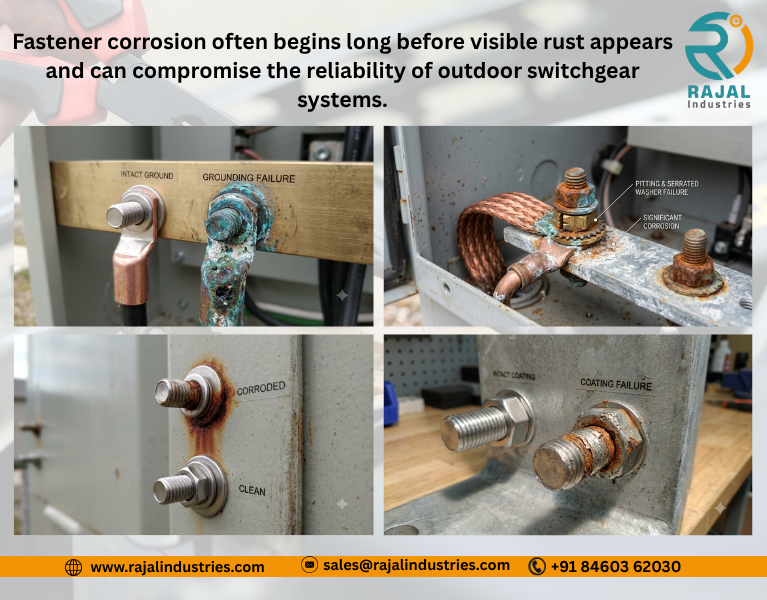
- Rust Around Fasteners
- Corroded Hinges
- Damaged Washer Assemblies
- Surface Pitting
- Discolored Hardware
The switchgear itself remained operational.
But the fasteners protecting it were already deteriorating.
The most surprising part?
Most of the corrosion occurred on components worth less than ₹100.
This situation is becoming increasingly common in:
- Outdoor RMU Installations
- Utility Substations
- Solar Switchyards
- Wind Farms
- Industrial Power Distribution Systems
- Outdoor Electrical Panels
- EV Charging Infrastructure
Quick Answer
Why do switchgear fasteners corrode so quickly outdoors?
Outdoor switchgear fasteners typically corrode due to humidity, rainfall, condensation, salt exposure, UV degradation, coating damage, galvanic corrosion, and incorrect material selection.
Why Outdoor Switchgear Is More Challenging
Indoor electrical panels operate in controlled environments.
Outdoor switchgear faces:
- Rain
- Dust
- Salt Air
- Temperature Cycling
- UV Exposure
- Pollution
- Condensation
Every fastener becomes part of the environmental protection system.
If the fastener fails:
- Water ingress may occur.
- Panel integrity may decrease.
- Maintenance costs increase.
What Fasteners Are Used in Outdoor Switchgear?
Outdoor switchgear manufacturers commonly use:
Structural Fasteners
- M6 Bolts
- M8 Bolts
- M10 Bolts
- M12 Bolts
- Flange Bolts
- Hex Bolts
Stainless Steel Hardware
- SS304 Bolts
- SS304 Nuts
- SS304 Washers
- SS316 Bolts
- SS316 Washers
Panel Hardware
- Captive Screws
- Machine Screws
- Self-Tapping Screws
- Rivet Nuts
- Cage Nuts
Grounding Hardware
- Grounding Bolts
- Serrated Washers
- Ground Lugs
These products are among the most common switchgear fasteners used worldwide.
Failure #1 – Wrong Stainless Steel Selection
Many OEMs automatically specify:
SS304 Hardware
because it offers good corrosion resistance at a reasonable cost.
For many indoor applications, SS304 performs very well.
However, outdoor environments can be much more aggressive.
Common exposure conditions include:
- Coastal Air
- Industrial Pollution
- Acid Rain
- High Humidity
In these situations, SS304 may develop:
- Surface Staining
- Pitting Corrosion
- Crevice Corrosion
within a relatively short period.
SS304 vs SS316 Fasteners
| Parameter | SS304 Hardware | SS316 Hardware |
| Corrosion Resistance | High | Very High |
| Salt Resistance | Moderate | Excellent |
| Coastal Applications | Limited | Preferred |
| Outdoor Performance | Good | Excellent |
| Service Life | Good | Longer |
| Cost | Lower | Higher |
Many utility projects now specify SS316 hardware for coastal installations.
Failure #2 – Corrosion Under Washers
One of the most common hidden failures.
Corrosion frequently develops beneath:
- Flat Washers
- Spring Washers
- Structural Washers
Why?
Washers trap:
- Moisture
- Dust
- Salt
- Contaminants
The corrosion remains hidden until visible staining appears.
By then, damage may already be significant.
Failure #3 – Damaged Protective Coatings
Many switchgear fasteners use:
- Zinc Plating
- Hot Dip Galvanizing
- Geomet Coating
- Zinc-Nickel Coating
During installation:
- Tools slip
- Threads are damaged
- Coatings are scratched
These small defects become corrosion initiation points.
Once corrosion starts, it often spreads rapidly.
Failure #4 – Galvanic Corrosion
Outdoor switchgear assemblies often contain:
- Stainless Steel Fasteners
- Aluminum Components
- Copper Grounding Systems
- Galvanized Steel Structures
When moisture is present, different metals can create electrochemical reactions.
This is known as:
Galvanic Corrosion
The fastener often becomes the weakest link.
Real RMU Inspection Example
An outdoor RMU installation near a coastal area underwent inspection after:
18 Months
Inspectors found:
- Corrosion Around Door Hardware
- Rust Under Washers
- Pitting On SS304 Screws
- Grounding Hardware Discoloration
Hardware Used:
- SS304 Machine Screws
- Zinc-Plated Washers
- Standard Grounding Hardware
Root Cause:
High chloride exposure combined with galvanic corrosion
Corrective Action:
✔ Upgraded to SS316 hardware
✔ Replaced washers
✔ Improved grounding hardware
✔ Updated material specifications
Failure #5 – Condensation Inside Outdoor Panels
Many engineers focus on rain protection.
However, condensation often causes more damage than direct water exposure.
Typical cycle:
Warm Day
↓
Moist Air Enters Panel
↓
Cool Night
↓
Condensation Forms
↓
Water Accumulates Around Fasteners
This cycle repeats every day.
Over time:
Corrosion becomes inevitable.
Failure #6 – Grounding Hardware Corrosion
Grounding systems are frequently overlooked.
Corroded grounding components can affect:
- Safety
- Fault Current Dissipation
- Equipment Protection
Commonly affected hardware:
- Grounding Bolts
- Serrated Washers
- Copper Ground Lugs
- Earth Bars
Many OEMs now specify corrosion-resistant grounding hardware for outdoor installations.
Failure #7 – Fastener Crevice Corrosion
Crevice corrosion occurs in narrow spaces where moisture becomes trapped.
Common locations:
- Under Bolt Heads
- Under Washers
- Around Gaskets
- Inside Threaded Connections
This type of corrosion can remain hidden for years.
Many failures are discovered only during maintenance shutdowns.
Why Corrosion Becomes a Reliability Problem
Most engineers think corrosion is cosmetic.
In reality, corrosion causes:
- Reduced Clamp Force
- Thread Damage
- Preload Loss
- Water Ingress
- Structural Weakness
- Grounding Problems
Eventually:
The switchgear enclosure itself becomes vulnerable.
Typical Fasteners Used in Outdoor Switchgear
Large switchgear manufacturers commonly purchase:
Stainless Steel Fasteners
- SS304 Bolts
- SS304 Screws
- SS304 Nuts
- SS304 Washers
- SS316 Bolts
- SS316 Screws
- SS316 Nuts
- SS316 Washers
Structural Hardware
- M6 Bolts
- M8 Bolts
- M10 Bolts
- M12 Bolts
- Flange Bolts
Panel Hardware
- Captive Screws
- Machine Screws
- Self-Tapping Screws
- Rivet Nuts
Grounding Hardware
- Grounding Bolts
- Serrated Washers
- Ground Lugs
These are among the most searched outdoor switchgear fasteners globally.
Cost of Choosing the Wrong Fastener
Assume:
Difference Between SS304 and SS316 Hardware:
₹3–₹10 Per Fastener
A switchgear panel may contain:
200 Fasteners
Additional Hardware Cost:
Approximately:
₹600–₹2,000
Compared to:
- Warranty Claims
- Maintenance Visits
- Corrosion Repairs
- Equipment Downtime
The upgrade cost is often insignificant.
Industries Most Affected
Corrosion-related fastener failures commonly impact:
- RMU Manufacturers
- VCB Manufacturers
- ACB Manufacturers
- Switchgear Manufacturers
- Outdoor Panel Manufacturers
- Solar EPC Companies
- Utility Companies
- Wind Energy Projects
- EV Charging Infrastructure Manufacturers
- Electrical Contractors
Inspection Checklist
Before dispatching outdoor switchgear:
✔ Verify fastener material
✔ Review coating specifications
✔ Inspect grounding hardware
✔ Check galvanic corrosion risks
✔ Evaluate environmental exposure
✔ Review washer compatibility
✔ Inspect sealing systems
✔ Verify stainless steel grade
✔ Check condensation control measures
Key Takeaways
- Fastener corrosion can begin within 18 months in aggressive outdoor environments.
- SS304 hardware may not be sufficient for all outdoor applications.
- Corrosion frequently begins beneath washers and bolt heads.
- Galvanic corrosion is often overlooked.
- Grounding hardware is particularly vulnerable.
- Condensation can be as damaging as direct rain exposure.
- Material selection significantly affects long-term reliability.
FAQ
Why do outdoor switchgear fasteners corrode so quickly?
Humidity, salt exposure, pollution, condensation, and coating damage are the most common causes.
Is SS304 suitable for outdoor switchgear?
SS304 performs well in many outdoor environments, but coastal and highly corrosive locations often require SS316 hardware.
Why does corrosion occur under washers?
Washers trap moisture and contaminants, creating ideal conditions for hidden corrosion.
What is galvanic corrosion?
Galvanic corrosion occurs when different metals are electrically connected in the presence of moisture, causing accelerated corrosion.
Which fasteners are commonly used in outdoor switchgear?
SS304 bolts, SS316 bolts, machine screws, captive screws, grounding bolts, flange bolts, rivet nuts, and grounding hardware.
How can OEMs reduce corrosion failures?
By selecting proper materials, improving sealing systems, minimizing galvanic corrosion, and implementing routine inspections.
Why is SS316 preferred in coastal areas?
SS316 contains molybdenum, which provides significantly better resistance to chlorides and salt exposure.
Which industries face this issue most often?
RMU manufacturers, switchgear manufacturers, utility companies, solar EPC firms, wind energy developers, and outdoor electrical panel manufacturers.
Conclusion
Corrosion rarely starts as a major problem.
It usually begins as a small stain around a screw head.
Eighteen months later, that stain can become a maintenance issue, a warranty claim, or a reliability concern.
For outdoor switchgear manufacturers, RMU OEMs, VCB manufacturers, and utility operators, fastener selection is not just a purchasing decision.
It is a lifecycle reliability decision.