

Introduction – The Entire Panel Was Healthy Except for One Bolt
An industrial facility reported recurring electrical issues in a newly installed switchgear system.
The maintenance team checked:
- RMU Panels
- VCB Panels
- PCC Panels
- MCC Panels
- Busbar Connections
- Circuit Breakers
- Protection Relays
Everything appeared normal.
No breaker faults.
No overloaded busbars.
No damaged cables.
Yet operators noticed:
- Random relay trips
- Communication errors
- Electrical noise
- Unexpected voltage fluctuations
After several days of investigation, engineers found the root cause.
A grounding connection inside the switchgear panel had failed.
The failed component wasn’t expensive.
It was a simple grounding bolt assembly.
The total hardware cost was less than ₹30.
The production losses caused by the issue exceeded several lakhs.
This scenario is surprisingly common across:
- RMU Manufacturing
- VCB Manufacturing
- ACB Assemblies
- LT Panels
- HT Panels
- PCC Panels
- MCC Panels
- Distribution Boards
- Industrial Electrical Systems
Quick Answer
Why do grounding connections fail in switchgear panels?
Grounding connections usually fail because of loose grounding bolts, missing serrated washers, corrosion, paint contamination, vibration, thermal cycling, or improper installation practices.
Why Grounding Is Critical in Switchgear
Grounding performs several important functions:
✔ Personnel Safety
✔ Fault Current Dissipation
✔ Equipment Protection
✔ Surge Protection
✔ Electrical Noise Reduction
✔ Reliable Relay Operation
✔ Stable Communication Systems
Without effective grounding, even a perfectly designed switchgear panel can experience operational problems.
What Is a Switchgear Grounding Connection?
A grounding connection creates a low-resistance path between equipment and earth.
Typical grounding assemblies include:
Grounding Hardware
- M6 Grounding Bolts
- M8 Grounding Bolts
- M10 Grounding Bolts
- M12 Grounding Bolts
Grounding Components
- Ground Lugs
- Earth Bars
- Copper Busbars
- Earthing Straps
Locking Components
- Serrated Washers
- Star Washers
- Spring Washers
- Lock Nuts
Structural Components
Among these, M8 and M10 grounding bolt assemblies are the most common switchgear grounding fasteners.
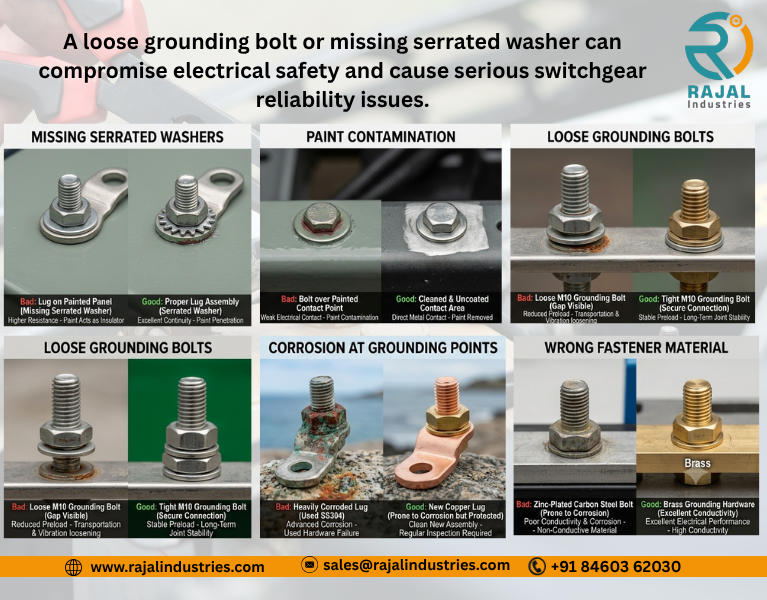
Failure #1 – Missing Serrated Washers
This is one of the most common grounding mistakes.
Many installers assemble:
and assume the connection is adequate.
However, switchgear panels often contain:
- Powder-Coated Surfaces
- Painted Frames
- Galvanized Structures
Paint acts as an insulator.
A serrated washer helps:
✔ Penetrate paint
✔ Break oxidation layers
✔ Create metal-to-metal contact
Without it, grounding resistance can increase significantly.
Why Serrated Washers Matter
A grounding bolt alone does not guarantee electrical continuity.
The connection requires:
Direct Metal Contact
Serrated washers create multiple contact points and improve long-term reliability.
This is why many switchgear OEMs specify serrated washers in grounding assemblies.
Failure #2 – Loose Grounding Bolts
Grounding bolts often loosen because of:
- Equipment Vibration
- Transportation
- Thermal Expansion
- Improper Torque
Even slight loosening can increase resistance.
The connection may still appear intact while electrical performance deteriorates.
Failure #3 – Corrosion at Grounding Points
Switchgear installations are often exposed to:
- Humidity
- Condensation
- Dust
- Industrial Pollution
- Coastal Environments
Corrosion commonly develops around:
- Ground Lugs
- Grounding Bolts
- Serrated Washers
- Copper Connections
As corrosion increases:
Resistance increases.
Grounding efficiency decreases.
Failure #4 – Paint Under Grounding Connections
Many panel manufacturers focus on corrosion protection.
However, painting over grounding surfaces creates another problem.
Paint can prevent proper electrical contact.
Common mistakes include:
- Painted Earthing Points
- Painted Ground Lug Areas
- Coated Contact Surfaces
Professional switchgear manufacturers typically create dedicated grounding locations with exposed metal surfaces.
Failure #5 – Improper Ground Lug Installation
Ground lugs are frequently overlooked.
Common installation errors include:
- Bent Lugs
- Misaligned Lugs
- Partial Contact Area
- Damaged Lug Surfaces
These issues reduce contact area and increase resistance.
Failure #6 – Thermal Cycling
Switchgear systems continuously heat and cool.
Daily temperature changes cause:
- Expansion
- Contraction
- Expansion
- Contraction
Over time:
- Preload decreases
- Grounding bolts loosen
- Contact pressure drops
The connection gradually degrades.
Failure #7 – Wrong Fastener Material
Grounding connections require more than mechanical strength.
Electrical performance matters.
Common grounding hardware materials include:
SS304 Fasteners
Good corrosion resistance.
SS316 Fasteners
Excellent corrosion resistance.
Brass Grounding Hardware
Excellent conductivity.
Copper Grounding Hardware
Excellent electrical performance.
Selecting the wrong material can create long-term reliability issues.
Real Switchgear Failure Example
A VCB panel manufacturer investigated repeated relay communication faults.
Initial inspections focused on:
- PLC Systems
- Communication Networks
- Protection Relays
No faults were found.
Further investigation revealed:
Grounding Assembly
- M8 Grounding Bolt
- Flat Washer
- Painted Surface
No serrated washer was installed.
Result:
Ground resistance increased.
Communication noise developed.
Corrective Action:
✔ Removed paint
✔ Installed serrated washer
✔ Re-torqued grounding assembly
✔ Added inspection procedure
The problem disappeared immediately.
Grounding Resistance Example
Assume:
Grounding Resistance:
0.02 Ohm
Fault Current:
200 Amps
Power Dissipation:
P = I²R
P = 200² × 0.02
= 800 Watts
Now corrosion doubles resistance:
0.04 Ohm
Power Dissipation:
P = 200² × 0.04
= 1600 Watts
Heat generation doubles.
The grounding connection becomes a potential failure point.
Serrated Washer vs Flat Washer
| Parameter | Flat Washer | Serrated Washer |
| Load Distribution | Good | Good |
| Electrical Contact | Low | High |
| Paint Penetration | No | Yes |
| Grounding Performance | Medium | Excellent |
| OEM Preference | Limited | Preferred |
This is why serrated washers are widely specified in switchgear grounding systems.
Common Grounding Fasteners Used by Switchgear OEMs
Large switchgear manufacturers regularly purchase:
Grounding Hardware
- M6 Grounding Bolts
- M8 Grounding Bolts
- M10 Grounding Bolts
- M12 Grounding Bolts
Grounding Components
- Ground Lugs
- Copper Earth Bars
- Earthing Straps
- Copper Busbars
Locking Hardware
- Serrated Washers
- Star Washers
- Lock Nuts
- Spring Washers
Structural Hardware
- Hex Bolts
- Hex Nuts
- Threaded Rods
- SS304 Fasteners
- SS316 Fasteners
These are among the most searched switchgear grounding fasteners used by OEM manufacturers.
Industries Most Affected
Grounding failures commonly impact:
- RMU Manufacturers
- VCB Manufacturers
- ACB Manufacturers
- Switchgear Manufacturers
- LT Panel Manufacturers
- HT Panel Manufacturers
- PCC Panel Manufacturers
- MCC Panel Manufacturers
- Control Panel Manufacturers
- Electrical Contractors
Inspection Checklist
Before panel dispatch:
✔ Verify grounding continuity
✔ Inspect grounding bolt torque
✔ Confirm serrated washer installation
✔ Remove paint from grounding points
✔ Check corrosion
✔ Inspect ground lugs
✔ Verify material compatibility
✔ Measure grounding resistance
✔ Review maintenance procedures
Key Takeaways
- Grounding failures often remain hidden until operational problems appear.
- Missing serrated washers are one of the most common causes.
- Paint contamination can prevent proper grounding.
- Corrosion increases resistance and reduces safety.
- Thermal cycling and vibration gradually reduce preload.
- Grounding bolts are low-cost components with high safety importance.
- Proper grounding design improves switchgear reliability and personnel safety.
FAQ
Why are serrated washers used in grounding connections?
Serrated washers penetrate paint and oxidation layers, creating reliable metal-to-metal electrical contact and reducing grounding resistance.
What bolt sizes are commonly used for switchgear grounding?
M6, M8, M10, and M12 grounding bolts are commonly used in RMU, VCB, ACB, and electrical panel applications.
Can a loose grounding bolt cause panel problems?
Yes. Loose grounding bolts can increase resistance, create electrical noise, affect relay operation, and compromise safety.
Why should paint be removed from grounding points?
Paint acts as an electrical insulator and can prevent proper metal-to-metal grounding contact.
Which materials are used for grounding hardware?
Copper, brass, SS304, SS316, grounding lugs, earthing straps, and copper busbars are commonly used.
How often should grounding connections be inspected?
Grounding systems should be checked during commissioning, preventive maintenance, shutdown inspections, and major equipment servicing.
What are the signs of grounding connection failure?
Electrical noise, communication issues, unexplained relay trips, increased resistance, overheating, and corrosion are common indicators.
Which industries commonly face grounding issues?
Switchgear manufacturers, RMU manufacturers, VCB manufacturers, electrical panel manufacturers, and industrial electrical facilities.
Conclusion
Grounding connections rarely receive attention when everything is working properly.
But when they fail, the consequences can affect safety, reliability, equipment performance, and production continuity.
For switchgear manufacturers, RMU manufacturers, VCB manufacturers, HT panel manufacturers, and electrical panel OEMs, grounding bolts and serrated washers are not minor hardware items.
They are critical safety components that help ensure the entire system operates as intended.