

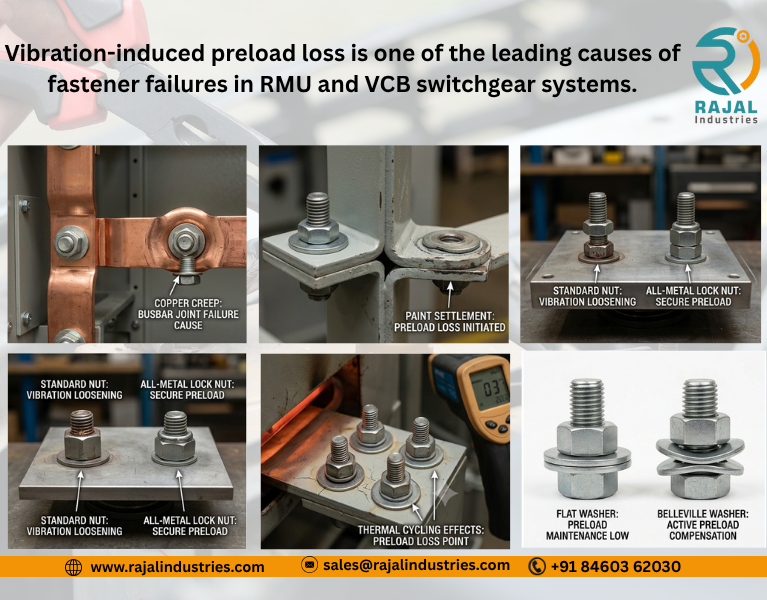
Introduction – The Bolt Was Still Tight, But the Joint Was Already Failing
A switchgear manufacturer received a warranty complaint from a utility customer.
The equipment involved:
- Ring Main Unit (RMU)
- Vacuum Circuit Breaker (VCB)
- Busbar Assemblies
- Current Transformers
- Cable Compartments
The customer reported:
- Abnormal vibration noise
- Loose structural panels
- Busbar heating
- Increased maintenance requirements
Inspection revealed something unusual.
The bolts were still present.
The nuts had not fallen off.
The hardware appeared intact.
Yet several joints had lost significant clamping force.
Engineers measured the remaining preload and discovered that some joints had lost more than:
40% of their original clamp force
The failure wasn’t caused by a broken bolt.
The failure was caused by preload loss.
This is one of the most common and least understood problems in:
- RMU Manufacturing
- VCB Manufacturing
- ACB Assemblies
- HT Panels
- LT Panels
- PCC Panels
- MCC Panels
- Switchgear OEM Production
Quick Answer
Why do RMU and VCB bolts lose preload?
Bolts lose preload because of vibration, thermal expansion, embedment relaxation, surface settlement, washer deformation, copper creep, improper torque, and incorrect locking methods.
What Is Bolt Preload?
Many people think a bolt’s job is simply to hold two parts together.
That is only partially true.
The real purpose of tightening a bolt is to create:
Clamp Force
also called:
Preload
When a bolt is tightened:
- The bolt stretches slightly
- The joint compresses
- Parts are clamped together
This stored tension keeps the assembly secure.
Without preload:
- Movement begins
- Vibration increases
- Wear develops
- Failures start
Why Vibration Is a Serious Problem in Switchgear
Although switchgear appears stationary, vibration exists everywhere.
Sources include:
Circuit Breaker Operations
VCBs generate mechanical shock during opening and closing.
Transformer Vibrations
Transformers continuously transmit vibration through structures.
Cooling Fans
Fan assemblies create continuous low-level vibration.
Transportation
RMUs and VCB panels often travel hundreds of kilometers before installation.
Seismic Activity
In some regions, even minor seismic events contribute to preload loss.
Common Fasteners Used in RMU and VCB Assemblies
Switchgear manufacturers commonly use:
Structural Bolts
- M6 Hex Bolts
- M8 Hex Bolts
- M10 Hex Bolts
- M12 Hex Bolts
- Flange Bolts
High Strength Fasteners
Locking Hardware
- Lock Nuts
- Nylock Nuts
- Prevailing Torque Nuts
- All-Metal Lock Nuts
Washers
- Flat Washers
- Spring Washers
- Belleville Washers
- Nord-Lock Washers
These are among the most common switchgear vibration fasteners used globally.
Failure #1 – Embedment Relaxation
This is often called:
Joint Settlement
Every surface contains microscopic irregularities.
After tightening:
- Paint compresses
- Coatings settle
- Surface roughness flattens
The result:
Loss of preload
This process often occurs within the first few days after assembly.
Failure #2 – Thermal Expansion
Switchgear equipment continuously heats and cools.
Examples:
- Busbars carrying load
- Circuit breakers operating
- Ambient temperature changes
This creates:
Expansion
↓
Contraction
↓
Expansion
↓
Contraction
Over thousands of cycles:
Preload gradually decreases.
Failure #3 – Copper Creep in Busbar Joints
Copper busbars are softer than steel bolts.
Under load:
Copper slowly deforms.
This phenomenon is called:
Copper Creep
As the copper compresses:
- Joint thickness changes
- Clamp force decreases
- Resistance increases
This is a common cause of busbar joint failures in RMUs and VCBs.
Failure #4 – Improper Torque
Many assembly teams rely on experience rather than measurement.
Common mistakes include:
Under-Tightening
Results:
- Insufficient preload
- Early loosening
Over-Tightening
Results:
- Thread damage
- Washer deformation
- Reduced fastener life
Both conditions reduce reliability.
Failure #5 – Standard Nuts Instead of Lock Nuts
One of the most common procurement mistakes.
Standard hex nuts provide little resistance to vibration-induced rotation.
Under vibration:
The nut gradually rotates.
Clamp force reduces.
Eventually:
The joint loosens.
Why Lock Nuts Are Becoming Standard
Modern switchgear manufacturers increasingly use:
Nylock Nuts
Advantages:
✔ Good vibration resistance
✔ Easy installation
✔ Cost effective
All-Metal Lock Nuts
Advantages:
✔ High temperature capability
✔ Long service life
✔ Suitable for switchgear environments
Prevailing Torque Nuts
Advantages:
✔ Excellent preload retention
✔ Strong vibration resistance
✔ Widely used by OEMs
Standard Nut vs Lock Nut
| Parameter | Standard Nut | Lock Nut |
| Vibration Resistance | Low | High |
| Preload Retention | Medium | High |
| Maintenance Frequency | Higher | Lower |
| RMU Applications | Limited | Preferred |
| VCB Applications | Limited | Preferred |
Failure #6 – Washer Selection Problems
Many OEMs still rely solely on:
Flat Washers
Flat washers distribute load but do not actively maintain preload.
Modern switchgear designs increasingly use:
Belleville Washers
because they act like springs.
They compensate for:
- Thermal Expansion
- Surface Settlement
- Copper Creep
Belleville Washer vs Spring Washer
| Parameter | Spring Washer | Belleville Washer |
| Preload Retention | Medium | High |
| Thermal Compensation | Medium | Excellent |
| Switchgear Usage | Common | Growing |
| Busbar Applications | Good | Excellent |
Failure #7 – Wrong Bolt Grade Selection
Some engineers attempt to solve preload loss by simply using stronger bolts.
Example:
Switching from:
Grade 8.8 Bolt
to
Grade 10.9 Bolt
This may increase preload capacity.
However:
A stronger bolt does not automatically prevent preload loss.
If the joint design is poor:
Even Grade 10.9 bolts will loosen.
Real VCB Manufacturing Example
A VCB manufacturer experienced repeated busbar joint maintenance issues.
Original Hardware:
- M10 Grade 8.8 Bolt
- Flat Washer
- Standard Hex Nut
Observed Problems:
- Preload Loss
- Heating
- Vibration Noise
Updated Design:
- M10 Grade 8.8 Bolt
- Belleville Washer
- Prevailing Torque Lock Nut
Results:
✔ Improved preload retention
✔ Reduced maintenance
✔ Lower busbar temperatures
✔ Better vibration performance
No change in bolt grade was required.
Why Preload Loss Causes Heating
A busbar connection relies on pressure.
As preload decreases:
Contact area decreases.
Resistance increases.
Heat increases.
The process follows:
Stage 1
Preload Loss
↓
Stage 2
Micro Movement
↓
Stage 3
Increased Resistance
↓
Stage 4
Heating
↓
Stage 5
Oxidation
↓
Stage 6
Further Resistance Increase
↓
Stage 7
Joint Failure
This is why many electrical failures actually begin as mechanical failures.
Fasteners Most Commonly Used in Vibration-Critical Switchgear Applications
Large switchgear manufacturers frequently purchase:
Structural Fasteners
- M6 Bolts
- M8 Bolts
- M10 Bolts
- M12 Bolts
- Flange Bolts
- Grade 8.8 Bolts
- Grade 10.9 Bolts
Locking Hardware
- Nylock Nuts
- Prevailing Torque Nuts
- All-Metal Lock Nuts
- Lock Nuts
Washers
- Belleville Washers
- Spring Washers
- Nord-Lock Washers
- Structural Washers
Busbar Hardware
- Busbar Bolts
- Copper Bolts
- Brass Bolts
- Grounding Hardware
These are among the highest-volume switchgear vibration fasteners used by OEMs.
Industries Most Affected
Preload loss commonly impacts:
- RMU Manufacturers
- VCB Manufacturers
- ACB Manufacturers
- Switchgear Manufacturers
- HT Panel Manufacturers
- LT Panel Manufacturers
- PCC Panel Manufacturers
- MCC Panel Manufacturers
- Control Panel Manufacturers
- Electrical EPC Companies
Inspection Checklist
Before switchgear dispatch:
✔ Verify torque values
✔ Confirm lock nut usage
✔ Review washer selection
✔ Check bolt grade
✔ Inspect busbar joints
✔ Evaluate thermal expansion effects
✔ Verify preload calculations
✔ Perform vibration testing
✔ Review maintenance requirements
Key Takeaways
- Preload loss is one of the leading causes of switchgear fastener failures.
- Vibration does not need to remove a bolt to create a failure.
- Copper creep and thermal expansion gradually reduce clamp force.
- Lock nuts significantly improve preload retention.
- Belleville washers help compensate for settlement and expansion.
- Heating problems often begin with mechanical preload loss.
- Proper joint design is more important than simply using stronger bolts.
FAQ
What is bolt preload?
Bolt preload is the clamping force created when a fastener is tightened. It keeps the joint secure and prevents movement.
Why do RMU bolts loosen over time?
Vibration, thermal expansion, surface settlement, and copper creep gradually reduce preload.
Are lock nuts necessary in switchgear assemblies?
For vibration-prone applications, lock nuts are strongly recommended because they improve preload retention and reduce loosening.
Which bolts are commonly used in RMU and VCB assemblies?
M6, M8, M10, and M12 bolts, along with Grade 8.8 and Grade 10.9 fasteners, are commonly used.
Are Belleville washers better than spring washers?
For preload retention and thermal compensation, Belleville washers often provide superior performance.
Can preload loss cause busbar heating?
Yes. Reduced clamp force increases contact resistance, which leads to localized heating.
Does using Grade 10.9 bolts solve vibration problems?
Not necessarily. Joint design, washer selection, and locking methods are usually more important than bolt strength alone.
Which industries face this issue most often?
RMU manufacturers, VCB manufacturers, switchgear OEMs, HT panel manufacturers, and industrial electrical equipment manufacturers.
Conclusion
Most RMU and VCB failures do not begin with electrical faults.
They begin with preload loss.
A joint that loses clamp force may continue operating for months before showing signs of trouble. By then, heating, oxidation, vibration, and maintenance costs have already started increasing.
For switchgear manufacturers, RMU OEMs, VCB manufacturers, and electrical panel producers, controlling preload retention is one of the most effective ways to improve reliability, reduce warranty claims, and extend equipment life.