

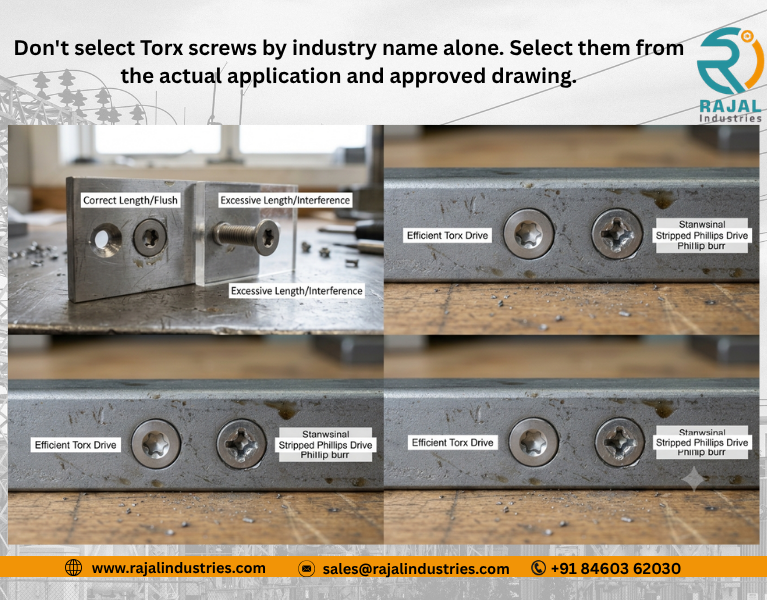
Selecting the correct Torx screw requires more than choosing a diameter and length.
For precision engineering applications, the screw should be selected as part of the complete joint.
A practical selection sequence is:
Application → Mating Parts → Thread → Length → Countersunk Head → Torx Drive → Material → Mechanical Properties → Finish → Assembly → Validation
This approach is useful for:
- Automotive components
- Electronics
- Industrial machinery
- Electrical equipment
- Automation systems
- Instruments
- Appliances
- Equipment enclosures
- Other precision OEM assemblies
A screw that looks correct can still fail in production if its thread, countersunk geometry, drive or coating does not match the actual assembly.
Quick Answer: How Do You Select a Countersunk Torx Screw?
To select a countersunk Torx screw, define these eight basic requirements:
- Thread diameter and pitch
- Required screw length
- Countersunk head geometry
- Torx drive size
- Material
- Mechanical properties
- Surface finish
- Assembly and inspection requirements
For custom OEM fasteners, use the approved engineering drawing as the main technical reference.
Do not select the screw only from a photograph, product name or approximate sample.
Step 1: Understand the Application First
Before choosing the screw, understand what the fastener actually needs to do.
Ask:
- Which components are being joined?
- What materials are the components?
- Is the joint structural or mainly for retention?
- Is the screw visible?
- Does the surface need to remain flush?
- Will the product be used indoors or outdoors?
- Will the screw be removed during servicing?
- Is installation manual or automated?
- What production volume is expected?
These questions determine which characteristics matter most.
Start With the Joint, Not the Screw Catalogue
A common sourcing mistake is:
“We need an M4 Torx screw.”
This starts with a screw description instead of the joint.
A better starting point is:
“We need to fasten a 2 mm housing to a tapped component. The external surface must remain flush, internal clearance is limited and the screw will be installed using a controlled electric driver.”
Now the engineer can select the screw around the real application.
Step 2: Identify the Mating Materials
The materials being joined strongly influence fastener selection.
Common mating materials can include:
- Carbon steel
- Stainless steel
- Aluminium
- Plastic
- Castings
- Sheet metal
- Threaded inserts
- Nuts
The same precision screw may behave differently in different mating materials.
Why Mating Material Matters
Mating material can affect:
- Thread engagement
- Installation torque
- Risk of thread stripping
- Countersink design
- Galvanic compatibility
- Required screw length
- Joint strength
For example, a tapped steel component and a threaded insert in plastic should not automatically use the same joint assumptions.
Step 3: Decide Whether a Countersunk Head Is Actually Needed
Countersunk heads are useful where the installed screw should sit flush or nearly flush with the surface.
Potential reasons include:
- Limited external clearance
- Moving components near the surface
- Appearance
- Smooth product surface
- Cover installation
- Compact assembly
However, a countersunk head is not automatically the best head style for every application.
When a Countersunk Screw May Not Be Suitable
Reconsider a countersunk head when:
- Sheet material is too thin
- A larger bearing area is required
- Countersinking would weaken the component
- Flushness is unnecessary
- Component geometry cannot support the countersink
In these cases, another head style may be more suitable.
The head style should follow the joint requirement rather than appearance alone.
Step 4: Select the Thread Diameter
Thread diameter should be selected based on:
- Joint requirement
- Mating component
- Available space
- Existing thread
- Required mechanical performance
- Applicable standard
Common small metric precision screws may include sizes such as:
- M2
- M2.5
- M3
- M4
- M5
- M6
Larger sizes are also possible depending on the product.
These sizes are examples, not a recommendation for a specific application.
Do Not Oversize the Screw Without Reason
A larger screw can increase:
- Head size
- Required countersink
- Component material removal
- Product weight
- Space requirement
For compact electronics or precision equipment, unnecessary oversizing can create new design problems.
Select the size required by the engineering design.
Do Not Undersize the Screw
A screw that is too small may not provide the required:
- Thread engagement
- Mechanical capacity
- Head geometry
- Drive capacity
- Joint performance
The correct size should be based on the actual design requirement.
Step 5: Select the Correct Thread Pitch
After selecting nominal diameter, confirm the pitch.
For example, writing:
M4
does not always provide every thread detail required for controlled manufacturing.
A complete thread callout may include:
Nominal Diameter + Pitch + Tolerance
where applicable.
The screw pitch must match the mating thread.
What Happens If Thread Pitch Is Wrong?
A wrong pitch can cause:
- Screw not entering
- Cross-threading
- Thread damage
- High installation torque
- Mating-component damage
- Assembly rejection
Never force a screw into a mating thread when the pitch is uncertain.
Coarse vs Fine Thread
Some metric thread diameters are available in more than one pitch.
Coarse Thread
Often used as the common standard pitch for general applications.
Fine Thread
May be used where the product design specifically requires it.
Neither should be selected simply because one sounds stronger or more precise.
Follow the engineering specification.
Step 6: Determine Required Thread Engagement
Thread engagement is the portion of thread actually engaged with the mating component.
It can depend on:
- Screw diameter
- Mating material
- Thread design
- Available depth
- Joint load
- Engineering requirements
Insufficient engagement can reduce joint capability.
Excessive screw length can create bottoming or interference.
Thread Engagement in a Tapped Hole
For a tapped component, check:
Available Thread Depth vs Required Screw Engagement
The selected screw should engage sufficiently without bottoming.
Do not confuse:
Hole Depth
with
Usable Thread Depth
They may not be identical.
Thread Engagement With a Nut
For a screw-and-nut assembly, consider:
- Nut thickness
- Thread engagement
- Required protrusion
- Washer arrangement
- Available clearance
The joint drawing should define the intended assembly.
Thread Engagement With an Insert
Threaded inserts are common in:
- Plastic housings
- Electronics
- Appliances
- Composite components
Check:
- Insert thread
- Insert depth
- Screw length
- Countersunk seating
- Installation torque
The screw should ideally be functionally tested with the actual insert.
Step 7: Select the Screw Length
For a countersunk screw, length selection requires special attention.
For many standard countersunk designs, nominal length includes the head.
This differs from many projecting-head screws where length is generally measured from below the head.
Always verify the measurement convention from the applicable standard or drawing.
Screw Length Selection Formula
A basic conceptual approach is:
Required Screw Length = Material Stack + Required Thread Engagement
But the actual calculation can require adjustments for:
- Countersunk geometry
- Washers
- Gaps
- Inserts
- Tapped-hole depth
- Internal clearance
For precision applications, use the actual assembly drawing rather than relying only on a simple formula.
What Happens If the Screw Is Too Short?
A short screw can create:
- Low thread engagement
- Poor clamping
- Weak joint
- Inconsistent assembly
- Fastener pull-out in some mating materials
The correct minimum engagement depends on the joint.
What Happens If the Screw Is Too Long?
An excessively long screw can:
- Bottom in a blind hole
- Contact internal electronics
- Interfere with moving parts
- Damage nearby components
- Give false torque readings during assembly
Compact OEM products can have very little internal clearance.
Step 8: Select the Countersunk Head Geometry
The countersunk head must fit the mating countersink.
Important dimensions include:
- Head diameter
- Head height
- Head angle
- Bearing geometry
- Head-to-shank transition
The screw and component should be considered together.
Why Head Diameter Matters
Head diameter affects:
- Countersink diameter
- Flushness
- Bearing area
- Available component material
- Appearance
A head that is too large may sit above the surface.
A head that is too small may sit deeper than intended.
Why Countersunk Head Angle Matters
The screw-head angle should match the component countersink.
If the angles do not match, contact can occur only in a limited area.
Possible problems include:
- Proud head
- Excessively deep seating
- Poor contact
- Localized loading
- Cosmetic rejection
For OEM fasteners, use the exact head angle defined by the standard or drawing.
Do All Countersunk Screws Have the Same Angle?
No.
Countersunk geometry can differ depending on:
- Screw standard
- Product family
- Industry
- Customer drawing
Never assume that every countersunk screw uses the same head angle.
Selecting Countersunk Screws for Thin Sheet
Thin sheet needs special attention.
Check:
Sheet Thickness → Countersink Depth → Remaining Material
If the countersink removes too much material, the component may not support the intended screw geometry.
Possible alternatives can include:
- Formed countersink
- Different head design
- Different component thickness
- Different fastening method
Any design change should be approved by the product engineer.
Selecting Countersunk Screws for Machined Components
Machined components often provide better control over countersink geometry.
Still verify:
- Countersink diameter
- Countersink angle
- Depth
- Surface condition
- Thread location
The screw should be tested in the actual component during sample approval.
Step 9: Select the Correct Torx Drive
The Torx drive should be selected from:
- Applicable fastener standard
- Approved drawing
- Head geometry
- Assembly requirement
Do not select the drive size only from the thread diameter.
Two screws with the same nominal thread can use different drives depending on their design.
Torx Drive Size vs Screw Size
These are different specifications.
Screw Size
Defines characteristics such as:
Thread Diameter + Pitch + Length
Torx Drive Size
Defines the matching internal-drive system and tool.
A purchase order should clearly identify both when required.
Why Torx Drive Selection Matters
The drive influences:
- Tool engagement
- Torque transfer
- Assembly speed
- Driver access
- Head geometry
For small industrial Torx screws, the recess must also leave sufficient material within the head.
Larger Torx Drive vs Smaller Torx Drive
A larger drive is not automatically better.
It needs sufficient head material and must fit within the specified head geometry.
A smaller drive is not automatically better either.
It must still support the required assembly conditions.
The correct drive is the one validated for the screw design.
Standard Torx vs Torx Plus
Torx and Torx Plus are different drive systems.
They should not be treated as automatically interchangeable.
When sourcing a replacement screw, verify:
- Drive system
- Drive size
- Approved bit
- Drawing
This is particularly important when localizing an imported fastener.
Standard Torx vs Security Torx
A normal Torx drive and a security-style Torx drive are also different.
Security designs may include additional features that require a matching tool.
Therefore:
Standard Torx ≠ Security Torx
Specify the exact drive required.
Step 10: Select Screw Material
Material should be selected from:
- Mechanical requirement
- Corrosion environment
- Temperature
- Mating materials
- Manufacturing requirements
- Customer specification
Possible material categories include:
- Carbon steel
- Alloy steel
- Stainless steel
- Customer-specified special material
The drive style itself does not determine the material.
Carbon Steel Torx Screws
Carbon steel may be suitable for many:
- Automotive
- Appliance
- Machinery
- Electrical
- General industrial applications
Depending on the specification, carbon steel screws may require:
- Heat treatment
- Zinc plating
- Other engineered coatings
The required properties should be specified.
Alloy Steel Torx Screws
Alloy steel may be considered where controlled or higher mechanical properties are needed.
Potential applications include:
- Industrial equipment
- Machinery
- Automotive components
- Higher-load assemblies
The exact grade and heat treatment should come from the engineering requirement.
Stainless Steel Torx Screws
Stainless steel can be selected where corrosion resistance, appearance or environmental compatibility is important.
Common commercial requirements can include:
- SS304 / A2-type
- SS316 / A4-type
The exact material grade should be stated in the RFQ and drawing.
SS304 vs SS316 Selection
| Factor | SS304 / A2-Type | SS316 / A4-Type |
| General Corrosion Resistance | Good | Generally higher in certain environments |
| Chloride Exposure | More limited | Generally improved |
| Cost | Usually lower | Usually higher |
| Indoor Industrial Use | Common | Application dependent |
| Coastal / Aggressive Environment | Needs evaluation | Often considered |
Do not automatically select SS316 for every outdoor application. Evaluate the actual environment and engineering requirement.
Step 11: Define Required Mechanical Properties
Material name alone may not fully define screw performance.
Depending on the product, the specification may also need:
- Strength class
- Hardness
- Tensile-related properties
- Torsional performance
- Heat-treatment condition
The applicable fastener standard or customer drawing should define the required properties.
Why Maximum Hardness Is Not the Goal
Higher hardness is not always better.
Excessive hardness can reduce toughness and may contribute to brittle failure under some conditions.
The target should be:
Correct Mechanical Properties
not:
Highest Possible Hardness
Step 12: Select the Surface Finish
Surface finish should be chosen based on:
- Corrosion requirement
- Appearance
- Friction
- Assembly
- Environment
- Customer specification
Potential options can include:
- Zinc plating
- Black finishes
- Engineered coatings
- Passivation for suitable stainless steel
- Customer-specific finishes
Finish Is More Than Colour
A request such as:
Black Torx Screw
does not fully define the finish.
The buyer may need to specify:
- Finish type
- Appearance
- Coating thickness
- Corrosion performance
- Friction requirement
Two black screws can have very different technical performance.
Why Coating Thickness Matters
On small precision screws, coating thickness can affect:
- Thread fit
- Torx recess
- Recess depth
- Head dimensions
A screw may be dimensionally acceptable before coating but problematic after coating if the process is not controlled.
Final inspection should therefore consider the finished condition.
Step 13: Consider Corrosion Environment
Ask where the product will operate.
Indoor Dry Environment
Basic corrosion protection may be sufficient depending on the product.
Humid Environment
Improved corrosion protection may be required.
Outdoor Environment
Material and coating should account for weather exposure.
Coastal / Chloride Environment
Additional material and corrosion evaluation may be necessary.
Do not select corrosion protection from industry name alone.
Step 14: Consider Assembly Method
How will the screw be installed?
Manual Assembly
Check:
- Driver access
- Correct bit
- Operator consistency
- Torque control where required
Powered Assembly
Check:
- Driver compatibility
- Installation setting
- Bit wear
- Screw consistency
Automated Assembly
Also check:
- Feeding
- Orientation
- Pickup
- Drive engagement
- Thread starting
- Seating consistency
The fastener should be tested using the intended production process.
Step 15: Determine Installation Requirements
Installation settings depend on the complete joint.
Factors can include:
- Screw material
- Thread size
- Coating
- Lubrication
- Mating material
- Thread engagement
- Required clamp load
Do not use a generic torque value based only on screw diameter.
The OEM should validate the installation requirement on the actual assembly.
Why Torque Tables Can Be Misused
A generic torque chart may assume conditions different from the actual product.
For example:
- Different coating
- Different lubrication
- Different mating material
- Different property class
- Different joint geometry
Therefore, generic values can be useful as engineering references, but they should not automatically become production settings.
Step 16: Check Driver Access
Even a technically correct screw can be difficult to assemble if the driver cannot reach it correctly.
Check:
- Available tool angle
- Nearby walls
- Component depth
- Bit length
- Driver diameter
- Assembly sequence
The driver should ideally approach the screw in correct alignment.
Misaligned Torx Driver
Driver misalignment can contribute to:
- Poor recess engagement
- Recess damage
- Bit wear
- Inconsistent tightening
- Assembly rejection
This can be mistaken for a screw-quality problem.
Always inspect both the screw and assembly tooling.
Step 17: Define Critical Dimensions
Not every dimension has the same functional importance.
For a countersunk Torx screw, critical characteristics may include:
- Thread
- Length
- Head diameter
- Head height
- Countersunk angle
- Torx recess
- Recess depth
The drawing should clearly identify any customer-designated critical characteristics.
Step 18: Define Tolerances
Avoid requesting unnecessarily tight tolerances.
Tighter tolerances can increase:
- Manufacturing difficulty
- Tooling requirements
- Inspection effort
- Rejection risk
- Cost
Use tolerances that are technically required for the application.
At the same time, do not leave functionally important dimensions uncontrolled.
Step 19: Define Inspection Requirements
Depending on the application, inspection may include:
| Characteristic | Possible Inspection |
| Thread | Gauge / dimensional check |
| Length | Dimensional measurement |
| Head Diameter | Dimensional measurement |
| Head Height | Dimensional measurement |
| Head Angle | Suitable inspection method |
| Torx Recess | Dimensional / functional inspection |
| Bit Fit | Functional test |
| Material | Certificate / verification |
| Hardness | Testing where specified |
| Coating | Thickness / performance as specified |
| Appearance | Visual inspection |
The final inspection plan should follow the drawing and customer requirements.
Step 20: Test the Screw in the Actual Assembly
Dimensional inspection alone may not reveal every assembly problem.
A practical functional trial can check:
- Screw starts correctly
- Thread engages smoothly
- Head seats correctly
- Bit fits properly
- Screw reaches the required position
- No internal interference occurs
- Assembly tool works correctly
For custom OEM fasteners, functional validation is especially valuable before bulk production.
Precision Screw Sample Approval Process
A practical process is:
Drawing Review → Supplier Feasibility → Tooling → Sample Manufacturing → Dimensional Inspection → Material/Finish Check → Assembly Trial → Approval
For larger production programs:
Approved Samples → Pilot Lot → Production Validation → Mass Production
The exact process should follow the customer’s quality system.
What Should Be Checked on Samples?
☐ Part number
☐ Drawing revision
☐ Thread diameter
☐ Pitch
☐ Length
☐ Head diameter
☐ Head height
☐ Head angle
☐ Torx drive
☐ Recess depth
☐ Bit engagement
☐ Material
☐ Mechanical properties
☐ Surface finish
☐ Thread fit
☐ Head seating
☐ Assembly behaviour
☐ Appearance
Selecting Torx Screws for High-Volume Production
For high-volume applications, selection should also consider manufacturing consistency.
A screw that works during a 20-piece sample trial still needs to remain consistent across:
- 10,000 pcs
- 100,000 pcs
- 1 million pcs
Important controls can include:
- Tooling condition
- Process control
- Inspection frequency
- Lot identification
- Coating consistency
- Mixed-part prevention
High-volume sourcing should evaluate the supplier’s process, not only the approved sample.
Industrial Torx Screws for Automatic Assembly
Automatic assembly can make small dimensional variations more important.
Key characteristics can include:
Drive Consistency + Head Geometry + Thread Quality + Burr Control + Finish + Part Feeding
Production trials should use the actual:
- Screwdriver
- Bit
- Feeder
- Mating component
where practical.
Selecting OEM Fasteners for Imported-Part Localization
When replacing an imported screw with a locally manufactured version, use:
Approved Drawing + Reference Sample + Application Information
Do not depend only on sample measurement.
A used or coated sample may not reveal:
- Original tolerances
- Material specification
- Mechanical properties
- Coating specification
- Manufacturing allowances
Reverse engineering should therefore be combined with available technical documentation.
Drawing-Based Selection vs Sample-Based Selection
| Method | Advantage | Limitation |
| Approved Drawing | Defines technical requirement | Must be current |
| Physical Sample | Shows actual product | Does not show all specifications |
| Drawing + Sample | Strongest combination | Requires both |
| Photograph Only | Useful for identification | Not enough for production |
For precision manufacturing, a photograph should never be the sole technical specification.
Standard vs Custom Torx Screw
Standard Screw
Consider a standard screw when:
- Standard dimensions fit
- Standard material is acceptable
- Standard finish works
- No special geometry is required
Custom Screw
Consider a custom screw when you need:
- Special head diameter
- Reduced head height
- Custom countersunk geometry
- Special drive
- Non-standard length
- Special material
- Special finish
- Customer marking
- Tight application-specific tolerances
Custom production should be controlled through a drawing.
When Custom Tooling May Be Required
Custom tooling may be necessary for:
- Non-standard head
- Special recess
- Unique countersunk geometry
- Customer marking
- Special forming requirement
Before paying tooling charges, confirm:
- Drawing approval
- Tool ownership
- Tool life expectations
- Sample process
- Modification policy
- Production MOQ
Cost vs Engineering Requirement
The cheapest screw is not always the lowest-cost solution.
A lower unit price can become expensive if the fastener creates:
- Assembly stoppages
- High rejection
- Rework
- Tool wear
- Field failures
- Supplier replacement
For OEM sourcing, compare:
Technical Compliance + Quality + Supply Reliability + Total Cost
not only price per piece.
How to Build a Complete Torx Screw Specification
A strong specification may look like:
Product Standard / Drawing + Thread Diameter + Pitch + Length + Countersunk Head Geometry + Torx Drive + Material + Mechanical Properties + Finish + Tolerances + Testing + Quantity
This gives the supplier enough information to review feasibility correctly.
Torx Screw Selection Checklist
Before releasing an RFQ, confirm:
- Application
- Mating materials
- Joint type
- Thread diameter
- Pitch
- Thread tolerance
- Required engagement
- Screw length
- Head style
- Head diameter
- Head height
- Countersunk angle
- Torx drive type
- Torx drive size
- Material
- Mechanical properties
- Heat treatment
- Finish
- Coating thickness
- Corrosion requirement
- Assembly method
- Installation requirement
- Critical dimensions
- Tolerances
- Inspection
- Testing
- Documentation
- Sample quantity
- Production quantity
- Annual demand
If these are clear, supplier quotations become much easier to compare.
Example: Selecting a Torx Screw for Electronics
Requirement
An electronics enclosure needs a small flush fastener.
Selection Process
Application: Electronics housing
Mating Part: Threaded metal insert
Head: Countersunk
Thread: As insert specification
Length: Based on stack and insert depth
Drive: Drawing-defined Torx
Material: Environment/OEM specified
Finish: Appearance and corrosion requirement
Assembly: Controlled electric screwdriver
Main Risk
A screw that is too long could bottom inside the insert or interfere with internal components.
Example: Selecting an Industrial Torx Screw
Requirement
A machine cover requires a flush, serviceable fastener.
Selection Process
Application: Industrial machinery
Head: Countersunk
Thread: Matching tapped component
Length: Required engagement without bottoming
Drive: Tool-compatible Torx
Material: Mechanical/environmental requirement
Finish: Industrial corrosion requirement
Assembly: Powered or manual maintenance tool
Main Risk
Selecting only by screw size without checking the countersink can cause poor head seating.
Example: Selecting an Automotive Torx Screw
Requirement
An OEM needs a countersunk fastener for a high-volume automotive component.
Important Requirements
- Approved drawing
- Correct thread
- Controlled head geometry
- Torx drive consistency
- Specified mechanical properties
- OEM-approved coating
- Traceability
- Assembly validation
- Production consistency
Main Risk
A sample can pass while uncontrolled production variation later causes assembly-line problems.
Example: Selecting a Stainless Torx Screw
Do not begin with:
“We want stainless because it is better.”
Instead ask:
- What environment?
- What corrosion exposure?
- What mechanical properties?
- What mating material?
- What finish?
- What cost target?
Then determine whether the specified application requires SS304, SS316 or another approved material.
Why Rajal Industries for Custom Torx Screw Requirements?
Rajal Industries can evaluate suitable standard and drawing-based Torx screw, precision screw, industrial Torx screw and OEM fastener requirements.
Depending on technical feasibility and customer specifications, requirements can be reviewed for:
- Countersunk Torx Screws
- Precision Screws
- Industrial Torx Screws
- OEM Fasteners
- Metric Threads
- Standard Sizes
- Custom Dimensions
- Custom Head Geometry
- Customer-Specified Torx Drives
- Carbon Steel
- Alloy Steel
- Stainless Steel
- Customer-Specified Finishes
- Drawing-Based Manufacturing
- Thread Inspection
- Dimensional Inspection
- Drive Inspection
- Material Verification
- Mechanical Testing as Specified
- Batch Traceability
- Sample Development
- Pilot Production
- Bulk OEM Supply
Final capability should always be confirmed against the customer’s approved drawing, material, tolerances, finish, testing requirements and quantity.
Bulk Buyer Quick Answer
What information should I provide when selecting a Torx screw?
For a precision Torx screw, provide:
Application + Drawing + Thread + Length + Countersunk Head Geometry + Torx Drive + Material + Mechanical Properties + Finish + Tolerances + Testing + Quantity
Also explain how the screw will be assembled and what mating component it will engage.
This allows the manufacturer to review both manufacturability and application requirements rather than quoting from screw size alone.
Practical Torx Screw Selection Decision Tree
For engineers and sourcing teams, the following decision process can simplify Torx screw selection.
1. Does the surface need to be flush?
→ Yes: Evaluate a countersunk head.
→ No: Compare other suitable head styles.
2. What mating thread is available?
→ Tapped hole: Match diameter, pitch and usable depth.
→ Threaded insert: Match insert specification.
→ Nut: Match screw and nut thread.
→ No existing machine thread: Evaluate the appropriate fastening system separately.
3. What is the available space?
→ Check screw length, head diameter, countersink and internal clearance.
4. Which drive is required?
→ Follow the applicable standard or approved OEM drawing.
5. What environment will the screw face?
→ Indoor, humid, outdoor, chemical or other conditions affect material and finish.
6. How will it be installed?
→ Manual, powered or automated assembly.
7. Is it a standard or custom part?
→ Use a standard product where it completely meets the requirement.
→ Use a drawing-controlled custom fastener where special geometry or performance is required.
Torx Screw Selection Matrix
| Requirement | What to Check | Common Risk |
| Thread | Diameter + pitch | Wrong mating fit |
| Length | Stack + engagement | Bottoming / short engagement |
| Head | Diameter + height | Poor seating |
| Countersink | Head angle + component | Head sits proud |
| Torx Drive | Correct system + size | Poor bit fit |
| Material | Application requirement | Wrong properties |
| Finish | Environment + friction | Corrosion / torque change |
| Tolerance | Functional requirement | Excess cost or poor fit |
| Assembly | Tool + mating component | Recess damage |
| Inspection | Critical characteristics | Batch variation |
This table can also be used during supplier technical review.
How to Select Precision Screws by Application
Different industries place different demands on precision screws.
| Application | Selection Priority |
| Automotive | Mechanical properties, coating, consistency, traceability |
| Electronics | Compact size, head geometry, length, finish |
| Industrial Machinery | Mechanical performance, serviceability, environment |
| Automation | Drive consistency, feeding, repeatable installation |
| Electrical Equipment | Geometry, finish, environment |
| Appliances | Cost, appearance, high-volume consistency |
| Instrumentation | Precision, size, surface condition |
| Medical Equipment | Customer-approved material, documentation and application requirements |
The application category is only a starting point. The actual joint should determine the final specification.
Selecting Torx Screws for Automotive Applications
For suitable automotive components, review:
- Approved drawing
- Thread
- Head geometry
- Torx drive
- Mechanical properties
- Surface coating
- Corrosion requirement
- Traceability
- Installation process
- Production volume
High-volume automotive production makes consistency particularly important.
A dimensional variation that seems small during sample inspection can become significant when repeated across large production quantities.
Selecting Torx Screws for Electronics
Electronics often require relatively small OEM fasteners.
Important checks include:
Length + Head Size + Countersink + Drive + Internal Clearance
A screw that is only slightly too long may interfere with:
- PCB-related components
- Internal brackets
- Wiring
- Covers
- Other electronics
Functional assembly trials are therefore valuable.
Selecting Industrial Torx Screws
For industrial Torx screws, consider:
- Joint load
- Vibration environment
- Maintenance
- Tool access
- Mating material
- Corrosion
- Temperature
- Installation process
Do not assume the Torx drive itself provides vibration resistance.
Vibration performance depends on the complete joint and any specified locking method.
Selecting Torx Screws for Automated Assembly
Automated production can place additional requirements on screw consistency.
The fastener may need to work through:
Feeding → Orientation → Pickup → Drive Engagement → Thread Start → Tightening → Final Seating
Potential characteristics to control include:
- Head geometry
- Torx recess
- Screw straightness
- Thread quality
- Burrs
- Surface finish
A production trial with the actual equipment is highly useful before mass production.
Selecting Torx Screws for Repeated Maintenance
Some equipment is regularly opened for:
- Inspection
- Repair
- Calibration
- Cleaning
- Component replacement
For these applications, consider:
- Tool availability
- Recess durability
- Thread durability
- Mating-thread material
- Corrosion
- Replacement availability
Serviceability should be considered during initial design rather than after production begins.
Material Selection Decision
A simple material-selection process is:
Does the application have a defined material specification?
Yes: Follow it.
No: Evaluate the environment and mechanical requirement.
Is corrosion a major concern?
Yes: Compare suitable stainless steel or engineered coating systems.
Are controlled mechanical properties important?
Yes: Evaluate the appropriate carbon/alloy steel grade or specified stainless grade.
Is appearance important?
Yes: Include surface-finish requirements.
Material should never be selected from cost alone.
Carbon Steel vs Stainless Steel Selection
| Factor | Carbon Steel | Stainless Steel |
| Cost | Often lower | Often higher |
| Strength Options | Broad | Grade dependent |
| Corrosion Protection | Usually coating dependent | Material contributes resistance |
| Coating Choices | Broad | Application dependent |
| General OEM Use | Very common | Common where required |
| Appearance | Finish dependent | Often suitable |
| Selection Basis | Properties + finish | Grade + environment |
The actual grade matters more than the generic material category.
When Should You Consider SS304?
SS304 may be considered for suitable applications requiring general corrosion resistance.
Potential examples include:
- Indoor equipment
- Electronics
- Instrumentation
- Appliances
- General industrial products
But the application specification should determine whether SS304 is acceptable.
When Should You Consider SS316?
SS316 may be considered where improved resistance to certain corrosive or chloride-containing environments is required.
Possible applications can include:
- Some coastal equipment
- Certain process environments
- Selected laboratory equipment
- Customer-specified applications
SS316 should not be selected simply because it is perceived as “better.”
Material Compatibility With Mating Components
Fastener material should also be reviewed against the mating component.
When dissimilar metals are combined in certain environments, galvanic-corrosion considerations may become relevant.
The complete assembly should therefore be evaluated rather than selecting the screw material independently.
How to Select the Surface Finish
Ask four questions:
1. What corrosion protection is required?
2. Is appearance important?
3. Does coating friction affect installation?
4. Is coating thickness critical to thread or drive fit?
Possible finish categories can include:
- Zinc plating
- Black finishes
- Engineered coatings
- Stainless passivation
- Customer-specified finishes
Corrosion Requirement Should Be Measurable
Instead of writing:
Good corrosion resistance required.
Use the applicable customer or industry specification and define the required test/performance where appropriate.
This makes supplier quotations easier to compare.
Why Finish Can Change Installation Behaviour
Surface finish affects friction.
Friction affects the relationship between:
Applied Torque → Thread Friction → Head Friction → Clamp Load
Therefore, changing the coating after approval can change assembly behaviour even if the screw dimensions remain identical.
For controlled joints, coating changes should be reviewed before implementation.
Coating Build-Up on Small Precision Screws
Small screws have limited dimensional space.
Excess coating can affect:
- Thread fit
- Torx recess
- Recess depth
- Head geometry
A suitable post-finish inspection plan is therefore important.
How to Select Torx Drive Size
The safest approach is:
Standard / Drawing → Required Drive → Matching Tool
Do not use:
Thread Diameter → Guess Drive Size
The drive should be defined by the applicable screw specification.
Torx Drive Selection for High-Volume Assembly
For high-volume production, verify:
- Correct bit engagement
- Recess consistency
- Recess depth
- Drive centering
- Burr control
- Coating buildup
- Tool wear
If thousands of screws are installed daily, small drive variations can create significant downtime.
Torx Recess Too Shallow
A shallow recess can result in:
- Incomplete bit engagement
- Bit slipping
- Recess damage
- Installation rejection
Check the recess against the drawing before increasing assembly torque.
Torx Recess Too Deep
An excessively deep recess can potentially affect:
- Head material thickness
- Head strength
- Driver engagement
- Drawing compliance
Recess depth should remain within the specified limits.
Off-Center Torx Drive
An off-center drive can create:
- Driver wobble
- Poor engagement
- Uneven loading
- Cosmetic rejection
- Automated assembly issues
Drive position is therefore important for precision screws.
Head Selection Troubleshooting
Problem: Head Sits Above the Surface
Check:
- Head diameter
- Head angle
- Countersink angle
- Countersink depth
- Burrs
Do not immediately increase installation torque.
Problem: Head Sits Too Deep
Check:
- Head diameter
- Head height
- Component countersink
- Countersink depth
- Component variation
The problem may be in the component rather than the screw.
Problem: Head Cracks During Installation
Potential causes can include:
- Excessive installation torque
- Mechanical-property issue
- Excessive recess depth
- Head geometry
- Misalignment
- Material/process issue
Inspect the failed part before changing the specification.
Thread Selection Troubleshooting
Screw Will Not Enter
Possible causes:
- Wrong diameter
- Wrong pitch
- Damaged thread
- Mating-thread problem
- Coating buildup
Screw Starts but Jams
Check:
- Thread dimensions
- Coating
- Mating hole
- Alignment
- Burrs
Screw Turns but Does Not Clamp
Possible causes:
- Stripped mating thread
- Incorrect screw length
- Damaged thread
- Screw bottoming before clamping
Why Bottoming Can Be Misdiagnosed
Consider a blind tapped hole.
The screw reaches the bottom and the driver records increased torque.
It may appear that the joint is tightened correctly.
But the screw head may not actually generate the intended clamp condition.
This is why screw length and usable hole depth must be checked.
Installation Troubleshooting Matrix
| Problem | Check First | Then Check |
| Bit Slips | Bit + recess | Tool alignment |
| High Torque | Thread + coating | Mating component |
| Low Torque | Thread condition | Tool setting |
| Head Proud | Countersink | Head geometry |
| Screw Jams | Pitch | Coating / mating thread |
| Screw Breaks | Torque | Material / joint |
| Head Cracks | Torque + geometry | Material |
| Early Corrosion | Finish | Environment |
| Feeder Jam | Screw geometry | Feeder setup |
This helps avoid automatically treating every assembly problem as a manufacturing defect.
Manual vs Powered vs Automated Installation
| Factor | Manual | Powered | Automated |
| Driver Fit | Important | Critical | Critical |
| Screw Consistency | Important | Very Important | Very Important |
| Tool Alignment | Operator | Tool controlled | System controlled |
| Feeding | Manual | Usually manual/semi | Automated |
| Torque Control | Varies | Common | Common |
| Production Speed | Lower | Higher | Highest |
| Validation Need | Application based | Important | Highly important |
The more automated the process becomes, the more valuable consistent fastener geometry becomes.
How to Validate Installation Settings
A practical validation process can include:
Approved Screw + Actual Component + Production Tool → Installation Trials → Joint Evaluation → Approved Setting
The exact validation method depends on the OEM and joint requirements.
Avoid setting production torque from a generic internet table alone.
Common Buyer Mistakes When Selecting Torx Screws
1. Ordering Only by M-Size
“M4 Torx” is incomplete.
2. Ignoring Pitch
The mating thread must match.
3. Assuming All Countersunk Heads Are the Same
They are not.
4. Guessing Torx Drive Size
Use the standard or drawing.
5. Selecting Material Only by Price
Environment and mechanical properties matter.
6. Selecting Finish Only by Colour
Colour does not define performance.
7. Copying Generic Torque Values
Actual joint conditions matter.
8. Approving Samples Without Assembly Testing
Dimensional compliance does not guarantee application fit.
9. Comparing Quotations With Different Specifications
First establish technical equivalence.
10. Ignoring Production Capability
A supplier capable of 100 samples may not necessarily support millions of consistent parts.
How to Compare Supplier Quotations Correctly
Before comparing price, normalize:
- Drawing revision
- Material
- Mechanical properties
- Finish
- Coating requirement
- Tolerances
- Inspection
- Testing
- Documentation
- Packaging
- Quantity
Then compare:
Price + Tooling + MOQ + Lead Time + Capacity + Quality + Supply Reliability
Otherwise, the lowest quotation may simply be quoting a different product.
MOQ vs Unit Price
Custom OEM fasteners may require dedicated tooling and setup.
This means price can change significantly with quantity.
For example, the economics of:
5,000 pcs
can be very different from:
500,000 pcs
because tooling, setup, inspection and production efficiency are distributed across different quantities.
Buyers should provide realistic annual demand when requesting quotations.
Prototype Quantity vs Production Quantity
For new custom screws, separate:
Sample Quantity
from:
Mass-Production Quantity
A supplier may use a different method for prototype development than final production.
Ask how production samples will represent the final manufacturing process.
Tooling Questions to Ask
For custom industrial Torx screws, ask:
- Is new tooling required?
- What is the tooling charge?
- Who owns the tooling?
- What is expected tool life?
- Is maintenance included?
- What happens if the drawing changes?
- Is modification possible?
- Will production use the same approved tooling concept?
These questions help prevent future commercial disputes.
Sample Approval vs Golden Sample
A physical approved sample can be useful as a reference.
However:
Golden Sample ≠ Complete Technical Specification
The approved drawing should remain the main control document.
The sample can support:
- Appearance
- Functional fit
- Assembly reference
but should not replace dimensions, material and tolerances.
Pilot Lot Before Mass Production
For high-volume or technically sensitive OEM fasteners, a pilot lot can help verify:
- Production tooling
- Process stability
- Coating
- Inspection
- Packaging
- Assembly performance
This provides another validation stage between prototypes and full-scale production.
Production Quality Control
Depending on the specification, manufacturing control may include:
Incoming Material → Heading/Forming → Thread Rolling → Heat Treatment → Finishing → Dimensional Inspection → Functional Inspection → Packaging
The exact route depends on the material and fastener design.
Critical Characteristics for Countersunk Torx Screws
Potential critical features can include:
| Feature | Potential Failure |
| Thread | Assembly failure |
| Length | Bottoming / insufficient engagement |
| Head Diameter | Poor countersink fit |
| Head Angle | Incorrect seating |
| Torx Recess | Driver failure |
| Recess Depth | Poor engagement |
| Material | Mechanical / corrosion issue |
| Finish | Corrosion / friction |
| Burrs | Assembly / appearance issue |
The customer should identify which characteristics are critical for their specific application.
Supplier Qualification Checklist
Before approving a manufacturer, evaluate:
- Similar screw experience
- Drawing review capability
- Cold-forming capability
- Torx recess capability
- Countersunk head control
- Thread-rolling capability
- Material capability
- Heat-treatment control where required
- Surface-finish capability
- Dimensional inspection
- Thread gauging
- Drive inspection
- Functional bit-fit testing
- Material documentation
- Mechanical testing
- Traceability
- Custom tooling
- Sample development
- Pilot production
- Mass-production capacity
- Packaging control
- Corrective-action process
Questions to Ask Before Approving a Torx Screw Manufacturer
Technical
- Can you manufacture from our drawing?
- Have you produced similar Torx screws?
- Which thread sizes can you produce?
- Which Torx drives can you form?
- Can you control our head angle?
- Can you control the specified recess depth?
- Which materials can you process?
- Which finishes can you supply?
Quality
- How do you inspect the thread?
- How do you inspect the Torx recess?
- How do you inspect head geometry?
- Can you provide dimensional reports?
- Can you provide material certificates?
- Can you provide batch traceability?
Commercial
- What is MOQ?
- What is tooling cost?
- What is sample lead time?
- What is production lead time?
- What is monthly capacity?
Complete OEM RFQ Checklist
Send:
☐ Part name
☐ Part number
☐ Application
☐ Approved drawing
☐ Drawing revision
☐ Applicable standard
☐ Thread diameter
☐ Pitch
☐ Thread tolerance
☐ Length
☐ Head diameter
☐ Head height
☐ Head angle
☐ Torx drive
☐ Recess depth
☐ Material
☐ Mechanical properties
☐ Heat treatment
☐ Surface finish
☐ Coating thickness, if specified
☐ Corrosion requirement
☐ Critical dimensions
☐ Inspection requirements
☐ Testing requirements
☐ Documentation
☐ Assembly method
☐ Sample quantity
☐ Pilot quantity
☐ First order quantity
☐ Monthly requirement
☐ Annual demand
☐ Packaging
☐ Delivery location
Example RFQ for a Precision Torx Screw
We require countersunk Torx screws for a precision OEM assembly. Please review the attached drawing and confirm manufacturing feasibility for the specified thread, length, countersunk head geometry, Torx recess, material, mechanical properties and finish. Please also confirm tooling requirements, sample lead time, inspection capability, MOQ, monthly capacity and bulk production lead time.
This gives the manufacturer much more useful information than:
Please quote M4 Torx screws.
When Should You Use a Custom Torx Screw?
A custom Torx screw may make sense when a standard product cannot meet:
- Head diameter
- Head height
- Countersink
- Drive
- Length
- Thread
- Material
- Finish
- Tolerance
- Product packaging constraints
However, customization can increase:
- Tooling cost
- MOQ
- Development time
- Validation requirements
Use a standard fastener when it fully meets the engineering requirement.
When Should You Avoid Customization?
Avoid unnecessary customization when a standard screw already satisfies:
- Fit
- Function
- Material
- Corrosion requirement
- Assembly
- Availability
Every unnecessary custom dimension can increase supply-chain complexity.
Frequently Asked Questions About Selecting Torx Screws
How do I choose the correct Torx screw?
Select a Torx screw based on the mating thread, required length, countersunk head geometry, drive size, material, mechanical properties, surface finish and assembly method.
How do I choose Torx screw size?
Start with the joint requirement and mating thread. Determine the required nominal diameter, pitch and length from the engineering design.
How do I select Torx drive size?
Use the drive size specified by the applicable fastener standard or approved OEM drawing. Do not select the drive only from the thread diameter.
How do I select countersunk screw length?
Determine the component stack, countersunk seating, required thread engagement and available internal depth. Follow the applicable standard’s length convention.
Are all countersunk Torx screws the same angle?
No. Head geometry can vary by standard and product design.
Which material is best for Torx screws?
There is no universal best material. Carbon steel, alloy steel and stainless steel can all be suitable depending on mechanical, corrosion and environmental requirements.
Should I use SS304 or SS316?
Select based on the actual corrosion environment and customer specification. SS316 can provide improved resistance in certain chloride-containing environments, but it is not automatically necessary for every application.
Can Torx screws be zinc plated?
Suitable carbon steel Torx screws can use zinc plating or other specified coating systems.
Why does my Torx bit keep slipping?
Check bit size, bit wear, recess geometry, recess depth, tool alignment and installation setting.
Why does my countersunk screw sit above the surface?
Check the screw-head diameter and angle against the mating countersink diameter, depth and angle.
Are Torx screws vibration resistant?
The Torx drive alone does not make a screw vibration resistant. Joint design, preload, mating materials and any approved locking method determine vibration performance.
Can Torx screws be used in automatic assembly?
Yes, suitable screws can be used in automated assembly when the screw, driver, feeder and mating component are validated together.
Should I approve custom screws from dimensions alone?
For precision applications, dimensional inspection should normally be combined with material/finish verification and functional assembly trials.
Can an imported Torx screw be manufactured locally?
Potentially yes. The best starting information is the approved drawing, reference sample, material, finish, testing requirements and expected quantities. Manufacturing feasibility should then be reviewed.
What should I send to an OEM fastener manufacturer?
Send the approved drawing, application, dimensions, material, mechanical requirements, finish, tolerances, testing, quantity and assembly information.
AEO Quick Answers
How do you select a Torx screw?
Select a Torx screw by matching its thread, length, countersunk head geometry, Torx drive, material, mechanical properties and finish to the actual joint. For precision OEM applications, validate samples in the real assembly before mass production.
How do you choose a countersunk Torx screw?
First confirm that a flush head is required. Then match the thread and screw length to the mating component, match the head geometry to the countersink, select the specified Torx drive and define material, finish and installation requirements.
What is most important when selecting precision screws?
For precision screws, the most important factors are functional dimensions, mating-thread compatibility, head and drive geometry, material, finish and consistent assembly performance. The approved drawing should control the final specification.
Can I select Torx drive size from screw diameter?
Not reliably. The same nominal thread diameter can use different Torx drive sizes depending on the head design and applicable standard. Use the drive specified by the drawing or standard.
What causes a countersunk Torx screw to fail during assembly?
Common causes include wrong thread or pitch, countersink mismatch, incorrect screw length, poor Torx engagement, excessive installation torque, coating buildup, material issues or problems with the mating component.
Final Torx Screw Buyer Checklist
Before placing a bulk order, confirm:
Application ✓
Approved Drawing ✓
Drawing Revision ✓
Thread & Pitch ✓
Length ✓
Head Geometry ✓
Countersunk Angle ✓
Torx Drive ✓
Material ✓
Mechanical Properties ✓
Finish ✓
Corrosion Requirement ✓
Assembly Method ✓
Installation Requirement ✓
Critical Dimensions ✓
Inspection ✓
Testing ✓
Samples Approved ✓
Functional Trial Completed ✓
MOQ & Capacity Confirmed ✓
Packaging Approved ✓
Production Lead Time Confirmed ✓
Only after technical equivalence is established should final price become the main comparison.
Key Takeaways
- Select a Torx screw from the joint requirement, not only from the screw catalogue.
- Confirm whether a countersunk head is actually required.
- Thread diameter and pitch must match the mating component.
- Check usable thread depth before selecting screw length.
- Countersunk head geometry must match the component countersink.
- Torx drive size and screw thread size are separate specifications.
- Do not assume all countersunk screws have the same angle.
- Select material based on mechanical and environmental requirements.
- Select finish by performance, not colour alone.
- Coating can change thread fit, drive fit and installation behaviour.
- A Torx drive alone does not provide vibration resistance.
- Generic torque charts should not automatically become production settings.
- Automated assembly should be validated using actual production equipment.
- For imported-part localization, use the approved drawing plus reference sample where available.
- Standard fasteners are preferable when they completely meet the application.
- Custom OEM fasteners should be controlled by an approved drawing.
- Compare suppliers technically before comparing price.
- Samples should be functionally tested before high-volume production.
Conclusion
Selecting the right countersunk Torx screw for precision engineering requires more than finding the correct diameter and length.
A reliable selection process is:
Application → Mating Material → Thread → Engagement → Length → Countersunk Head → Torx Drive → Material → Mechanical Properties → Finish → Assembly → Inspection → Validation
For precision screws, industrial Torx screws and custom OEM fasteners, small dimensional or process differences can affect assembly performance.
The safest approach is to define the requirement through an approved drawing, manufacture samples, inspect critical characteristics and test the fastener in the actual assembly before releasing mass production.
Rajal Industries can evaluate standard and drawing-based countersunk Torx screw requirements based on customer specifications, materials, finishes, tolerances, testing requirements and bulk quantities.