

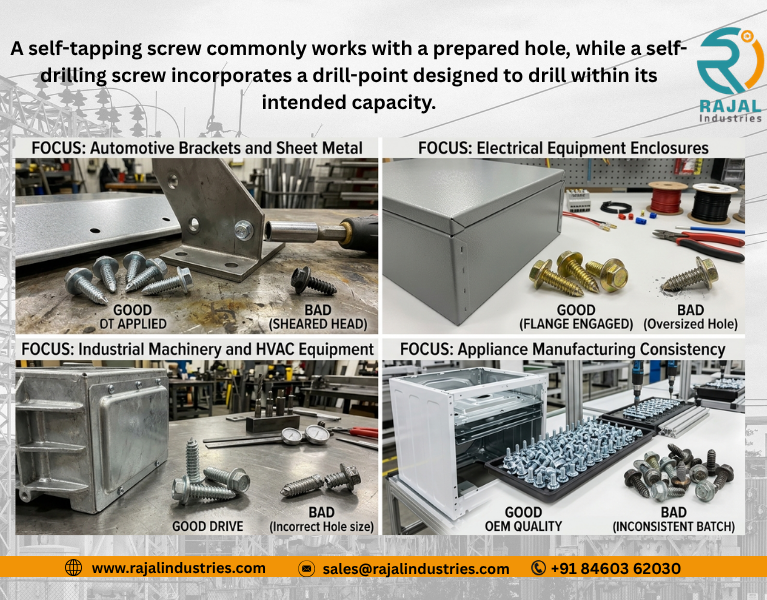
Finding the right Hex Flange Self Tapping Screw Manufacturer is important when an OEM needs consistent thread formation, controlled hex-head geometry, reliable flange dimensions and repeatable bulk supply.
Hex flange self-tapping screws combine three important features:
Hex Drive + Integrated Flange + Self-Tapping Thread
Depending on the screw design and mating material, the thread-forming or thread-cutting feature can create or develop a mating thread during installation without requiring a conventional pre-tapped machine thread.
These screws can be used in suitable:
- Automotive assemblies
- Sheet-metal components
- Electrical equipment
- Industrial machinery
- Appliances
- HVAC equipment
- Equipment enclosures
- Fabricated components
- General OEM assemblies
However, “self-tapping” covers more than one screw and thread design. Buyers should specify the actual thread form, point, material thickness, pilot hole and application requirements rather than sourcing only by product name.
Quick Answer: What Is a Hex Flange Self-Tapping Screw?
A hex flange self-tapping screw is a screw with an external hex drive, an integrated flange under the head and a self-tapping thread designed to form or cut a mating thread in a suitable prepared hole or material.
The flange can provide a wider bearing surface than a conventional small hex head.
Depending on the design, this may reduce the need for a separate washer in applications where the engineering specification permits it.
The screw should still be matched to:
Material → Thickness → Pilot Hole → Thread Type → Installation Requirement
What Does “Hex Flange” Mean?
The head combines:
Hexagonal External Drive
Allows installation using a suitable:
- Socket
- Nut setter
- Wrench
- Powered assembly tool
Integrated Flange
A wider bearing surface is formed as part of the screw head.
This can help distribute contact over a larger area than some non-flanged hex-head designs.
The exact flange diameter and geometry depend on the applicable standard or customer drawing.
What Does “Self-Tapping” Mean?
A self-tapping screw creates or develops its mating thread during installation into a suitable hole or material.
Depending on the design, self-tapping screws may operate by:
- Thread forming
- Thread cutting
- Other application-specific tapping mechanisms
The screw does not automatically eliminate every preparation operation.
Many applications still require a correctly sized:
Pilot Hole / Pre-Punched Hole / Drilled Hole
Self-Tapping vs Self-Drilling Screws
These terms should not be used interchangeably.
| Feature | Self-Tapping Screw | Self-Drilling Screw |
| Main Function | Creates/develops mating thread | Drills and forms thread |
| Prepared Hole | Often required | May not require a separate pilot-hole drilling operation within its designed capacity |
| Point | Application-specific tapping point | Drill-point geometry |
| Typical Selection | Hole + material + thread | Material + drilling capacity + thread |
| Same Product? | No | No |
Hex Flange Self-Tapping Screw Construction
A typical screw can contain:
Hex Head → Integrated Flange → Shank → Self-Tapping Thread → Point
Important manufacturing characteristics can include:
- Across-flats dimension
- Head height
- Flange diameter
- Flange thickness
- Under-head geometry
- Thread diameter
- Thread pitch/form
- Thread length
- Overall length
- Point geometry
- Material
- Hardness/mechanical properties
- Surface finish
The exact requirements should follow the applicable product standard or approved OEM drawing.
Why OEMs Use Hex Flange Self-Tapping Screws
A properly selected design can combine several functions in one fastener:
External Drive + Bearing Surface + Thread Creation
This can be useful in high-volume OEM assembly.
Potential benefits, depending on the joint design, include:
- Fewer separate components
- Convenient powered installation
- Wider integrated bearing surface
- Simplified assembly
- Suitable high-volume production
- Reduced separate washer handling where permitted
These are application-dependent benefits, not universal guarantees.
Why the Integrated Flange Matters
The flange creates a larger under-head contact area.
This can be useful where the joint requires:
- Wider bearing contact
- Better support around the hole
- Controlled seating
- Elimination of a separate washer where approved
However, a flange is not automatically equivalent to every washer arrangement.
A separate washer may still be required where the engineering design specifies one.
Hex Washer Head Screws vs Hex Flange Screws
The terms Hex Washer Head Screws and hex flange screws are sometimes used broadly in commercial sourcing.
However, terminology and geometry can vary between standards, suppliers and industries.
For a controlled OEM purchase, buyers should define:
- Head drawing
- Across-flats dimension
- Head height
- Flange/washer-face diameter
- Flange thickness
- Under-head profile
A product name alone may not fully define the head geometry.
Hex Flange Self-Tapping Screw Manufacturer: What Buyers Should Check
When evaluating a Hex Flange Self Tapping Screw Manufacturer, check whether the supplier can control:
- Head geometry
- Flange geometry
- Self-tapping thread
- Point geometry
- Material
- Heat treatment where required
- Surface finish
- Dimensional tolerances
- Functional tapping performance
- Bulk-production consistency
For OEM requirements, functional installation trials can be just as important as dimensional inspection.
Manufacturing Process Overview
Depending on material, design and specification, a production route may include:
Raw Material → Wire Preparation → Cold Heading/Forming → Thread Rolling/Forming → Heat Treatment → Surface Finish → Inspection → Sorting → Packaging
Some screw designs may require additional or different operations.
The actual process should be determined from the product specification.
Raw Material Selection
Material selection depends on:
- Required mechanical properties
- Self-tapping function
- Mating material
- Corrosion environment
- Heat-treatment requirements
- Customer specification
Potential material categories can include:
- Carbon steel
- Alloy steel where specified
- Stainless steel for suitable designs
- Customer-specified materials
Not every material is equally suitable for every self-tapping thread design.
Why Material Is Critical for Self-Tapping Screws
A self-tapping screw must interact mechanically with the mating material during installation.
The screw may need sufficient:
- Strength
- Hardness
- Toughness
- Thread integrity
If the screw properties are incorrect, possible problems can include:
- Thread deformation
- Point damage
- Screw breakage
- Poor thread formation
- Drive failure
Material and heat treatment therefore need to be matched to the screw design and application.
Cold Heading of Hex Flange Screws
Cold heading can be used to form features such as:
- Hex head
- Flange
- Under-head geometry
- Basic screw blank
For high-volume industrial screws, tooling consistency is important because head and flange dimensions affect both installation and bearing contact.
Hex Head Dimensional Control
Important head characteristics can include:
- Across flats
- Across corners
- Head height
- Head concentricity
- Drive engagement
Poor head geometry can result in:
- Loose socket fit
- Tool slipping
- Assembly difficulty
- Cosmetic rejection
For powered production lines, functional socket or nut-setter fit can be valuable.
Flange Dimensional Control
Important flange characteristics can include:
- Outside diameter
- Thickness
- Flatness
- Under-head surface
- Concentricity
Variation can affect how the head contacts the mating component.
The drawing or applicable standard should define the acceptable dimensions.
Thread Manufacturing
Self-tapping threads must be manufactured consistently because the thread is responsible for developing the mating thread during installation.
Important characteristics can include:
- Major diameter
- Minor/root geometry
- Pitch
- Thread profile
- Thread length
- Point transition
The exact inspection method depends on the screw type and specification.
Why Thread Geometry Matters
Incorrect thread geometry can lead to:
- High tapping torque
- Low holding performance
- Damaged mating material
- Cross-threading
- Screw breakage
- Inconsistent assembly
This is why a Self Tapping Supplier should understand the intended mating material and hole condition before confirming a custom requirement.
Thread-Forming Self-Tapping Screws
A thread-forming design creates a mating thread primarily by displacing material.
It may be suitable for specific materials and hole conditions.
Selection depends on:
- Mating material
- Material hardness
- Thickness
- Hole diameter
- Screw geometry
The manufacturer’s recommended or engineering-validated hole size should be followed.
Thread-Cutting Self-Tapping Screws
Thread-cutting designs remove some mating material while developing the thread.
These designs have their own:
- Point geometry
- Cutting features
- Hole requirements
- Application limitations
Thread-forming and thread-cutting screws should not be treated as identical products.
Pilot Hole Is a Critical Design Parameter
One of the most important variables for a self-tapping screw is the pilot hole.
If the pilot hole is too small:
- Installation torque can increase
- Screw may break
- Thread may deform
- Mating material may crack or distort
If the pilot hole is too large:
- Thread engagement can decrease
- Holding performance can reduce
- Screw may strip the formed thread
The correct pilot-hole size depends on the complete screw and mating material.
Why There Is No Single Universal Pilot Hole Size
A pilot-hole recommendation can depend on:
- Screw diameter
- Thread form
- Material type
- Material hardness
- Sheet thickness
- Hole manufacturing method
- Required joint performance
Therefore, buyers should avoid generic internet charts when validating an OEM joint.
Use the applicable standard, manufacturer technical data or engineering test results.
Hex Flange Self-Tapping Screws for Sheet Metal
Sheet-metal assemblies are a major potential application.
Suitable uses can include:
- Covers
- Brackets
- Enclosures
- Panels
- Automotive components
- Appliance components
- HVAC assemblies
- Industrial equipment
Important selection variables include:
Sheet Material + Sheet Thickness + Hole Diameter + Screw Thread + Point + Installation Setting
Thin Sheet Applications
Thin sheet can create challenges because available thread engagement is limited.
Potential problems include:
- Hole stripping
- Sheet deformation
- Over-tightening
- Low thread engagement
The screw size and thread form should therefore be validated for the actual sheet thickness.
Multiple-Layer Sheet Metal
Some assemblies fasten through multiple layers.
Check:
- Total stack thickness
- Which layer receives the formed thread
- Hole alignment
- Screw length
- Flange seating
Do not assume that the total stack thickness alone defines the correct screw.
Hex Flange Self-Tapping Screws for Automotive OEMs
Suitable industrial screws can be used in selected automotive:
- Brackets
- Sheet-metal assemblies
- Covers
- Interior components
- Equipment housings
- Electrical/electronic supporting assemblies
- Non-critical mounting applications
The exact use should follow the vehicle OEM or Tier supplier’s approved specification.
Automotive Screw Requirements
Automotive fasteners can require controlled:
- Dimensions
- Mechanical properties
- Heat treatment
- Surface coating
- Corrosion performance
- Installation behaviour
- Traceability
- Packaging
- Batch consistency
For high-volume production, consistency can be as important as the nominal dimensions.
Why Automotive Assembly Needs Repeatability
Suppose an assembly line installs:
100,000 screws per week
Even a 0.2% installation problem rate would equal:
200 problematic installations per week.
This simple example shows why OEMs care about:
- Consistent thread formation
- Stable tapping torque
- Head dimensions
- Tool engagement
- Coating
- Point geometry
The percentages above are illustrative only, not a claimed defect rate.
Hex Flange Self-Tapping Screws for Automotive Sheet Metal
Potential applications can include suitable:
- Brackets
- Panels
- Covers
- Housings
- Supporting structures
The joint should be validated for:
- Sheet grade
- Thickness
- Hole diameter
- Screw geometry
- Installation conditions
- Required retention
A screw approved for one sheet specification should not automatically be transferred to another.
Hex Flange Self-Tapping Screws for Electrical Equipment
Potential applications include:
- Electrical enclosures
- Control cabinets
- Panels
- Equipment housings
- Internal brackets
- Covers
The flange can be useful where the design requires a wider integrated bearing surface.
Electrical requirements still need to be considered separately.
Hex Flange Self-Tapping Screws for Industrial Machinery
Potential machinery applications can include:
- Covers
- Guards
- Enclosures
- Brackets
- Access panels
- Control equipment
For vibrating machinery, do not assume the self-tapping thread or flange automatically provides resistance to loosening.
The complete joint must be engineered for the vibration environment.
Hex Flange Self-Tapping Screws for HVAC Equipment
HVAC equipment often contains sheet-metal:
- Cabinets
- Duct-related components
- Covers
- Panels
- Brackets
- Equipment housings
Hex-driven self-tapping screws can support powered assembly where the design permits them.
For outdoor HVAC equipment, corrosion protection becomes an additional consideration.
Hex Flange Self-Tapping Screws for Appliances
Appliance manufacturing can require high-volume screws for:
- Panels
- Housings
- Covers
- Frames
- Internal brackets
Important characteristics may include:
- Fast installation
- Consistent thread
- Reliable hex drive
- Controlled flange
- Surface finish
- Bulk-production stability
Hex Flange Self-Tapping Screws for Equipment Enclosures
Enclosure manufacturers may use these screws where:
- A hex-driven installation is convenient
- A wider bearing surface is useful
- Self-tapping into the selected material is appropriate
For visible enclosures, surface appearance may also need to be controlled.
Industrial Screw Material Options
| Material | Potential Use | Important Consideration |
| Carbon Steel | General industrial / automotive | Heat treatment + coating |
| Alloy Steel | Specified mechanical requirements | Exact grade/properties |
| Stainless Steel | Suitable corrosion-resistant applications | Self-tapping feasibility |
| Customer-Specified Material | OEM designs | Drawing controls |
Material choice must be reviewed together with the self-tapping function.
Carbon Steel Self-Tapping Screws
Carbon steel is widely considered for self-tapping designs because appropriate grades and heat-treatment processes can provide the required mechanical characteristics.
Depending on specification, surface treatments may then provide corrosion protection.
The actual steel grade and hardness requirements should follow the applicable standard or customer drawing.
Stainless Steel Self-Tapping Screws
Stainless steel can be used for suitable self-tapping screw designs, but it should not simply be substituted for hardened carbon steel.
Important considerations include:
- Mating material
- Required tapping behaviour
- Screw strength
- Thread design
- Installation torque
- Galling risk
- Corrosion environment
Manufacturing feasibility and functional performance should be validated.
Heat Treatment
Some self-tapping screws require controlled heat treatment to achieve the properties necessary for forming or cutting threads in the intended mating material.
Heat-treatment control can influence:
- Surface hardness
- Core properties
- Toughness
- Thread performance
The required process depends on the material and applicable specification.
Why “Harder Is Better” Is Wrong
A self-tapping screw needs the correct balance of properties.
Excessive hardness can increase brittleness.
Insufficient hardness can affect tapping performance.
Therefore, the goal is:
Specified Mechanical Properties
not:
Maximum Hardness
Surface Finish Options
Depending on the specification, suitable finishes may include:
- Zinc-based finishes
- Black finishes
- Engineered corrosion-resistant coatings
- Passivation for appropriate stainless-steel screws
- Customer-specified coating systems
Finish should be selected based on:
Environment + Corrosion Requirement + Friction + Appearance + OEM Specification
Coating Can Affect Self-Tapping Performance
Coating can influence:
- Thread dimensions
- Friction
- Tapping torque
- Seating torque
- Head contact
- Corrosion performance
For this reason, functional testing should ideally use screws in their final finished condition.
Why Tapping Torque Matters
During installation, the screw must create or develop its mating thread.
If tapping torque is unexpectedly high, possible causes can include:
- Pilot hole too small
- Mating material too hard
- Incorrect thread design
- Coating/friction effects
- Point geometry
- Misalignment
If torque is too low, possible causes can include:
- Pilot hole too large
- Insufficient material engagement
- Incorrect hole
- Thread mismatch
The actual acceptable installation window should be validated for the joint.
Tapping Torque vs Final Tightening
These are related but different parts of installation.
Tapping Stage
The screw develops the mating thread.
Seating / Tightening Stage
The head seats and the joint develops the required clamp condition.
A good application should provide a suitable installation window between these stages and any failure limit.
The exact acceptance criteria must come from testing or the relevant specification.
Self-Tapping Screw Functional Testing
For custom OEM applications, functional testing can include:
- Installation into actual material
- Actual pilot-hole size
- Tapping behaviour
- Head seating
- Thread integrity
- Strip/failure behaviour where specified
- Removal or retention testing where required
This can reveal problems that dimensional inspection alone may miss.
Hex Head Inspection
A Hex Flange Self Tapping Screw Manufacturer should be able to control relevant head characteristics such as:
- Across flats
- Head height
- Flange diameter
- Flange thickness
- Concentricity
- Visual defects
Functional socket/nut-setter fit may also be useful for high-volume OEM applications.
Thread & Point Inspection
Potential inspection points include:
- Thread diameter
- Pitch
- Thread profile
- Thread length
- Point geometry
- Burrs
- Damage
- Coating condition
The inspection method should match the applicable product specification.
Surface Finish Inspection
Depending on customer requirements, inspection may include:
- Visual appearance
- Coating thickness
- Corrosion-performance testing
- Adhesion or other specified tests
- Surface defects
Do not promise a particular corrosion-test duration unless it is defined by the coating specification.
Bulk OEM Quality Control
For large-volume industrial screws, quality planning may include:
Raw Material Control → In-Process Inspection → Heat-Treatment Control → Finish Inspection → Dimensional Inspection → Functional Testing → Final Inspection → Lot Identification
The actual control plan should be based on customer requirements and production risk.
Why Sample Approval Matters
For a self-tapping screw, a sample can pass dimensional inspection yet perform poorly in the actual assembly.
Samples should therefore be checked for both:
Dimensional Compliance + Functional Installation
where the application requires it.
Recommended Sample Approval Process
A practical process can be:
Drawing Review → Application Details → Manufacturing Feasibility → Tooling → Samples → Dimensional Inspection → Final Finish → Installation Trial → Customer Approval
For high-volume projects, a pilot-production stage may also be appropriate.
What Buyers Should Send With an RFQ
A strong enquiry should include:
- Drawing
- Drawing revision
- Screw diameter
- Length
- Head dimensions
- Flange dimensions
- Thread form
- Point design
- Material
- Mechanical properties
- Heat-treatment requirements
- Surface finish
- Mating material
- Material thickness
- Pilot-hole diameter
- Testing requirements
- Quantity
- Annual demand
For a self-tapping product, mating material and hole information are particularly valuable.
Example Weak RFQ
Please quote 5 mm hex self-tapping screws.
This leaves major questions unanswered.
Example Strong RFQ
We require hex flange self-tapping screws for an automotive sheet-metal assembly. Please review the attached drawing and confirm manufacturing feasibility for the specified head, flange, thread, point, material and coating. The screw will install into the stated sheet grade, thickness and pilot-hole diameter. Please confirm sample support, functional testing, MOQ, monthly capacity and production lead time.
This allows a Self Tapping Supplier to review the actual application rather than quoting only from nominal size.
Standard vs Custom Hex Flange Self-Tapping Screws
Standard Screws
Suitable when an existing product standard fully meets:
- Dimensions
- Thread
- Point
- Material
- Finish
- Application
Custom Screws
May be required for:
- Special flange diameter
- Modified head
- Custom thread
- Special point
- Non-standard length
- Special material
- Customer coating
- Customer marking
- Application-specific tolerances
Custom requirements should be controlled through an approved drawing.
Custom Tooling
Custom hex flange screw designs may require tooling for:
- Head forming
- Flange geometry
- Thread
- Point
- Customer marking
Before approving tooling, buyers should confirm:
- Drawing revision
- Tooling charge
- Tool ownership
- Sample process
- Modification terms
- Production MOQ
Bulk Manufacturing Considerations
For high-volume OEM projects, evaluate more than unit price.
Important commercial and manufacturing factors include:
- MOQ
- Tooling
- Sample lead time
- Production lead time
- Monthly capacity
- Quality documentation
- Packaging
- Delivery schedule
- Lot traceability
A technically correct screw with unreliable supply can still create production risk.
Manufacturer vs Trader
For custom OEM requirements, buyers may benefit from understanding whether the supplier:
- Manufactures in-house
- Subcontracts key processes
- Controls tooling
- Controls thread production
- Controls inspection
- Manages heat treatment and coating
- Provides traceability
Subcontracting itself is not necessarily a problem.
The important question is whether the supplier has effective control over the complete manufacturing and quality process.
What to Ask a Hex Flange Self-Tapping Screw Manufacturer
Before supplier approval, ask:
- Have you produced similar screws?
- Can you manufacture from our drawing?
- Which thread types can you produce?
- Can you control custom flange dimensions?
- Which materials can you process?
- How is heat treatment controlled?
- Which coatings are available?
- How do you inspect the hex head?
- How do you inspect the thread and point?
- Can you perform application-based installation tests?
- Can you provide dimensional reports?
- Can you provide material certificates?
- Can you provide required coating reports?
- Is batch traceability available?
- Can you develop custom tooling?
- What is the sample lead time?
- What is the MOQ?
- What is monthly production capacity?
- What is bulk lead time?
- Can you support scheduled OEM deliveries?
Why Rajal Industries for Hex Flange Self-Tapping Screw Requirements?
Rajal Industries can evaluate standard and drawing-based hex flange self-tapping screw requirements for suitable automotive and industrial OEM applications.
Depending on customer specifications and technical feasibility, requirements can be reviewed for:
- Hex Flange Self-Tapping Screws
- Hex Washer Head Screws
- Industrial Screws
- Automotive Screws
- Sheet-Metal Screws
- Standard and Custom Sizes
- Customer-Specified Thread Forms
- Custom Head and Flange Dimensions
- Customer-Specified Point Geometry
- Carbon Steel
- Suitable Stainless Steel Requirements
- Customer-Specified Surface Finishes
- Dimensional Inspection
- Material Verification
- Specified Mechanical Testing
- Functional Installation Testing
- Batch Traceability
- Custom Tooling
- Sample Development
- Pilot Production
- Bulk OEM Supply
Final manufacturing feasibility should be confirmed against the approved drawing, mating material, hole condition, mechanical requirements, finish, testing and production quantity.
Bulk Buyer Quick Answer
What should I send to a Hex Flange Self Tapping Screw Manufacturer?
For an accurate technical review, send:
Drawing + Thread + Length + Hex Head + Flange Dimensions + Point + Material + Finish + Mating Material + Material Thickness + Pilot Hole + Testing + Quantity
For self-tapping screws, the application is particularly important because thread-forming performance depends on the interaction between the screw and mating material.
Application-Based Selection Matrix
| Application | Important Requirements | Main Risk to Check |
| Automotive Sheet Metal | Thread performance, coating, consistency | Installation variation |
| Electrical Enclosures | Sheet thickness, flange seating, finish | Thread stripping |
| HVAC Equipment | Sheet metal, corrosion, assembly speed | Wrong hole size |
| Industrial Machinery | Strength, serviceability, vibration | Joint suitability |
| Appliances | High-volume consistency, cost, finish | Assembly-line problems |
| Equipment Covers | Seating, appearance, removal | Over-tightening |
| Fabricated Assemblies | Hole size, material thickness | Poor thread formation |
| Outdoor Equipment | Corrosion protection | Early corrosion |
The approved drawing and actual assembly should determine the final specification.
Selecting Self-Tapping Screws for Automotive Applications
Automotive applications can involve:
- High production volumes
- Automated or powered installation
- Defined corrosion requirements
- Controlled mechanical properties
- Traceability
- Tight process control
For suitable automotive assemblies, industrial screws should be selected around the actual component rather than using a generic catalogue description.
Automotive Sheet-Metal Selection
For an automotive sheet-metal application, define:
Sheet Grade + Sheet Thickness + Hole Diameter + Screw Thread + Point + Finish + Installation Requirement
The interaction between these variables determines whether the screw can develop a suitable mating thread.
A screw that performs correctly in one sheet specification may behave differently after changing:
- Sheet thickness
- Sheet hardness
- Hole diameter
- Coating
- Screw finish
Any significant change should therefore be reviewed.
Selecting Screws for Automotive Brackets
Automotive brackets can vary considerably in:
- Material
- Thickness
- Hole design
- Load
- Environment
A typical sourcing mistake is approving a self-tapping screw based only on nominal diameter.
Instead, test the screw with the actual bracket or representative production material.
Automotive Interior Applications
Suitable self-tapping fasteners may be used in selected:
- Brackets
- Covers
- Housings
- Supporting components
- Interior equipment assemblies
Important considerations can include:
- Head clearance
- Flange diameter
- Appearance
- Installation behaviour
- Noise/vibration requirements
- Serviceability
The OEM specification should control final selection.
Automotive Electrical & Electronic Assemblies
Self-tapping screws may also be considered for suitable:
- Module housings
- Covers
- Brackets
- Electrical enclosures
- Supporting sheet-metal components
For electronic equipment, screw length is particularly important.
An excessively long screw can interfere with:
- Wiring
- Electronics
- Internal components
- Moving mechanisms
Always verify internal clearance.
Selecting Hex Washer Head Screws for Electrical Equipment
Hex Washer Head Screws can be useful where an integrated bearing surface and external hex drive are required.
Potential applications include:
- Electrical panels
- Enclosures
- Control cabinets
- Brackets
- Equipment housings
However, verify the exact head geometry.
“Hex washer head” can be used commercially for different geometries, so the approved drawing should control the requirement.
Selecting Self-Tapping Screws for HVAC Equipment
HVAC assemblies commonly involve sheet-metal components.
Potential applications include:
- Equipment cabinets
- Panels
- Covers
- Brackets
- Housings
Selection should consider:
Sheet Thickness + Hole + Screw Geometry + Environment
For outdoor equipment, corrosion protection becomes particularly important.
Selecting Industrial Screws for Machinery
For machinery applications, check:
- Component material
- Material thickness
- Joint function
- Installation access
- Vibration
- Service requirements
- Environment
Self-tapping screws may be useful for suitable covers, panels, brackets and enclosures.
They should not automatically replace engineered machine-thread fasteners in critical joints.
Thread-Forming vs Thread-Cutting: Which Should You Choose?
This is an important engineering decision.
Thread-Forming Screw
Primarily displaces mating material to develop the internal thread.
Potential benefits in suitable applications can include:
- No cutting chips from the thread-forming action
- Strong material engagement
- Efficient assembly
But installation torque can be significant depending on material and hole conditions.
Thread-Cutting Screw
Uses cutting features to remove some mating material while creating the thread.
This may be useful for particular materials and applications.
However, cutting can produce chips.
The correct choice depends on the mating material, product design and applicable screw specification.
Thread-Forming vs Thread-Cutting Comparison
| Factor | Thread Forming | Thread Cutting |
| Thread Creation | Material displacement | Material removal |
| Chips | Generally avoids cutting chips | Can produce chips |
| Installation Torque | Application dependent | Application dependent |
| Mating Material | Must be suitable | Must be suitable |
| Hole Size | Critical | Critical |
| Reuse | Application dependent | Application dependent |
| Best Selection Method | Functional testing | Functional testing |
Do not choose between them based only on price.
Why Pilot-Hole Engineering Is Critical
For a self-tapping fastener, the hole is part of the fastening system.
Think of the joint as:
Screw + Pilot Hole + Mating Material
not simply:
Screw
A change in hole diameter can significantly change installation behaviour.
What Happens When the Pilot Hole Is Too Small?
Possible effects include:
- Higher tapping torque
- Screw deformation
- Screw breakage
- Point damage
- Mating material distortion
- Difficult installation
If a screw repeatedly breaks during installation, increasing screw hardness is not automatically the correct solution.
Check the hole and mating material first.
What Happens When the Pilot Hole Is Too Large?
Possible effects include:
- Reduced thread engagement
- Lower stripping resistance
- Loose installation
- Poor retention
- Thread failure
The screw may install easily but still create a weak joint.
Low installation torque is therefore not automatically a sign of good performance.
How to Determine the Correct Pilot Hole
The correct pilot-hole diameter depends on:
- Screw diameter
- Thread geometry
- Point
- Mating material
- Material hardness
- Material thickness
- Required thread engagement
- Hole manufacturing method
Use:
Applicable Standard / Manufacturer Data / Engineering Validation
rather than selecting a hole from a generic chart without checking the application.
Drilled vs Punched Holes
The method used to create the hole can affect the final condition.
Drilled Hole
Can have characteristics related to:
- Drill size
- Tool wear
- Burrs
- Hole roundness
Punched Hole
Can have:
- Punch/die clearance effects
- Burrs
- Taper
- Edge condition
For high-volume OEM production, the fastener should ideally be tested using holes produced by the actual production process.
Hole Burrs and Self-Tapping Performance
Burrs can affect:
- Screw alignment
- Initial thread engagement
- Flange seating
- Installation torque
If the assembly uses punched sheet metal, hole condition should be included in functional testing.
Thin Sheet Selection
Thin sheet creates limited material for thread engagement.
Important variables include:
- Sheet thickness
- Screw thread
- Hole diameter
- Material properties
- Required retention
Possible failure modes include:
- Hole stripping
- Sheet distortion
- Pull-out
- Over-tightening
Do not simply use a larger screw without checking the component design.
Thicker Material Selection
With thicker mating material, thread engagement can increase, but so can the amount of material through which the screw must form or cut its mating thread.
This can affect:
- Installation torque
- Required screw properties
- Point/thread design
- Installation time
Functional testing remains important.
Screw Length Selection
Length should provide the required engagement without causing interference.
Check:
Component Stack + Required Engagement + Available Clearance
Avoid unnecessary extra length.
What Happens If the Screw Is Too Short?
Possible problems include:
- Insufficient engagement
- Poor retention
- Incomplete thread formation
- Joint failure
What Happens If the Screw Is Too Long?
Possible problems include:
- Internal interference
- Contact with wiring
- Contact with moving parts
- Unnecessary installation time
- Product damage
For enclosed equipment, check what is behind the hole.
Selecting the Hex Head
The external hex drive should be compatible with the intended installation tool.
Check:
- Across flats
- Head height
- Socket or nut-setter fit
- Available tool clearance
For automated production, functional tool fit should be verified during sample approval.
Selecting the Flange Diameter
A larger flange can provide a wider bearing surface, but larger is not automatically better.
An oversized flange can interfere with:
- Nearby walls
- Formed sheet features
- Other fasteners
- Components
- Tool access
Select flange dimensions from the actual assembly requirement.
Can the Flange Replace a Washer?
Sometimes an integrated flange can eliminate the need to handle a separate washer.
But this should not be assumed universally.
A separate washer may still be required for:
- Specific bearing requirements
- Surface protection
- Electrical functions
- Joint design
- Customer specification
The engineering drawing should determine the arrangement.
Selecting Material & Heat Treatment
For a self-tapping screw, material and heat treatment can directly affect installation performance.
The screw needs the specified balance of:
Hardness + Strength + Toughness + Thread Performance
A screw that is too soft may deform.
A screw that is excessively brittle may fracture.
Heat-Treatment Problems to Watch
Potential symptoms include:
| Symptom | Possible Area to Investigate |
| Thread Deforms | Material / hardness / application |
| Point Damages | Hardness / hole / mating material |
| Screw Breaks | Brittleness / torque / hole |
| Head Failure | Material / forming / installation |
| Inconsistent Tapping | Process / hole / screw properties |
Failure analysis should consider both the screw and application.
Surface Coating Selection
Coating selection should answer:
Where will the screw be used?
Indoor Equipment
May require relatively basic corrosion protection depending on the specification.
Automotive
May require an OEM-defined coating and corrosion performance.
Outdoor HVAC
May require stronger environmental protection.
Industrial Machinery
Depends on operating conditions.
Visible Equipment
May also require cosmetic consistency.
Why Coating Friction Matters
Self-tapping screws experience friction during thread formation and seating.
A coating change can alter installation behaviour.
Therefore, production validation should use the final approved coating whenever possible.
Do not approve an uncoated sample and assume a later coated screw will behave identically.
Tapping Torque, Seating Torque & Failure Torque
These concepts help engineers understand the installation process.
Tapping Torque
Torque required while creating or developing the mating thread.
Seating / Tightening Torque
Torque associated with seating the head and tightening the joint.
Failure / Strip Torque
Torque at which the screw, formed thread or mating material reaches an unacceptable failure condition.
The exact values depend on the application.
Why a Good Installation Window Matters
Conceptually, the assembly should provide enough separation between normal installation conditions and failure.
If normal installation conditions are too close to stripping or screw failure, production variation can create problems.
The acceptable window should be established by application testing and the customer’s engineering criteria.
Do Not Use Universal Torque Values
There is no single installation torque that can safely be recommended from only:
Screw Diameter
Torque can change with:
- Material
- Heat treatment
- Thread design
- Pilot hole
- Mating material
- Sheet thickness
- Coating
- Lubrication
- Tool
- Joint geometry
Production settings should be validated on the actual assembly.
Powered Installation
For powered screwdrivers or nutrunners, consider:
- Correct socket
- Driver alignment
- Speed
- Installation setting
- Tool condition
- Screw consistency
High speed is not automatically better.
The process should be optimized for the actual screw and joint.
Automated Assembly
High-volume automotive, appliance and industrial production may use automatic screw feeding.
The screw then needs to work through:
Feeder → Orientation → Delivery → Nut Setter → Hole Alignment → Thread Formation → Seating
Fastener consistency becomes particularly important.
Fastener Characteristics for Automatic Feeding
Potentially important characteristics include:
- Head diameter
- Flange diameter
- Head concentricity
- Screw straightness
- Length
- Point
- Burr control
- Surface condition
Packaging and contamination can also affect feeding systems.
Common Problem: Screw Will Not Start
Possible causes include:
- Hole too small
- Misalignment
- Damaged point
- Incorrect screw
- Hole burr
- Mating material issue
Check First
Screw + Hole + Alignment
Common Problem: Installation Torque Is Too High
Possible causes:
- Pilot hole too small
- Material harder than expected
- Incorrect thread
- Coating friction
- Point issue
- Misalignment
Do not immediately increase the driver setting.
Find the cause first.
Common Problem: Screw Installs Too Easily
Possible causes:
- Pilot hole too large
- Incorrect screw diameter
- Low engagement
- Damaged hole
- Incorrect material thickness
Easy installation does not guarantee a strong joint.
Common Problem: Thread Strips Before Proper Seating
Check:
- Pilot-hole diameter
- Sheet thickness
- Mating material
- Thread geometry
- Installation setting
- Hole quality
The failure may be in the mating material rather than the screw.
Common Problem: Screw Breaks
Possible causes include:
- Excessive installation torque
- Hole too small
- Mating material too hard
- Misalignment
- Incorrect mechanical properties
- Heat-treatment issue
- Thread/point problem
A broken screw should be investigated rather than simply replaced with a harder screw.
Common Problem: Hex Head Rounds or Tool Slips
Check:
- Across-flats dimension
- Socket size
- Socket wear
- Driver alignment
- Installation setting
- Head quality
Tool wear can create symptoms that look like a fastener defect.
Common Problem: Flange Does Not Seat Flat
Possible causes:
- Burr under head
- Flange distortion
- Component deformation
- Hole burr
- Misalignment
- Surface geometry
Inspect both the fastener and mating component.
Common Problem: Screw Corrodes Early
Check:
Environment → Material → Coating Specification → Coating Condition → Storage
Do not judge corrosion performance only from coating colour.
Troubleshooting Table
| Problem | First Check | Additional Check |
| Won’t Start | Hole / alignment | Point |
| High Tapping Torque | Hole size | Material / coating |
| Low Tapping Torque | Hole size | Engagement |
| Thread Strips | Hole + sheet | Driver setting |
| Screw Breaks | Torque + hole | Mechanical properties |
| Head Rounds | Socket | Hex dimensions |
| Flange Won’t Seat | Hole / burr | Flange geometry |
| Early Corrosion | Coating | Environment |
| Feeder Jam | Screw geometry | Equipment |
| Assembly Variation | Screw + hole | Tool/process |
Reuse of Self-Tapping Screws
Whether a self-tapping screw can be repeatedly removed and reinstalled depends on the joint design and mating material.
Repeated service can affect the formed internal thread.
For serviceable products, engineers should validate:
- Removal
- Reinsertion
- Retention
- Thread condition
Do not assume unlimited reuse.
Common Buyer Mistakes
1. Ordering Only by Diameter and Length
A self-tapping screw requires more information.
2. Ignoring the Mating Material
The screw interacts directly with it.
3. Ignoring Material Thickness
Thin and thick materials behave differently.
4. Using a Generic Pilot-Hole Chart
Actual application conditions matter.
5. Confusing Self-Tapping and Self-Drilling
They are different screw categories.
6. Assuming Hex Washer Head and Hex Flange Always Mean the Same Geometry
Verify dimensions.
7. Choosing Maximum Hardness
Correct properties matter more than maximum hardness.
8. Selecting Coating Only by Colour
Performance and friction matter.
9. Approving Samples Without Installation Testing
Dimensional approval alone may miss functional problems.
10. Comparing Price Before Technical Compliance
Different specifications can produce very different quotations.
Supplier Qualification Checklist
When selecting a Hex Flange Self Tapping Screw Manufacturer, evaluate:
- Experience with similar self-tapping screws
- Drawing-review capability
- Cold-heading capability
- Hex-head forming
- Flange forming
- Thread-production capability
- Point-forming capability
- Material control
- Heat-treatment control
- Surface-finish control
- Dimensional inspection
- Thread inspection
- Functional installation testing
- Material documentation
- Mechanical testing
- Coating inspection
- Traceability
- Custom tooling
- Sample development
- Pilot production
- Bulk capacity
- Packaging control
- Corrective-action support
- Delivery reliability
Sample Approval Checklist
Before bulk production, confirm:
☐ Drawing revision
☐ Diameter
☐ Length
☐ Hex head
☐ Across flats
☐ Flange diameter
☐ Flange thickness
☐ Thread geometry
☐ Point geometry
☐ Material
☐ Mechanical properties
☐ Heat treatment
☐ Surface finish
☐ Coating condition
☐ Mating material
☐ Material thickness
☐ Pilot hole
☐ Tool fit
☐ Installation behaviour
☐ Head seating
☐ Functional performance
Pilot Lot Before Mass Production
For large automotive or industrial projects, consider:
Samples → Approval → Pilot Lot → Production Trial → Mass Production
A pilot lot can help verify:
- Production tooling
- Heat-treatment consistency
- Coating
- Functional installation
- Inspection
- Packaging
- Batch consistency
This reduces the gap between prototype approval and high-volume production.
How to Compare Self-Tapping Suppliers
| Requirement | Supplier A | Supplier B | Supplier C |
| Similar Product Experience | |||
| Drawing Review | |||
| Head/Flange Capability | |||
| Thread Capability | |||
| Point Capability | |||
| Heat Treatment Control | |||
| Coating Capability | |||
| Functional Testing | |||
| Traceability | |||
| Samples | |||
| MOQ | |||
| Capacity | |||
| Lead Time | |||
| Price |
First compare technical compliance.
Then compare commercial terms.
MOQ & Tooling Considerations
Custom Hex Washer Head Screws or hex flange self-tapping screws may require dedicated tooling.
The economics of:
5,000 pcs
can be very different from:
500,000 pcs
because tooling, setup, inspection and production costs are distributed differently.
Provide realistic:
- Trial quantity
- First order quantity
- Monthly demand
- Annual demand
This helps suppliers quote the correct production method.
Custom Tooling Questions
Before approving tooling, ask:
- What tooling is required?
- What is the tooling cost?
- Who owns the tooling?
- Is tooling dedicated to our drawing?
- What is expected tool life?
- Who pays for normal maintenance?
- Can tooling be modified?
- What happens if our drawing changes?
- Will production samples use final tooling?
These points should be clarified commercially before development.
Complete OEM RFQ Checklist
Send the Self Tapping Supplier:
☐ Product name
☐ Part number
☐ Application
☐ Drawing
☐ Drawing revision
☐ Applicable standard
☐ Screw diameter
☐ Length
☐ Head geometry
☐ Across flats
☐ Flange diameter
☐ Flange thickness
☐ Thread type/form
☐ Point geometry
☐ Material
☐ Mechanical properties
☐ Heat treatment
☐ Surface finish
☐ Coating requirement
☐ Mating material
☐ Mating material grade
☐ Material thickness
☐ Pilot-hole diameter
☐ Hole manufacturing method
☐ Installation method
☐ Functional-testing requirements
☐ Dimensional inspection requirements
☐ Documentation
☐ Sample quantity
☐ Pilot quantity
☐ First order quantity
☐ Monthly requirement
☐ Annual demand
☐ Packaging
☐ Delivery location
Example Automotive RFQ
We require hex flange self-tapping screws for an automotive sheet-metal assembly. Please review the attached drawing and confirm manufacturing feasibility for the specified hex head, flange, thread, point, material, heat treatment and coating. The mating sheet grade, thickness and pilot-hole diameter are provided. Please confirm sample lead time, functional testing capability, MOQ, monthly capacity and bulk lead time.
Example Industrial RFQ
We require hex flange self-tapping screws for an industrial equipment assembly. Please review the attached drawing together with the mating material and pilot-hole details. Please confirm your capability for the required thread, point, head, flange, material, finish, inspection and functional installation testing. Quote sample and production quantities separately.
Frequently Asked Questions
What is a hex flange self-tapping screw?
A hex flange self-tapping screw combines an external hex drive, integrated flange and a self-tapping thread designed to form or cut a mating thread in a suitable material and prepared hole.
What is the advantage of a flange head?
The integrated flange provides a wider bearing surface than some conventional hex-head designs and can eliminate a separate washer in applications where the engineering design permits it.
Are hex flange screws and hex washer head screws the same?
The terms may overlap commercially, but geometry can vary. For OEM sourcing, specify the actual head and flange dimensions rather than relying only on terminology.
What is the difference between self-tapping and self-drilling screws?
A self-tapping screw creates or develops a mating thread, usually in a prepared hole. A self-drilling screw incorporates a drill-point feature intended to drill and then form the fastening thread within its designed application range.
Do self-tapping screws need a pilot hole?
Many self-tapping applications use a prepared pilot or punched hole. The requirement depends on the screw design and mating material.
How do I choose the correct pilot-hole size?
Pilot-hole size depends on screw diameter, thread form, mating material, hardness, thickness and required joint performance. Use validated manufacturer or engineering data for the actual application.
What happens if the pilot hole is too small?
Installation torque can increase, potentially causing thread damage, material distortion or screw failure.
What happens if the pilot hole is too large?
Thread engagement can decrease, potentially reducing retention and stripping resistance.
Can self-tapping screws be used in automotive applications?
Yes, suitable self-tapping screws can be used in selected automotive sheet-metal, bracket, housing and supporting assemblies when approved by the OEM or Tier supplier.
Can stainless steel be used for self-tapping screws?
It can be suitable for certain designs and mating materials. Material properties, thread-forming capability, galling risk and installation conditions should be evaluated.
Can the flange replace a washer?
In some applications, yes. However, a separate washer may still be required by the joint design or customer specification.
Are self-tapping screws reusable?
Reuse depends on the mating material, thread condition and joint design. Repeated removal and installation should be validated where serviceability is required.
Why does a self-tapping screw break during installation?
Possible causes include a small pilot hole, excessive installation torque, hard mating material, misalignment, incorrect mechanical properties or unsuitable thread/point geometry.
Why does a self-tapping screw strip the hole?
Possible causes include an oversized hole, insufficient material thickness, excessive tightening or unsuitable thread geometry.
What should I send to a self-tapping screw manufacturer?
Send the drawing, screw geometry, material, finish, mating material, thickness, pilot-hole details, installation method, testing requirements and production quantities.
AEO Quick Answers
How do you select a hex flange self-tapping screw?
Select a hex flange self-tapping screw by matching the thread and point to the mating material, thickness and pilot hole. Then define the screw length, hex/flange geometry, material, heat treatment, coating and installation requirements. Validate the final screw in the actual assembly before mass production.
What is the correct pilot hole for a self-tapping screw?
There is no single universal pilot-hole size. The correct diameter depends on the screw thread, point design, mating material, material hardness, thickness and required joint performance. Use application-specific technical data or validated testing.
Why does my self-tapping screw keep breaking?
Check the pilot-hole size, mating-material hardness, screw alignment, installation torque, thread and point geometry, material and heat treatment. Increasing screw hardness without identifying the actual cause can create additional problems.
Should a self-tapping screw be tested before production?
Yes, particularly for custom OEM applications. Testing the finished screw in the actual mating material and production hole can confirm thread formation, installation behaviour, flange seating and functional performance before high-volume production.
What information does a self-tapping screw supplier need?
A Self Tapping Supplier should receive the screw drawing, mating material and thickness, pilot-hole size, thread and point design, material, finish, installation method, testing requirements and expected production quantity.
Key Takeaways
- A self-tapping fastener should be selected as part of the complete joint.
- The mating material and pilot hole are critical inputs.
- Self-tapping and self-drilling screws are different products.
- Thread-forming and thread-cutting designs work differently.
- The pilot hole should not be selected from screw diameter alone.
- A hole that is too small can increase installation torque.
- A hole that is too large can reduce thread engagement.
- Thin-sheet applications need particular attention to stripping and retention.
- Hex and flange dimensions affect tool fit and seating.
- An integrated flange does not automatically replace every washer.
- Correct mechanical properties matter more than maximum hardness.
- Coating can affect corrosion protection and installation friction.
- Production torque should be validated on the actual joint.
- Tool wear can sometimes look like a fastener defect.
- Functional installation testing is important for custom OEM screws.
- High-volume projects can benefit from pilot-lot validation.
- Compare supplier technical capability before unit price.
Conclusion
Choosing the right Hex Flange Self Tapping Screw Manufacturer is especially important for automotive and industrial OEMs because the fastener must do more than meet dimensional requirements.
The screw must work correctly with the:
Mating Material + Material Thickness + Pilot Hole + Installation Process
A practical development process is:
Application Review → Drawing → Screw Design → Material → Heat Treatment → Finish → Samples → Functional Installation Test → Pilot Lot → Production
For high-volume industrial screws, repeatable head geometry, flange dimensions, thread, point, mechanical properties and surface finish can directly affect assembly performance.
Rajal Industries can evaluate drawing-based hex flange self-tapping screw requirements for suitable automotive, electrical, HVAC, appliance, sheet-metal and industrial OEM applications, subject to technical feasibility and customer specifications.