

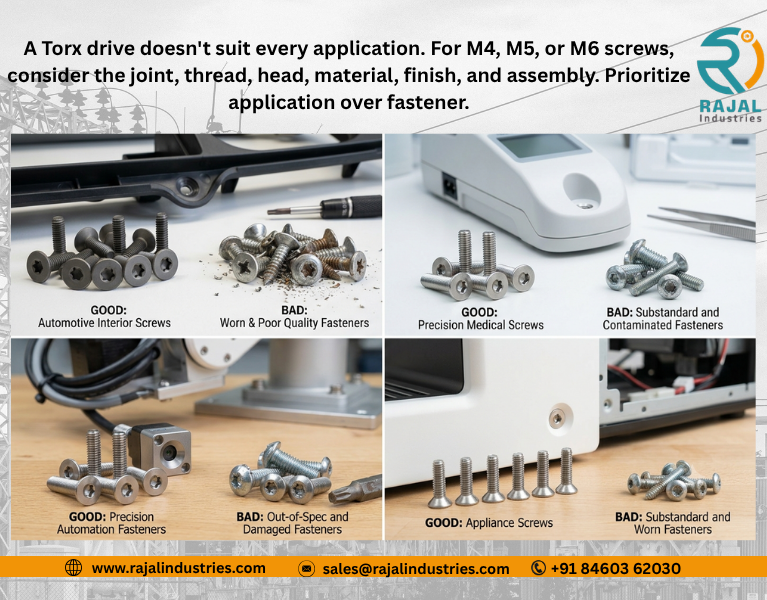
Torx Screw Applications cover many industrial and OEM assemblies where manufacturers need reliable driver engagement, controlled installation and a suitable head design.
When a countersunk head is combined with a Torx-style internal drive, the fastener can be useful where the assembly requires a flush or low-profile surface.
Typical industries can include:
- Automotive
- Automotive electronics
- Consumer electronics
- Electrical equipment
- Industrial machinery
- Automation equipment
- Medical equipment
- Appliances
- Instruments
- Equipment enclosures
- Precision OEM products
However, a countersunk Torx screw should not be selected simply because it is commonly used in a particular industry.
The correct fastener depends on:
Joint Design → Mating Material → Thread → Head Geometry → Drive → Material → Finish → Assembly Process
For OEM applications, the approved drawing and engineering requirements should control the final selection.
Quick Answer: Where Are Countersunk Torx Screws Used?
Countersunk Torx screws can be used in suitable:
Automotive Components → Electronics → Industrial Machinery → Medical Equipment → Electrical Equipment → Appliances → Enclosures → Automation Systems
They are especially useful where the product design requires:
- Flush or low-profile installation
- Internal drive access
- Repeatable assembly
- Compact fastening
- Controlled head geometry
- Clean finished appearance
The actual material, thread, drive size and finish depend on the application.
Why Are Torx Screws Used in OEM Products?
OEM manufacturers often install thousands or millions of screws during production.
Fastener consistency therefore becomes important.
A well-specified Torx-driven screw can support:
- Positive driver engagement
- Powered installation
- Repeatable assembly
- Compact head designs
- Automated or semi-automated production
- Controlled product appearance
Actual performance still depends on the complete screw, driver, tooling and joint.
A Torx drive does not automatically make every screw suitable for high-torque or critical applications.
Why Use a Countersunk Torx Screw?
The countersunk head allows the screw to sit within a matching countersink.
This can be useful when:
- A projecting head is undesirable
- The external surface should remain smooth
- Clearance is limited
- A cover must fit over the fastener
- Appearance matters
- Nearby parts move across the surface
The mating countersink must match the screw-head geometry.
Main Torx Screw Applications by Industry
| Industry | Potential Applications |
| Automotive | Interior parts, brackets, housings, covers |
| Automotive Electronics | Modules, enclosures, control equipment |
| Electronics | Housings, chassis, covers, mounting components |
| Industrial Machinery | Guards, covers, plates, equipment housings |
| Automation | Sensors, controls, fixtures, robotic equipment |
| Medical Equipment | Housings, covers, equipment assemblies |
| Electrical | Panels, enclosures, control equipment |
| Appliances | Housings, panels, internal assemblies |
| Instrumentation | Covers, enclosures, precision assemblies |
Every application still requires engineering validation.
Torx Screw Applications in Automotive Components
Automotive manufacturers use many different screw types throughout a vehicle and its supporting systems.
Countersunk Torx screws may be suitable for selected:
- Interior components
- Trim assemblies
- Covers
- Brackets
- Housings
- Electronic modules
- Equipment panels
- Secondary mechanical assemblies
Automotive fasteners may need controlled:
- Dimensions
- Mechanical properties
- Surface finish
- Corrosion performance
- Traceability
- Assembly behaviour
The OEM or Tier supplier specification should define these requirements.
Automotive Screws for Interior Components
Vehicle interiors contain many components where appearance and packaging space matter.
Potential applications for automotive screws can include:
- Trim mounting
- Interior brackets
- Covers
- Console components
- Equipment housings
- Access components
- Supporting hardware
A countersunk head can help where the design requires a smooth or low-profile surface.
For visible applications, buyers may also specify:
- Surface appearance
- Coating colour
- Head finish
- Burr limits
- Scratch requirements
Automotive Screws for Dashboard & Console Assemblies
Dashboard and console systems contain:
- Plastic components
- Metal brackets
- Electronic modules
- Displays
- Switches
- Supporting structures
Depending on the design, a Torx-driven screw may be used with:
- Threaded inserts
- Tapped metal parts
- Nuts
- Other engineered mating features
The correct thread should match the actual mating component.
Torx Screws for Automotive Electronic Modules
Modern vehicles contain increasing numbers of electronic systems.
Potential fastener applications can include:
- Control-unit housings
- Sensor assemblies
- Electronic enclosures
- Covers
- Mounting brackets
- Communication modules
These applications can require relatively small precision fasteners.
Important characteristics may include:
Accurate Thread + Consistent Head + Correct Torx Recess + Controlled Finish
Torx Screws for EV Components
Electric vehicles contain many electronic, control and supporting assemblies.
Countersunk Torx screws may be considered for suitable:
- Control electronics
- Auxiliary housings
- Interior systems
- Covers
- Brackets
- Low-profile equipment assemblies
However, EV battery, structural and safety-critical systems can have specific engineering and validation requirements.
Do not assume a general-purpose Torx screw is suitable for every EV application.
Torx Screws for Automotive Sensors
Sensors and their supporting components can require compact fasteners.
Potential applications include:
- Sensor housings
- Mounting plates
- Covers
- Brackets
The fastener may need controlled:
- Head size
- Thread
- Length
- Drive
- Finish
Where space is limited, correct screw length is especially important to prevent interference.
Torx Screws for Automotive Lighting Components
Lighting assemblies can contain:
- Housings
- Brackets
- Electronic modules
- Covers
- Adjustment-related components
Depending on the product design, Torx-driven automotive screws may be used for selected fastening points.
Material and coating should match the environmental requirements of the actual location.
Why Automotive OEMs Need Consistent Fasteners
Consider an assembly line using:
50,000 screws per day
Even a 0.5% problem rate could mean:
250 problematic screws per day
This simple example shows why dimensional and functional consistency matters in mass production.
Problems such as:
- Poor drive fit
- Thread damage
- Head variation
- Coating buildup
can create repeated assembly interruptions.
Torx Screw Applications in Electronics
Electronics is another important application area for small Torx-driven fasteners.
Potential uses include:
- Electronic enclosures
- Control boxes
- Housings
- Chassis
- Covers
- Mounting plates
- Internal brackets
- Power electronics
- Communication equipment
Electronics applications can require small dimensions and controlled surface quality.
Why Torx Drives Can Be Useful in Electronics
Electronic products often have limited assembly space.
A Torx-style internal drive can provide useful tool engagement within a compact head design.
This can support:
- Powered screwdrivers
- Controlled assembly
- Small fastener sizes
- Repeatable installation
The actual suitability depends on the head and screw design.
Electronics Screws for Product Housings
Product housings may require screws to remain flush with the external surface.
A typical assembly can be:
Countersunk Torx Screw → Housing → Threaded Insert / Tapped Component
Important checks include:
- Housing thickness
- Countersink geometry
- Screw length
- Thread engagement
- Driver access
Electronics Screws for Metal Enclosures
Metal electronics enclosures can use countersunk screws where the outer surface should remain smooth.
Potential applications include:
- Control enclosures
- Power electronics
- Communication equipment
- Industrial computers
- Instrumentation
- Electronic cabinets
The designer should ensure that the material thickness can properly support the countersink.
Electronics Screws for Plastic Housings
A countersunk Torx machine screw can be used in a plastic housing when the design includes a suitable:
- Threaded insert
- Metal nut
- Threaded mating component
Some plastic assemblies instead use special thread-forming screws.
These products are different.
Do not replace a plastic thread-forming screw with a standard machine screw without engineering approval.
Torx Screws for PCB-Related Assemblies
Torx screws may be used around electronic assemblies for:
- Mounting brackets
- Covers
- Chassis
- Supporting hardware
- Equipment frames
The screw should not be assumed to be suitable for direct PCB fastening unless the assembly has been designed for it.
Important factors can include:
- Clamp requirement
- Insulation
- Clearance
- Component location
- Screw length
Torx Screws for Power Electronics
Power electronics equipment can include:
- Inverters
- Power supplies
- Control units
- Industrial drives
- Converters
- Electronic cabinets
Potential electronics screws may be used in:
- Housings
- Covers
- Brackets
- Panels
- Internal supporting assemblies
Electrical, thermal and mechanical requirements should be reviewed by the OEM.
Torx Screws for Telecom Equipment
Telecommunications products may require compact precision fasteners for:
- Enclosures
- Communication modules
- Equipment racks
- Covers
- Control units
- Outdoor equipment
For outdoor telecom equipment, corrosion resistance can become more important.
Material and coating should match the actual environment.
Torx Screws for Data Center Equipment
Data center equipment can contain many electronic and mechanical assemblies.
Potential uses can include:
- Server-related housings
- Power equipment
- Control equipment
- Equipment enclosures
- Mounting components
Fastener selection should consider:
- Service access
- Tool compatibility
- Electrical requirements
- Material
- Finish
- Assembly process
Torx Screw Applications in Industrial Machinery
Industrial machinery often requires fasteners for:
- Machine covers
- Guards
- Access plates
- Equipment housings
- Brackets
- Instrumentation
- Control equipment
- Mechanical subassemblies
A countersunk Torx screw can be useful where a protruding head could interfere with equipment operation.
Torx Screws for Machine Covers
Machine covers may need a smooth surface for:
- Operator access
- Nearby moving components
- Appearance
- Clearance
- Cleaning
A correctly seated countersunk screw can reduce head projection.
However, the joint still needs adequate thread engagement and strength.
Torx Screws for Machine Guards
Machine guards can use different fastening methods depending on:
- Safety requirements
- Removal frequency
- Material
- Thickness
- Equipment design
Where countersunk Torx screws are specified, the manufacturer should follow the machine designer’s drawing.
Do not substitute guard fasteners without checking the applicable safety and equipment requirements.
Torx Screws for Industrial Control Equipment
Industrial control systems can contain:
- Panels
- Enclosures
- Electronic modules
- Control housings
- Covers
- Mounting hardware
Suitable Torx fasteners can support compact assembly and service access.
For maintenance applications, tool availability should also be considered.
Torx Screws for CNC Machinery
CNC machines contain numerous mechanical and electrical subassemblies.
Possible non-critical applications can include:
- Covers
- Panels
- Control housings
- Access plates
- Instrumentation mounts
Fasteners used in structural, rotating or safety-critical areas should always follow the machine manufacturer’s engineering specification.
Torx Screws for Robotics
Robotic and automation systems can require compact precision fasteners.
Potential applications include:
- Sensor mounts
- Covers
- Electronic housings
- Control modules
- Brackets
- End-effector supporting components
- Fixtures
The required fastener depends on:
Load + Space + Material + Assembly + Maintenance
Torx Screws for Automated Equipment
Automated production equipment often benefits from repeatable fastener geometry.
Important characteristics can include:
- Consistent drive
- Correct thread
- Controlled head dimensions
- Low burr level
- Repeatable finish
- Reliable bit engagement
Where automatic screw feeding is used, the screw should also be tested with the feeding system.
Precision Fasteners for Automation
The term precision fasteners should refer to controlled functional characteristics rather than simply small screws.
For automated equipment, important characteristics can include:
| Feature | Why It Matters |
| Torx Recess | Driver engagement |
| Head Diameter | Component fit |
| Head Angle | Seating |
| Thread | Mating fit |
| Length | Clearance |
| Burr Control | Feeding / assembly |
| Finish | Friction / corrosion |
| Consistency | Production stability |
Torx Screw Applications in Medical Equipment
Medical equipment can contain precision mechanical, electronic and enclosure assemblies.
Depending on the specific product and regulatory requirements, Torx-driven screws may be used in suitable:
- Equipment housings
- Diagnostic equipment
- Electronic modules
- Instrument enclosures
- Covers
- Panels
- Supporting mechanical assemblies
Medical applications require extra care because product requirements can vary significantly depending on equipment type and intended use.
Precision Fasteners for Medical Equipment
A precision fastener used in medical equipment may require controlled:
- Dimensions
- Material
- Surface condition
- Cleanliness
- Corrosion resistance
- Traceability
- Documentation
The exact requirements should come from the medical-equipment manufacturer.
A general industrial screw should not automatically be treated as a medical-grade fastener.
Torx Screws for Diagnostic Equipment
Diagnostic machines can contain:
- Electronic housings
- Covers
- Display assemblies
- Control equipment
- Internal brackets
- Equipment panels
Countersunk Torx screws may be suitable where the product requires a flush surface and controlled assembly.
The manufacturer should work strictly to the customer’s drawing and approved material specification.
Torx Screws for Medical Electronic Equipment
Medical electronic products may need relatively small screws for:
- Control housings
- Enclosures
- Panels
- Displays
- Electronic modules
- Supporting brackets
Important considerations can include:
- Dimensional accuracy
- Surface quality
- Material
- Corrosion resistance
- Cleanliness
- Traceability
Requirements should be agreed before manufacturing.
Torx Screws for Laboratory Equipment
Laboratory equipment can include:
- Analytical instruments
- Measurement systems
- Electronic devices
- Benchtop equipment
- Control systems
Potential fastener applications include:
- Covers
- Enclosures
- Panels
- Mounting brackets
- Equipment housings
Stainless steel may be considered where the environment or cleaning requirements call for it, but the actual grade should be specified.
Medical Equipment Material Selection
Do not assume that stainless steel automatically makes a screw suitable for medical equipment.
Material selection can depend on:
- Equipment environment
- Cleaning process
- Chemical exposure
- Corrosion requirements
- Mechanical properties
- Regulatory requirements
Where specified, buyers may consider stainless grades such as SS304 or SS316, but final selection belongs to the OEM design.
Important Note About Implantable Applications
General industrial countersunk Torx screws should not be described as suitable for implants simply because they are made from stainless steel or have a Torx-style drive.
Implantable medical fasteners involve specialized:
- Materials
- Manufacturing controls
- Validation
- Cleanliness
- Traceability
- Regulatory requirements
Unless a manufacturer specifically has the required capability and approvals, these should be treated as a separate product category.
Torx Screw Applications in Electrical Equipment
Potential electrical applications include:
- Electrical panels
- Switchgear equipment
- Control cabinets
- Instrumentation
- Enclosures
- Covers
- Mounting plates
The fastener should match:
- Component material
- Thread
- Electrical design
- Environment
- Finish requirement
Torx Screws for Electrical Panels
Countersunk Torx screws may be used where panel design requires:
- Flush mounting
- Compact head
- Controlled assembly
- Smooth outer surface
The panel thickness and countersink geometry must be suitable for the screw.
Torx Screws for Switchgear
Switchgear assemblies can contain:
- Covers
- Panels
- Housings
- Control components
- Supporting brackets
The screw selection should follow the switchgear manufacturer’s approved design.
Fasteners associated with critical electrical connections require specific engineering requirements and should not be selected only from a general application guide.
Torx Screws for Industrial Enclosures
Industrial enclosures may use Torx fasteners for:
- Covers
- Access plates
- Internal brackets
- Equipment panels
- Control modules
Outdoor enclosures may require additional corrosion protection.
For serviceable equipment, maintenance-tool compatibility should also be considered.
Torx Screw Applications in Appliances
Appliance manufacturers may use Torx-driven fasteners in suitable:
- Housings
- Covers
- Panels
- Frames
- Internal brackets
- Control assemblies
High-volume appliance production places importance on:
- Fast installation
- Consistent dimensions
- Reliable drive fit
- Stable finish
- Bulk supply
Torx Screws for Consumer Appliances
Potential applications can include:
- Kitchen appliances
- Cleaning equipment
- Home equipment
- Electrical appliances
- Professional appliances
The exact fastener design depends on the product.
For visible screws, appearance can become an additional acceptance criterion.
Torx Screws for Professional Equipment
Professional equipment may be opened repeatedly for:
- Maintenance
- Calibration
- Repair
- Inspection
The designer should consider:
- Driver availability
- Repeated assembly
- Thread durability
- Mating material
- Surface condition
Service requirements should form part of the fastener-selection process.
Torx Screws for Instrumentation
Instrumentation can require small and controlled fasteners for:
- Covers
- Housings
- Display assemblies
- Mounting plates
- Sensors
- Internal components
For small electronics screws, dimensional variation can have a larger effect because available space is limited.
Torx Screws for Measurement Equipment
Measurement equipment may require good repeatability and careful assembly.
Potential uses can include:
- Equipment covers
- Instrument housings
- Mounting hardware
- Electronic modules
Where calibration or measurement accuracy could be affected by assembly loads, the fastener and installation method should be defined by the product engineer.
Torx Screw Applications in Aerospace-Related Equipment
Torx-driven fasteners may appear in some aerospace-related equipment, fixtures or ground-support products.
However, aerospace fasteners can involve specialized:
- Material specifications
- Qualification
- Traceability
- Testing
- Approved supplier requirements
A general industrial Torx screw should not be marketed as an aerospace fastener without meeting the applicable specification and approvals.
Torx Screws for Furniture & Premium Fixtures
Torx drives can also appear in:
- Premium furniture
- Fixtures
- Equipment cabinets
- Display systems
- Commercial interiors
Countersunk heads can provide a clean finished surface.
However, these applications may use different thread designs from industrial machine screws.
Torx Screws for Security Applications
A standard Torx screw should not automatically be called a security screw.
Security Torx-style designs can include additional drive features intended to restrict access with common tools.
Therefore:
Standard Torx ≠ Security Torx
The exact drive should be specified on the drawing.
Standard Torx vs Security Torx Applications
| Feature | Standard Torx | Security-Style Torx |
| Drive | Six-lobe | Modified restricted-access design |
| Standard Tool Access | Normal matching tool | Special matching tool may be needed |
| OEM Assembly | Common | Application-specific |
| Maintenance | Easier | Controlled access |
| Selection | Assembly need | Access-control need |
Do not substitute one for the other without approval.
How Application Changes the Screw Specification
The same basic screw size can require very different specifications.
Indoor Electronics
May prioritize:
Small Size + Appearance + Precision
Automotive
May prioritize:
Mechanical Properties + Coating + Traceability + Production Consistency
Industrial Machinery
May prioritize:
Strength + Assembly + Serviceability
Medical Equipment
May prioritize:
Precision + Material + Surface Condition + Traceability
Outdoor Equipment
May prioritize:
Corrosion Resistance + Environmental Durability
This is why Torx Screw Applications should always be considered together with the actual operating environment.
Material Selection by Application
| Application | Important Material Considerations |
| Automotive | Mechanical properties + corrosion |
| Electronics | Size + appearance + corrosion |
| Machinery | Strength + environment |
| Medical Equipment | OEM material + cleanliness requirements |
| Electrical Equipment | Mechanical + environmental requirements |
| Outdoor Equipment | Corrosion resistance |
| Appliances | Cost + corrosion + appearance |
| Instrumentation | Precision + environment |
No single material is correct for every industry.
Surface Finish by Application
Surface finish can influence:
- Corrosion resistance
- Appearance
- Friction
- Installation behaviour
- Thread fit
- Drive engagement
Possible systems can include:
- Zinc plating
- Black finishes
- Engineered coatings
- Stainless-steel passivation
- Customer-specified finishes
The finish should be selected from the actual product requirement.
Why Small Precision Fasteners Need Good Coating Control
For small screws, coating buildup can become significant relative to the dimensions of:
- Thread
- Torx recess
- Head geometry
Excess coating may cause:
- Tight threads
- Poor bit fit
- Reduced recess depth
- Assembly problems
Post-finish inspection can therefore be important.
Application-Based Screw Selection Checklist
Before selecting a countersunk Torx screw, determine:
- What product will use the screw?
- What components are being joined?
- What is the mating material?
- Is there a tapped hole, insert or nut?
- What thread is required?
- What screw length is required?
- Is a countersunk head necessary?
- What head geometry is required?
- Which Torx drive is specified?
- What material is required?
- What mechanical properties are required?
- What finish is required?
- What environment will the screw see?
- Is appearance important?
- Is the screw installed manually or automatically?
- What installation requirement applies?
- Is traceability required?
- What testing is required?
- What is the annual quantity?
- Is sample approval required?
OEM Application Example 1: Electronics Housing
Application: Electronic enclosure
Possible Requirement:
- Small metric thread
- Countersunk head
- Torx drive
- Controlled length
- Clean finish
- Accurate head geometry
Critical Check:
The screw must seat correctly without interfering with internal electronics.
OEM Application Example 2: Automotive Interior
Application: Interior trim assembly
Possible Requirement:
- Controlled head appearance
- Torx drive
- Suitable thread
- Specified finish
- High-volume consistency
Critical Check:
Fastener should meet the OEM drawing and assembly-line requirements.
OEM Application Example 3: Industrial Machine Cover
Application: Machine access cover
Possible Requirement:
- Countersunk head
- Machine thread
- Suitable mechanical properties
- Serviceable drive
- Industrial finish
Critical Check:
Head should not interfere with adjacent machine movement or operator access.
OEM Application Example 4: Medical Equipment Housing
Application: Diagnostic-equipment enclosure
Possible Requirement:
- Precision dimensions
- Controlled surface
- Specified stainless or other approved material
- Torx drive
- Traceability
Critical Check:
Material, finish and cleanliness requirements must come from the equipment manufacturer’s specification.
Application Example 5: Automation Sensor Bracket
Application: Sensor mounting system
Possible Requirement:
- Compact screw
- Accurate head geometry
- Repeatable Torx drive
- Controlled thread
- Reliable assembly
Critical Check:
The fastener must fit the limited assembly space and remain compatible with the installation tool.
How to Send an Application-Based RFQ
Instead of sending only:
Need M4 Torx screws.
A stronger RFQ is:
We require countersunk Torx screws for an electronics OEM enclosure. Please review the attached drawing and confirm manufacturing feasibility for the specified thread, head geometry, Torx recess, material and finish. The screws will be used in high-volume assembly, so please also confirm sample support, inspection capability, MOQ and monthly production capacity.
Application information helps the supplier understand which characteristics may be especially important.
Why Rajal Industries for Application-Based Torx Fasteners?
Rajal Industries can evaluate drawing-based precision fasteners for suitable OEM applications across:
- Automotive components
- Electronics
- Electrical equipment
- Industrial machinery
- Automation
- Appliances
- Equipment enclosures
- Instrumentation
- Medical-equipment components, subject to customer specifications and required compliance
- Other industrial OEM products
Requirements can be reviewed for suitable:
- Countersunk Torx Screws
- Automotive Screws
- Electronics Screws
- Precision Fasteners
- OEM Screws
- Metric Threads
- Custom Dimensions
- Customer-Specified Torx Drives
- Carbon Steel
- Alloy Steel
- Stainless Steel
- Customer-Specified Finishes
- Drawing-Based Manufacturing
- Dimensional Inspection
- Thread Inspection
- Drive Inspection
- Material Verification
- Mechanical Testing as Specified
- Batch Traceability
- Bulk Packaging
- Scheduled OEM Supply
Final manufacturing capability should be confirmed against the customer’s approved drawing, material, tolerances, testing requirements, application and order quantity.
Bulk Buyer Quick Answer
Which industries use countersunk Torx screws?
Countersunk Torx screws can be used in suitable automotive, electronics, industrial machinery, automation, electrical, appliance, instrumentation and medical-equipment assemblies.
Their main advantage in these applications is the combination of a flush countersunk head and Torx-style internal drive.
However, buyers should select the screw based on the actual joint, material, thread, environment and assembly process rather than industry name alone.
How to Select Countersunk Torx Screws by Application
The correct fastener depends on how and where it will be used.
For most Torx Screw Applications, buyers should evaluate:
Application → Joint → Mating Material → Thread → Head → Drive → Material → Finish → Installation → Inspection
An automotive interior screw may have very different requirements from a screw used in industrial machinery or medical equipment.
The application should therefore guide the specification.
Application Selection Table
| Application | Main Fastener Requirements | Important Check |
| Automotive Interior | Appearance, consistency, drive fit | Head & finish |
| Automotive Electronics | Precision, small size, traceability | Thread & drive |
| Electronics Housing | Compact size, flush head | Countersink fit |
| Industrial Machinery | Mechanical performance, serviceability | Joint design |
| Automation | Repeatable drive, consistent geometry | Assembly trial |
| Medical Equipment | Material, precision, documentation | OEM specification |
| Electrical Equipment | Finish, fit, environment | Drawing |
| Appliances | Cost, appearance, volume consistency | Production stability |
| Instrumentation | Precision, compact geometry | Dimensional control |
This table is a starting point. The approved engineering drawing should control the final fastener.
Selecting Automotive Screws
Automotive production can involve very high fastener volumes.
For suitable countersunk automotive screws, buyers should consider:
- Thread dimensions
- Head geometry
- Torx drive
- Mechanical properties
- Coating
- Corrosion requirements
- Appearance
- Traceability
- Assembly process
- Production volume
The exact requirements can differ between interior, exterior, electronic and mechanical assemblies.
Automotive Interior Applications
Interior components can place greater importance on:
Appearance + Flush Seating + Drive Quality + Batch Consistency
Possible applications include:
- Trim assemblies
- Console components
- Covers
- Interior brackets
- Equipment housings
If the screw is visible after installation, the customer may define cosmetic acceptance requirements.
Automotive Electronics Applications
Electronic modules can require smaller and more precise fasteners.
Important characteristics can include:
- Accurate thread
- Controlled length
- Consistent countersunk head
- Correct Torx recess
- Clean surface finish
- Traceability
A screw that is only slightly too long can interfere with internal components.
For compact electronics, length should therefore be carefully controlled.
Automotive Exterior Applications
Exterior automotive components can face:
- Moisture
- Road contamination
- Temperature changes
- Corrosive environments
If a countersunk Torx screw is specified for an exterior application, material and coating should be selected according to the OEM’s corrosion requirement.
Do not select the finish only by appearance.
Automotive High-Volume Assembly
For high-volume production, a supplier should be able to maintain consistency across large batches.
Important characteristics include:
- Drive geometry
- Thread
- Head diameter
- Head angle
- Length
- Finish
- Packaging
A small variation repeated across hundreds of thousands of screws can create major production problems.
Automated Installation of Automotive Screws
Where screws are installed using powered or automated equipment, the fastener should be tested with the actual production system.
Check:
- Bit engagement
- Screw presentation
- Thread starting
- Installation behaviour
- Seating
- Final head position
Fastener quality and tool condition should both be monitored.
Selecting Electronics Screws
For electronics screws, space is often limited.
Selection should consider:
Small Size + Head Geometry + Screw Length + Drive Fit + Surface Finish
Potential applications include:
- Enclosures
- Housings
- Chassis
- Covers
- Control modules
- Communication equipment
- Power electronics
Electronics Housing Selection
A housing may require a completely flush external surface.
Check:
- Housing thickness
- Countersink diameter
- Countersink angle
- Screw-head diameter
- Screw-head angle
- Screw length
- Thread engagement
- Internal clearance
The screw and housing should be checked as one assembly.
Electronics Screws for Threaded Inserts
Plastic and composite housings often use threaded inserts.
A typical connection can be:
Countersunk Torx Screw → Housing → Threaded Insert
Important checks include:
- Insert thread
- Insert depth
- Screw pitch
- Screw length
- Countersink geometry
- Installation requirement
A screw that bottoms inside the insert may appear tight without properly clamping the assembly.
Electronics Screws for Tapped Metal Parts
For metal housings and chassis, a machine-thread Torx screw may engage directly with a tapped component.
Check:
- Thread diameter
- Pitch
- Thread tolerance
- Available depth
- Surface finish
- Screw length
Functional testing with the actual mating part is useful before mass production.
Electronics Screw Surface Appearance
Visible electronics can have strict cosmetic requirements.
Possible rejection points include:
- Scratches
- Head marks
- Burrs
- Coating variation
- Discoloration
- Damaged drive
- Corrosion spots
If appearance matters, acceptable and unacceptable conditions should be defined before production.
Precision Fasteners for Compact Electronics
Small precision fasteners require good dimensional control because there is less room for variation.
For example, a small variation in recess depth can represent a significant percentage of the available Torx drive depth.
This can affect:
- Driver engagement
- Torque transfer
- Assembly speed
Small screws should therefore not be treated as technically simple just because they use less material.
Selecting Torx Screws for Industrial Machinery
Industrial machinery applications can require a different balance of:
- Mechanical performance
- Serviceability
- Corrosion resistance
- Tool access
- Head clearance
Countersunk Torx screws may be useful for:
- Covers
- Guards
- Access panels
- Housings
- Plates
- Instrumentation
- Control equipment
Machine Cover Applications
A countersunk screw can help maintain a low-profile surface on machine covers.
This can be useful where:
- Parts move close to the cover
- Operators work near the surface
- A cover slides during removal
- Appearance matters
However, the countersunk joint still needs adequate material around the screw.
Machine Guard Applications
Machine guards can be safety-related components.
Fastener substitution should therefore follow the equipment manufacturer’s engineering requirements.
Consider:
- Strength
- Removal requirements
- Tool access
- Thread engagement
- Vibration
- Inspection
A general-purpose screw should not replace an approved guard fastener without review.
Torx Screws in Vibrating Machinery
Where vibration is present, the complete joint should be evaluated.
Vibration performance depends on more than the drive type.
Important factors can include:
- Clamp load
- Thread engagement
- Joint stiffness
- Mating material
- Locking method
- Installation process
A Torx drive by itself does not make a screw vibration-resistant.
Torx Screws for Machinery Maintenance
Maintenance teams may repeatedly remove and reinstall covers.
For these applications, consider:
- Driver availability
- Recess durability
- Mating-thread condition
- Replacement availability
- Surface corrosion
- Access space
Serviceability can be as important as initial assembly speed.
Selecting Precision Fasteners for Automation
Automation equipment often requires stable fastener geometry.
Important characteristics include:
- Consistent Torx recess
- Head concentricity
- Thread quality
- Head dimensions
- Length
- Burr control
- Surface finish
If automatic screw feeding is involved, fastener geometry and packaging should also be evaluated with the feeder.
Automatic Screwdriving
Automated screwdriving systems may depend on consistent:
Screw Pickup → Bit Engagement → Positioning → Thread Start → Tightening → Seating
A variation at any stage can stop the process.
For this reason, automatic assembly should be discussed with the fastener manufacturer during development.
Common Automatic Screwdriving Problems
| Problem | Possible Fastener-Related Cause |
| Bit Won’t Engage | Recess variation |
| Screw Drops | Head/drive compatibility |
| Screw Won’t Start | Thread damage or alignment |
| Screw Jams | Thread/coating issue |
| Head Won’t Seat | Countersunk geometry |
| Recess Strips | Drive/tool/torque issue |
| Feeder Jams | Geometry or part variation |
The machine, bit and mating component should also be checked before blaming the screw.
Precision Fasteners for Robotic Equipment
Robotic systems can contain fasteners in:
- Sensor brackets
- Covers
- Electronic housings
- Control systems
- Fixtures
- Mechanical modules
Compact designs can make head size and tool access especially important.
The screw should be selected together with the assembly method.
Selecting Torx Screws for Medical Equipment
Medical equipment requires careful application-specific review.
Potential Torx Screw Applications can include suitable:
- Diagnostic equipment
- Laboratory equipment
- Medical electronics
- Equipment housings
- Covers
- Panels
- Instrument enclosures
The equipment manufacturer should define the required material, surface condition, cleanliness, traceability and documentation.
Medical Equipment Housing Screws
Equipment housings may require:
- Flush head
- Clean appearance
- Corrosion resistance
- Accurate dimensions
- Reliable drive engagement
Where stainless steel is required, the actual grade should be specified.
Simply writing:
Stainless Steel Torx Screw
is not enough for a controlled requirement.
Medical Equipment & Cleanliness
Some medical-equipment applications may have specific cleanliness requirements.
These can depend on:
- Equipment type
- Manufacturing environment
- Cleaning method
- Product specification
A standard industrial fastener should not be described as meeting special medical cleanliness requirements unless those requirements have actually been defined and validated.
Medical Equipment Traceability
Where required, traceability may connect finished fasteners to:
- Raw material
- Production lot
- Surface treatment
- Inspection
- Testing
The level of traceability should be agreed with the OEM before production.
Medical Equipment Documentation
Depending on the application, buyers may request:
- Material certificate
- Dimensional report
- Surface-finish documentation
- Inspection report
- Batch identification
- Other customer-specific documents
The exact documentation should be defined in the RFQ.
Important Medical Application Limitation
Medical equipment is a broad category.
A screw suitable for an external diagnostic-equipment housing is not automatically suitable for:
- Surgical instruments
- Patient-contact applications
- Implantable devices
- Sterile systems
These applications can have very different material, manufacturing and regulatory requirements.
The product should only be supplied against the applicable approved specification.
Selecting Torx Screws for Electrical Equipment
Electrical OEMs can use suitable countersunk Torx fasteners in:
- Panels
- Enclosures
- Covers
- Control equipment
- Instrumentation
- Mounting components
Selection should consider:
- Electrical design
- Component material
- Corrosion environment
- Thread
- Head geometry
- Service access
Torx Screws for Electrical Panels
Countersunk heads can be useful where a panel needs a smooth surface.
However, thin sheet can make countersinking difficult.
Check:
Panel Thickness → Countersink Depth → Head Geometry
before selecting the screw.
Torx Screws for Switchgear Equipment
Switchgear equipment can include:
- Covers
- Enclosures
- Panels
- Control modules
- Supporting components
For electrical-current carrying or safety-critical connections, use the fastener specified by the equipment engineer.
A general Torx screw application guide should not be used to select critical electrical-joint fasteners.
Selecting Torx Screws for Appliances
Appliance manufacturing often combines:
High Volume + Cost Control + Fast Assembly + Appearance
Suitable Torx-driven screws can be used in:
- Panels
- Covers
- Housings
- Frames
- Internal brackets
- Control assemblies
Consistency is important because even a low defect percentage can affect many units.
Appliance Assembly Requirements
High-volume appliance production may prioritize:
- Reliable bit engagement
- Fast installation
- Stable finish
- Consistent dimensions
- Bulk packaging
- Scheduled supply
If automatic feeding is used, production samples should be tested with the actual equipment.
Torx Screws for Instrumentation
Precision instruments may require compact fasteners for:
- Housings
- Covers
- Sensors
- Display assemblies
- Internal brackets
- Mounting plates
Important factors can include:
- Head geometry
- Thread
- Length
- Drive
- Surface condition
For sensitive instruments, assembly load should follow the product engineer’s requirements.
Industry-Based Material Matrix
| Industry | Material / Finish Factors |
| Automotive | Strength, corrosion, OEM coating |
| Electronics | Precision, appearance, corrosion |
| Machinery | Mechanical performance, environment |
| Automation | Consistency, friction, assembly |
| Medical Equipment | Approved material, surface, documentation |
| Electrical | Environment, finish, electrical design |
| Appliances | Cost, appearance, corrosion |
| Instrumentation | Precision, environment |
This table should be used for initial discussion only.
Final selection must follow the application specification.
Indoor vs Outdoor Torx Screw Applications
Indoor Applications
May prioritize:
- Appearance
- Cost
- Dimensional accuracy
- Assembly speed
Outdoor Applications
May add:
- Moisture resistance
- Corrosion protection
- Temperature exposure
- Environmental durability
The same screw finish should not automatically be used for both environments.
Stainless Steel for Application-Based Fasteners
Stainless steel may be considered for suitable:
- Medical equipment
- Electronics
- Outdoor equipment
- Laboratory equipment
- Industrial machinery
Possible requirements can include SS304 or SS316.
However, stainless grade selection should depend on the actual environment and mechanical requirement.
Carbon Steel for OEM Applications
Carbon steel can be suitable for many:
- Automotive
- Appliance
- Electrical
- Machinery
- General OEM
applications when combined with the required mechanical properties and surface finish.
The customer should define the grade or required properties rather than simply requesting “MS.”
Coating Selection by Environment
| Environment | Requirement to Consider |
| Indoor Dry | Basic corrosion protection |
| Humid | Increased corrosion resistance |
| Outdoor | Environmental protection |
| Automotive | OEM-approved coating |
| Electronics | Clean, controlled finish |
| Medical Equipment | Approved surface requirement |
| Visible Product | Cosmetic consistency |
Corrosion performance should be specified when it matters.
Why Coating Matters to Assembly
Coating changes more than appearance.
It can affect:
- Thread fit
- Friction
- Installation torque
- Torx recess fit
- Head seating
This is particularly important for small precision fasteners.
Common Application Failure: Head Does Not Sit Flush
Possible causes include:
- Wrong countersunk angle
- Wrong head diameter
- Incorrect countersink
- Burrs
- Component variation
First Check
Screw Head Geometry + Actual Component
Common Application Failure: Torx Bit Slips
Possible causes include:
- Wrong bit
- Worn bit
- Poor recess geometry
- Shallow recess
- Misalignment
- Excessive torque
First Check
Approved Bit + Drive Geometry + Tool Setting
Common Application Failure: Screw Jams
Possible causes:
- Wrong pitch
- Thread damage
- Coating buildup
- Mating-thread issue
- Cross-threading
First Check
Screw Thread + Mating Thread
Common Application Failure: Screw Breaks
Possible causes can include:
- Excess installation torque
- Incorrect material
- Heat-treatment problem
- Thread interference
- Joint misalignment
The broken fastener should be examined before changing the specification.
Common Application Failure: Early Corrosion
Possible causes:
- Incorrect coating
- Wrong material
- Coating damage
- Environment more severe than expected
- Poor storage
First Check
Environment + Material + Finish Specification
Common Application Failure: Automatic Assembly Stops
Possible fastener-related causes can include:
- Inconsistent drive
- Head variation
- Damaged thread
- Burrs
- Feeding problems
But also check:
- Driver bit
- Feeder
- Tool alignment
- Mating component
A production problem may involve more than one factor.
Application Troubleshooting Table
| Problem | Likely Area to Check |
| Head Proud | Countersink / head |
| Head Too Deep | Countersink / head |
| Bit Slips | Drive / bit / torque |
| Thread Jams | Thread / coating |
| Screw Breaks | Material / torque / joint |
| Corrosion | Material / coating / environment |
| Cosmetic Rejection | Finish / handling |
| Feeder Jam | Screw geometry / equipment |
| Line Stoppage | Screw + tooling + component |
OEM Localization of Torx Screws
OEMs may want to replace imported automotive screws, electronics screws or other precision fasteners with locally manufactured parts.
A practical localization process is:
Approved Drawing + Existing Sample → Technical Review → Material Confirmation → Tooling → Samples → Inspection → Functional Trial → Approval → Production
The approved drawing should remain the main technical reference.
Why Sample-Only Reverse Engineering Can Be Risky
An existing screw may have:
- Manufacturing variation
- Wear
- Damaged coating
- Deformed threads
- Previous assembly marks
Measuring one physical sample may therefore not reveal the complete original specification.
Where available, use:
Approved Drawing + Sample
rather than sample alone.
Custom Torx Screw Development
Custom development may be required for:
- Special head diameter
- Reduced head height
- Custom countersunk angle
- Special Torx recess
- Non-standard length
- Special thread
- Customer marking
- Special material
- Special coating
The requirement should be controlled through an approved drawing.
Application Sample Approval
Before mass production, test samples for:
☐ Thread fit
☐ Screw length
☐ Head seating
☐ Torx bit engagement
☐ Material
☐ Finish
☐ Appearance
☐ Assembly behaviour
☐ Tool compatibility
☐ Functional fit
For automated production, also run samples through the actual assembly equipment where practical.
High-Volume Production Approval
A prototype can work correctly while mass-production variation still creates problems.
For larger OEM programs, consider:
Initial Samples → Functional Approval → Pilot Lot → Production Validation → Bulk Supply
The exact approval process should follow the customer’s quality system.
How to Evaluate a Precision Fastener Supplier
Check whether the supplier can support:
- Drawing-based manufacturing
- Countersunk head control
- Torx recess forming
- Small thread sizes
- Material requirements
- Heat treatment, where required
- Surface finishing
- Thread inspection
- Drive inspection
- Dimensional reports
- Material certificates
- Mechanical testing
- Traceability
- Custom tooling
- Sample development
- Pilot production
- High-volume manufacturing
- Controlled packaging
- Scheduled supply
- Corrective-action support
Application-Based Supplier Comparison
| Requirement | Supplier A | Supplier B | Supplier C |
| Application Experience | |||
| Drawing Capability | |||
| Torx Capability | |||
| Countersunk Head Control | |||
| Precision Threading | |||
| Material Options | |||
| Finish Options | |||
| Inspection | |||
| Traceability | |||
| Samples | |||
| Pilot Lot | |||
| Monthly Capacity | |||
| Lead Time | |||
| Price |
Technical fit should be checked before comparing price.
Questions to Ask a Torx Screw Supplier
- Have you manufactured similar screws before?
- Can you manufacture from our drawing?
- Which Torx drive sizes can you produce?
- Can you control our countersunk head geometry?
- Which thread sizes can you manufacture?
- Which materials can you process?
- Which coatings can you supply?
- How do you inspect the Torx recess?
- How do you inspect the countersunk angle?
- Can you provide functional bit-fit checks?
- Can you provide material certificates?
- Can you provide dimensional reports?
- Can you support mechanical testing?
- Can you provide coating reports?
- Can you provide batch traceability?
- Can you develop custom tooling?
- Can you provide samples?
- Can you support pilot production?
- Can you support our monthly quantity?
- What is the production lead time?
Application-Based RFQ Checklist
Send the supplier:
☐ Application / industry
☐ Product drawing
☐ Drawing revision
☐ Applicable standard
☐ Thread diameter
☐ Pitch
☐ Length
☐ Head diameter
☐ Head height
☐ Countersunk angle
☐ Torx drive
☐ Material
☐ Mechanical properties
☐ Surface finish
☐ Corrosion requirement
☐ Dimensional tolerances
☐ Assembly method
☐ Testing requirements
☐ Documentation requirements
☐ Sample quantity
☐ First order quantity
☐ Monthly quantity
☐ Annual demand
☐ Packaging
☐ Delivery schedule
Example Automotive RFQ
We require countersunk Torx screws for an automotive component. Please review the attached drawing and confirm manufacturing feasibility for the specified thread, countersunk head, Torx drive, material and coating. Please also confirm sample lead time, inspection capability, traceability, MOQ and monthly production capacity.
Example Electronics RFQ
We require precision countersunk Torx screws for an electronics housing. Please review the attached drawing and confirm the specified small thread, screw length, head geometry, Torx recess, material and finish. Please quote sample and bulk quantities and confirm dimensional and functional inspection capability.
Example Machinery RFQ
We require countersunk Torx screws for industrial machinery assemblies. Please review the drawing and confirm material, mechanical properties, head geometry, drive, thread and surface finish capability. Please quote the required bulk quantity and confirm sample and production lead time.
Example Medical Equipment RFQ
We require precision screws for a medical-equipment assembly. Please review the attached OEM drawing and confirm whether you can meet the specified dimensions, material, surface finish, traceability, inspection and documentation requirements. Please confirm manufacturing feasibility before quotation.
For medical equipment, avoid asking a supplier to simply quote “medical-grade screws” without defining what the product actually requires.
Frequently Asked Questions About Torx Screw Applications
Where are Torx screws used?
Torx Screw Applications include suitable automotive, electronics, machinery, automation, electrical, appliance, instrumentation and medical-equipment assemblies.
Why are Torx screws used in automotive applications?
Torx-driven screws can provide positive tool engagement and can work well with powered assembly systems when correctly specified.
Where are Torx screws used in cars?
Potential uses include interior components, brackets, housings, covers and electronic modules. The exact fastener depends on the vehicle manufacturer’s specification.
Are Torx screws used in electronics?
Yes. Electronics screws with Torx drives can be used in suitable housings, enclosures, covers, chassis and control equipment.
Why use countersunk Torx screws in electronics?
A countersunk head can provide a flush or low-profile surface, while the Torx drive provides internal tool engagement.
Are Torx screws used in industrial machinery?
Yes. Suitable applications can include machine covers, panels, guards, housings and control equipment.
Are Torx screws suitable for automated assembly?
They can be. The drive, screw geometry, feeding system, driver and mating component should be validated together.
Can Torx screws be used in medical equipment?
Yes, in suitable equipment assemblies when they meet the OEM’s material, dimensional, surface, cleanliness, documentation and regulatory requirements.
Are ordinary stainless screws medical-grade screws?
No. Stainless material alone does not make a fastener medical grade.
Are Torx screws used in medical implants?
Specialized fasteners may use similar drive concepts, but implantable fasteners require dedicated materials, manufacturing controls, validation and regulatory compliance. General industrial Torx screws should not be presented as implant fasteners.
Are Torx screws suitable for outdoor equipment?
They can be, provided the material and finish meet the environmental and corrosion requirements.
Are Torx screws vibration resistant?
Not simply because they use a Torx drive. Vibration resistance depends on the complete joint design and any approved locking method.
Can countersunk Torx screws be customized?
Yes, subject to manufacturing feasibility. Head dimensions, thread, length, drive, material and finish can be evaluated against an approved drawing.
What information should I send to a Torx screw manufacturer?
Send the drawing, application, thread, length, head geometry, Torx drive, material, finish, tolerances, testing requirements and quantity.
AEO Quick Answers
What are the main Torx Screw Applications?
Torx Screw Applications include automotive components, electronics, industrial machinery, automation equipment, electrical systems, appliances, instrumentation and suitable medical-equipment assemblies. The exact screw specification depends on the joint and operating environment.
Why are countersunk Torx screws used in electronics?
Countersunk Torx screws can provide a flush external surface with an internal six-lobe drive. This can be useful for compact electronics housings, covers, enclosures and other precision assemblies.
Where are Torx screws used in automotive manufacturing?
Automotive screws with Torx drives can be used in suitable interior components, housings, covers, brackets and electronic modules. Material, coating and mechanical requirements should follow the OEM specification.
Can Torx screws be used in medical equipment?
Yes, where the screw meets the medical-equipment manufacturer’s approved material, dimensional, surface, cleanliness, traceability and documentation requirements. A standard industrial screw should not automatically be called medical grade.
Are Torx screws good for automated assembly?
Torx-driven screws can be suitable for automated assembly when the recess, screw geometry, driver, feeder, installation settings and mating component are properly matched and validated.
Key Takeaways
- Torx Screw Applications cover many automotive, electronics, machinery and OEM assemblies.
- A countersunk Torx screw can provide a flush or low-profile installation.
- Automotive screws may require coating, traceability and high-volume consistency.
- Electronics screws often require tight dimensional control because assembly space is limited.
- Machinery fasteners should consider load, vibration and serviceability.
- Automation applications require consistent drive and screw geometry.
- Medical-equipment fasteners should follow the OEM’s exact specification and compliance requirements.
- Stainless steel alone does not make a screw “medical grade.”
- A Torx drive alone does not make a screw vibration-resistant.
- Coating can affect both corrosion protection and assembly behaviour.
- Automatic screwdriving should be validated with production equipment.
- Samples should be tested in the actual mating assembly.
- For imported-part localization, use the approved drawing together with the reference sample.
- Supplier capability should be confirmed before comparing prices.
Conclusion
The best Torx Screw Applications are those where the complete fastener is matched correctly to the product and assembly process.
For automotive applications, buyers may prioritize:
Consistency + Mechanical Requirements + Coating + Traceability
For electronics:
Precision + Small Size + Flush Seating + Drive Quality
For industrial machinery:
Mechanical Performance + Serviceability + Joint Design
For medical equipment:
Precision + Approved Material + Surface Requirements + Documentation
The correct selection process is:
Application → Drawing → Thread → Head → Torx Drive → Material → Finish → Sample → Functional Trial → Approval
Rajal Industries can evaluate drawing-based countersunk Torx screw requirements for suitable automotive, electronics, industrial and OEM applications, subject to technical feasibility and customer specifications.