

Introduction – The Switchgear Passed Testing, But Failed Six Months Later
A switchgear manufacturer supplied a batch of RMUs for a solar substation project.
Factory testing was successful.
The equipment passed:
✔ High Voltage Testing
✔ Dielectric Testing
✔ Current Carrying Tests
✔ Mechanical Operations
✔ Quality Inspection
Six months after commissioning, one of the units reported abnormal heating.
Infrared scanning revealed:
Busbar Joint Temperature
78°C
Nearby busbar joints:
34°C to 38°C
The copper busbar was not damaged.
The RMU design was not faulty.
The electrical load was within specification.
The actual problem was a single loose busbar bolt.
A fastener worth less than ₹50 created a risk for equipment worth several lakhs.
This scenario is frequently reported in:
- RMU Assemblies
- VCB Panels
- ACB Panels
- PCC Panels
- MCC Panels
- HT Panels
- LT Panels
- Distribution Boards
- Switchgear Manufacturing Plants
Quick Answer
Why do busbar bolts fail inside switchgear assemblies?
Busbar bolts typically fail because of preload loss, incorrect torque, thermal expansion, vibration, poor contact surfaces, oxidation, washer issues, and improper switchgear fastener selection.
Why Busbar Bolts Are Critical
Every switchgear assembly depends on reliable electrical joints.
A typical RMU, VCB, or ACB contains dozens of busbar connections.
These joints carry:
- High Current
- Fault Current
- Peak Loads
- Continuous Operational Loads
The entire connection relies on:
Clamp Force
generated by the fastener assembly.
If clamp force decreases:
Resistance increases.
Heat increases.
Reliability decreases.
What Fasteners Are Used in Busbar Assemblies?
Switchgear manufacturers commonly use:
Busbar Bolts
- M6 Busbar Bolts
- M8 Busbar Bolts
- M10 Busbar Bolts
- M12 Busbar Bolts
Structural Hardware
- Hex Bolts
- Flange Bolts
- Grade 8.8 Bolts
- Stainless Steel Bolts
Electrical Connection Hardware
- Copper Bolts
- Brass Bolts
- Tin-Plated Copper Bolts
Washers
- Flat Washers
- Spring Washers
- Belleville Washers
- Nord-Lock Washers
Locking Hardware
- Lock Nuts
- Flange Nuts
- Prevailing Torque Nuts
Among these, M8 busbar bolts and M10 busbar bolts are among the most widely used switchgear fasteners.
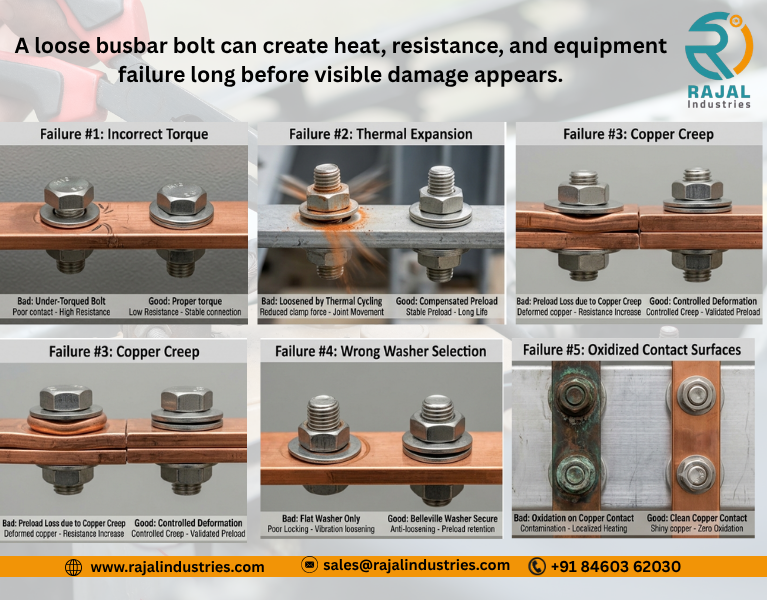
Failure #1 – Incorrect Torque
This is the most common problem.
Many installers believe:
Tight Is Tight
In reality:
Under-tightening causes:
- Poor Contact Pressure
- Increased Resistance
- Joint Heating
Over-tightening causes:
- Thread Damage
- Washer Deformation
- Copper Distortion
Both situations reduce reliability.
Why Torque Matters
The goal is not tightening.
The goal is:
Proper Preload
Preload creates:
✔ Low Contact Resistance
✔ Stable Electrical Connection
✔ Long-Term Reliability
Without preload, the joint begins degrading immediately.
Failure #2 – Thermal Expansion
Switchgear operates through repeated heating and cooling cycles.
Every day:
Current increases
↓
Busbar heats up
↓
Busbar expands
↓
Current reduces
↓
Busbar cools
↓
Busbar contracts
This cycle repeats thousands of times.
Eventually:
Clamp force decreases.
The joint loosens.
Failure #3 – Copper Creep
Copper is softer than steel.
When compressed:
Copper gradually deforms.
This phenomenon is called:
Copper Creep
As copper creeps:
- Joint thickness changes
- Preload decreases
- Resistance increases
This issue is common in:
- RMU Busbars
- VCB Busbars
- ACB Connections
- PCC Panels
Failure #4 – Wrong Washer Selection
Many switchgear assemblies still use:
Flat Washers Only
Flat washers distribute load but do not compensate effectively for preload loss.
Modern switchgear manufacturers increasingly use:
Belleville Washers
because they help maintain clamp force.
Belleville Washer vs Spring Washer
| Parameter | Spring Washer | Belleville Washer |
| Preload Retention | Medium | High |
| Thermal Expansion Compensation | Medium | Excellent |
| Electrical Joint Stability | Medium | High |
| RMU Applications | Good | Better |
| VCB Applications | Good | Better |
Leading OEMs increasingly prefer Belleville washers for critical busbar joints.
Failure #5 – Oxidized Contact Surfaces
Many overheating problems originate from poor surface preparation.
Common issues:
- Copper Oxidation
- Dirt
- Dust
- Fingerprints
- Paint Residue
These contaminants reduce actual contact area.
Less contact area means:
Higher resistance.
Higher resistance means:
Higher temperature.
Failure #6 – Vibration
Switchgear panels experience vibration from:
- Circuit Breaker Operations
- Transformers
- Nearby Equipment
- Transportation
Over time:
Vibration reduces preload.
The joint gradually loosens.
This is particularly common in:
- RMU Assemblies
- Outdoor Switchgear
- Industrial Distribution Panels
Failure #7 – Incorrect Bolt Material
Many engineers focus only on bolt strength.
Electrical performance is equally important.
Common materials include:
Zinc-Plated Steel Bolts
Widely used.
Copper Bolts
Excellent conductivity.
Brass Bolts
Good conductivity and corrosion resistance.
Stainless Steel Bolts
Excellent corrosion resistance but lower conductivity.
Selecting the wrong material can affect long-term performance.
Real VCB Failure Example
A VCB manufacturer investigated recurring busbar heating.
Thermal Scan Results:
Normal Connections:
35°C–40°C
Problem Connection:
82°C
Hardware Used:
- M10 Busbar Bolt
- Flat Washer
- Hex Nut
Root Cause:
Preload loss caused by copper creep
Corrective Action:
✔ Replaced damaged hardware
✔ Added Belleville washers
✔ Updated torque procedures
Result:
Operating temperature reduced to:
37°C
Why Heating Starts Before Failure
Most switchgear failures follow this sequence:
Stage 1
Preload Loss
↓
Stage 2
Increased Resistance
↓
Stage 3
Localized Heating
↓
Stage 4
Oxidation
↓
Stage 5
Further Resistance Increase
↓
Stage 6
Insulation Damage
↓
Stage 7
Equipment Failure
By the time visible damage appears, the failure process has usually been developing for months.
Example Calculation
Assume:
Current:
1000 Amps
Joint Resistance:
50 Micro-ohms
Power Loss:
P = I²R
P = 1000² × 0.00005
= 50 Watts
Now resistance doubles because of preload loss:
100 Micro-ohms
Power Loss becomes:
100 Watts
Heat generation doubles.
The electrical load did not change.
Only the fastener joint changed.
Most Common Busbar Fasteners Used by OEMs
Large switchgear manufacturers regularly purchase:
Busbar Hardware
- M6 Busbar Bolts
- M8 Busbar Bolts
- M10 Busbar Bolts
- M12 Busbar Bolts
- Copper Bolts
- Brass Bolts
Structural Fasteners
- Grade 8.8 Bolts
- Flange Bolts
- Hex Bolts
Washers
- Belleville Washers
- Spring Washers
- Flat Washers
- Nord-Lock Washers
Locking Hardware
- Lock Nuts
- Flange Nuts
- Prevailing Torque Nuts
These are among the most commonly searched switchgear fasteners globally.
Industries Most Affected
Busbar bolt failures commonly impact:
- RMU Manufacturers
- VCB Manufacturers
- ACB Manufacturers
- MCCB Manufacturers
- LT Panel Manufacturers
- HT Panel Manufacturers
- PCC Panel Manufacturers
- MCC Panel Manufacturers
- Switchgear OEMs
- Electrical Panel Manufacturers
Inspection Checklist
Before switchgear dispatch:
✔ Verify busbar bolt torque
✔ Check washer selection
✔ Inspect contact surfaces
✔ Verify preload requirements
✔ Review thermal imaging data
✔ Check oxidation levels
✔ Verify bolt material
✔ Inspect vibration-prone locations
✔ Review maintenance procedures
Key Takeaways
- Most busbar failures begin with preload loss.
- Thermal expansion and copper creep gradually reduce clamp force.
- Heating is usually a symptom, not the root cause.
- Belleville washers often outperform spring washers.
- Proper torque procedures are critical.
- Oxidized contact surfaces increase resistance.
- A small busbar bolt can determine the reliability of an entire switchgear assembly.
FAQ
Why do busbar bolts overheat?
Overheating usually occurs because of increased contact resistance caused by preload loss, oxidation, poor contact surfaces, or improper torque.
Which busbar bolt sizes are commonly used?
M6, M8, M10, and M12 busbar bolts are commonly used in RMU, VCB, ACB, and switchgear assemblies.
Why are Belleville washers used in switchgear?
Belleville washers help maintain preload despite thermal expansion, copper creep, and vibration.
Can loose busbar bolts cause switchgear failure?
Yes. A loose busbar bolt can create localized heating, insulation damage, voltage loss, and equipment failure.
What is copper creep?
Copper creep is the gradual deformation of copper under load, which can reduce clamp force over time.
Are spring washers enough for busbar joints?
Spring washers are widely used, but many OEMs now prefer Belleville washers for critical electrical connections.
Which industries commonly face busbar bolt failures?
RMU manufacturers, VCB manufacturers, ACB manufacturers, switchgear OEMs, HT panel manufacturers, and electrical panel manufacturers.
How can OEMs reduce busbar joint failures?
By controlling torque, using proper washers, maintaining clean contact surfaces, selecting suitable bolt materials, and performing thermal inspections.
Conclusion
Most switchgear failures do not start with the breaker.
They start with the connection.
A loose M8 or M10 busbar bolt can create heat, resistance, oxidation, and reliability problems long before operators notice any visible signs.
For RMU manufacturers, VCB manufacturers, ACB manufacturers, switchgear OEMs, and electrical panel manufacturers, proper busbar fastener selection is one of the most effective ways to improve equipment reliability and reduce warranty issues.