

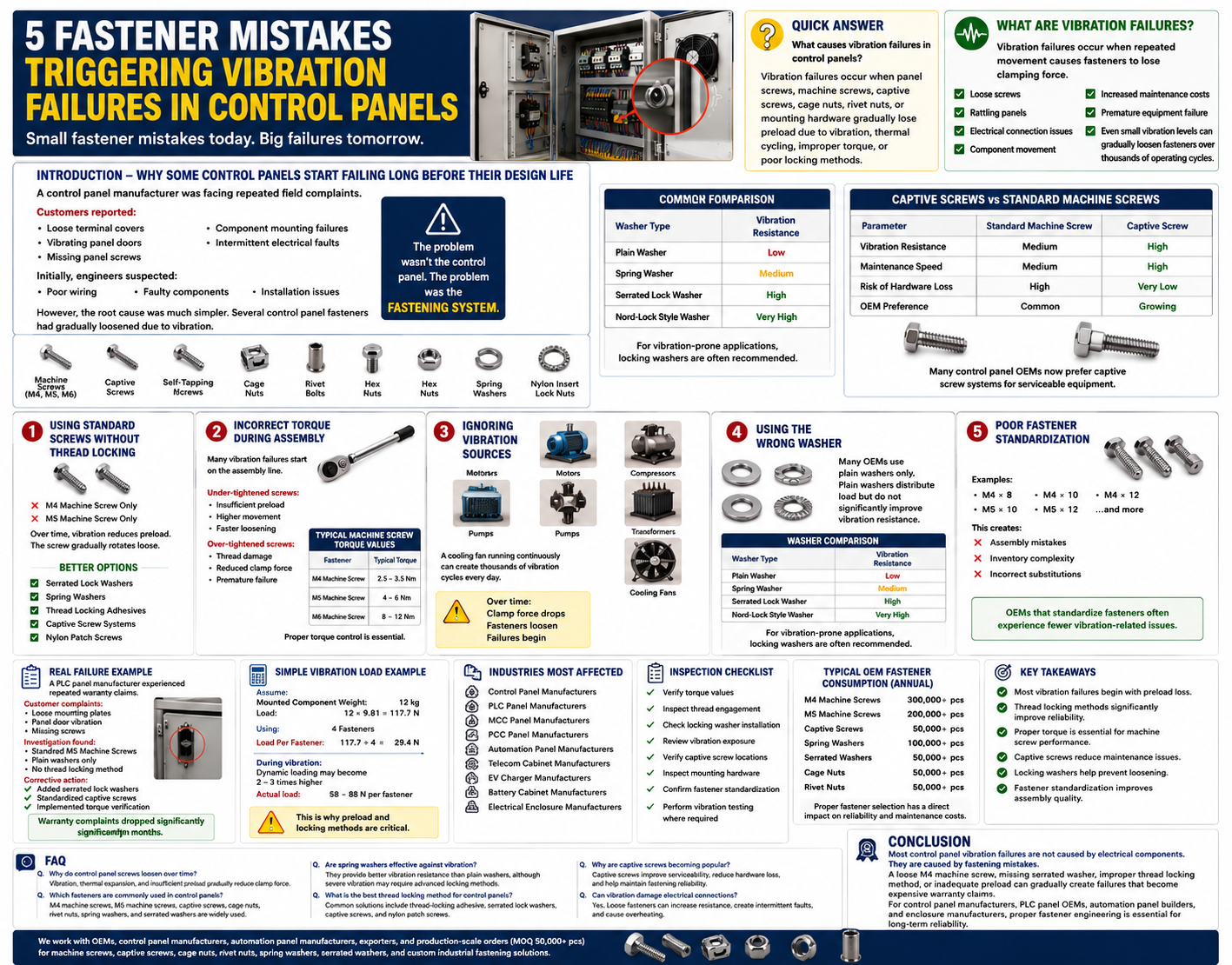
Introduction – Why Some Control Panels Start Failing Long Before Their Design Life
A control panel manufacturer was facing repeated field complaints.
Customers reported:
- Loose terminal covers
- Vibrating panel doors
- Missing panel screws
- Component mounting failures
- Intermittent electrical faults
Initially, engineers suspected:
- Poor wiring
- Faulty components
- Installation issues
However, the root cause was much simpler.
Several control panel fasteners had gradually loosened due to vibration.
The problem wasn’t the control panel.
The problem wasn’t the electrical design.
The problem was the fastening system.
Today, vibration-induced fastener failures are among the most common reliability issues in:
- Control Panels
- PLC Panels
- MCC Panels
- PCC Panels
- Automation Panels
- VFD Panels
- Telecom Cabinets
- EV Charger Cabinets
Quick Answer
What causes vibration failures in control panels?
Vibration failures occur when panel screws, machine screws, captive screws, cage nuts, rivet nuts, or mounting hardware gradually lose preload due to vibration, thermal cycling, improper torque, or poor locking methods.
What Are Vibration Failures?
Vibration failures occur when repeated movement causes fasteners to lose clamping force.
Common symptoms include:
- Loose screws
- Rattling panels
- Electrical connection issues
- Component movement
- Increased maintenance costs
- Premature equipment failure
Even small vibration levels can gradually loosen fasteners over thousands of operating cycles.
Common Fasteners Used in Control Panels
Most control panel manufacturers use:
- M4 Machine Screws
- M5 Machine Screws
- M6 Machine Screws
- Captive Screws
- Self-Tapping Screws
- Cage Nuts
- Rivet Nuts
- Hex Bolts
- Hex Nuts
- Spring Washers
- Serrated Lock Washers
- Nylon Insert Lock Nuts
These fasteners are commonly used for:
- Door mounting
- Component mounting
- Cable management
- DIN rail systems
- Terminal blocks
- Electrical accessories
Mistake #1 – Using Standard Screws Without Thread Locking
Many manufacturers install standard machine screws without any locking feature.
Typical examples:
❌ M4 Machine Screw Only
❌ M5 Machine Screw Only
Over time, vibration reduces preload.
The screw gradually rotates loose.
Better options include:
✔ Serrated Lock Washers
✔ Spring Washers
✔ Thread Locking Adhesives
✔ Captive Screw Systems
✔ Nylon Patch Screws
Mistake #2 – Incorrect Torque During Assembly
Many vibration failures start on the assembly line.
Under-tightened screws:
- Insufficient preload
- Higher movement
- Faster loosening
Over-tightened screws:
- Thread damage
- Reduced clamp force
- Premature failure
Typical Machine Screw Torque Values
| Fastener | Typical Torque |
| M4 Machine Screw | 2.5–3.5 Nm |
| M5 Machine Screw | 4–6 Nm |
| M6 Machine Screw | 8–12 Nm |
Proper torque control is essential.
Mistake #3 – Ignoring Vibration Sources
Many control panels operate near:
- Motors
- Compressors
- Pumps
- Transformers
- Cooling Fans
- Generators
A cooling fan running continuously can create thousands of vibration cycles every day.
Over time:
- Clamp force drops
- Fasteners loosen
- Failures begin
Mistake #4 – Using the Wrong Washer
Many OEMs use plain washers only.
Plain washers distribute load but do not significantly improve vibration resistance.
Washer Comparison
| Washer Type | Vibration Resistance |
| Plain Washer | Low |
| Spring Washer | Medium |
| Serrated Lock Washer | High |
| Nord-Lock Style Washer | Very High |
For vibration-prone applications, locking washers are often recommended.
Mistake #5 – Poor Fastener Standardization
Many control panel manufacturers use dozens of screw variations.
Examples:
- M4 × 8
- M4 × 10
- M4 × 12
- M5 × 10
- M5 × 12
This creates:
- Assembly mistakes
- Inventory complexity
- Incorrect substitutions
OEMs that standardize fasteners often experience fewer vibration-related issues.
Real Failure Example
A PLC panel manufacturer experienced repeated warranty claims.
Customer complaints:
- Loose mounting plates
- Panel door vibration
- Missing screws
Investigation found:
- Standard M5 Machine Screws
- Plain washers only
- No thread locking method
Corrective action:
- Added serrated lock washers
- Standardized captive screws
- Implemented torque verification
Warranty complaints dropped significantly within months.
Simple Vibration Load Example
Assume:
Mounted Component Weight:
12 kg
Load:
12 × 9.81
= 117.7 N
Using:
4 Fasteners
Load Per Fastener:
117.7 ÷ 4
= 29.4 N
During vibration:
Dynamic loading may become:
2–3 times higher
Actual load:
58–88 N per fastener
This is why preload and locking methods are critical.
Captive Screws vs Standard Machine Screws
| Parameter | Standard Machine Screw | Captive Screw |
| Vibration Resistance | Medium | High |
| Maintenance Speed | Medium | High |
| Risk of Hardware Loss | High | Very Low |
| OEM Preference | Common | Growing |
Many control panel OEMs now prefer captive screw systems for serviceable equipment.
Industries Most Affected
This issue frequently affects:
- Control Panel Manufacturers
- PLC Panel Manufacturers
- MCC Panel Manufacturers
- PCC Panel Manufacturers
- Automation Panel Manufacturers
- Telecom Cabinet Manufacturers
- EV Charger Manufacturers
- Battery Cabinet Manufacturers
- Electrical Enclosure Manufacturers
Inspection Checklist
Before panel dispatch:
✔ Verify torque values
✔ Inspect thread engagement
✔ Check locking washer installation
✔ Review vibration exposure
✔ Verify captive screw locations
✔ Inspect mounting hardware
✔ Confirm fastener standardization
✔ Perform vibration testing where required
Typical OEM Fastener Consumption
A medium-sized control panel manufacturer may consume annually:
- 300,000+ M4 Machine Screws
- 200,000+ M5 Machine Screws
- 50,000+ Captive Screws
- 100,000+ Spring Washers
- 50,000+ Serrated Washers
- 50,000+ Cage Nuts
- 50,000+ Rivet Nuts
Proper fastener selection has a direct impact on reliability and maintenance costs.
Key Takeaways
- Most vibration failures begin with preload loss.
- Thread locking methods significantly improve reliability.
- Proper torque is essential for machine screw performance.
- Captive screws reduce maintenance issues.
- Locking washers help prevent loosening.
- Fastener standardization improves assembly quality.
FAQ
Why do control panel screws loosen over time?
Vibration, thermal expansion, and insufficient preload gradually reduce clamp force, allowing screws to loosen.
Which fasteners are commonly used in control panels?
Are spring washers effective against vibration?
They provide better vibration resistance than plain washers, although severe vibration may require advanced locking methods.
What is the best thread locking method for control panels?
Common solutions include thread-locking adhesive, serrated lock washers, captive screws, and nylon patch screws.
Why are captive screws becoming popular?
Captive screws improve serviceability, reduce hardware loss, and help maintain fastening reliability.
Can vibration damage electrical connections?
Yes. Loose fasteners can increase resistance, create intermittent faults, and cause overheating.
Which industries face vibration-related fastener failures most often?
Control panel manufacturers, automation panel manufacturers, telecom cabinet manufacturers, EV charger manufacturers, and battery cabinet manufacturers.
How can OEMs reduce vibration failures?
By using proper torque control, thread locking methods, locking washers, captive screws, and standardized fastener systems.
Conclusion
Most control panel vibration failures are not caused by electrical components.
They are caused by fastening mistakes.
A loose M4 machine screw, missing serrated washer, improper thread locking method, or inadequate preload can gradually create failures that become expensive warranty claims.
For control panel manufacturers, PLC panel OEMs, automation panel builders, and enclosure manufacturers, proper fastener engineering is essential for long-term reliability.