

Introduction – A Failure That Starts Before Final Assembly
A sheet metal panel manufacturer was producing electrical enclosures for an OEM customer.
The assembly team followed standard procedures.
The torque values were correct.
The screws were tightened properly.
The operators followed work instructions.
Yet during assembly, multiple M6 weld nuts cracked and detached from the panel.
Production stopped.
Rework increased.
Delivery schedules were affected.
At first glance, the torque appeared to be the cause.
However, after investigation, engineers discovered something important:
👉 The weld nut failed long before the assembly process.
The crack simply became visible during tightening.
Today, weld nut failures are a common issue in:
- Electrical Panels
- Control Panels
- Telecom Cabinets
- Battery Cabinets
- EV Charger Cabinets
- Industrial Enclosures
- Sheet Metal Assemblies
Understanding why M6 weld nuts crack is essential for OEM manufacturers handling production-scale volumes.
Quick Answer
Why do M6 weld nuts crack during assembly?
M6 weld nuts typically crack due to poor welding parameters, insufficient weld penetration, incorrect sheet thickness, material stress, excessive heat input, or misalignment during installation. The visible crack often appears during tightening, but the root cause usually originates during welding.
What Is a Weld Nut?
A weld nut is a threaded fastener permanently attached to sheet metal using a welding process.
Common types include:
- Projection Weld Nut
- Hex Weld Nut
- Square Weld Nut
- Round Base Weld Nut
- Flange Weld Nut
These fasteners provide reliable threaded connections where tapping is impractical.
Fasteners Commonly Used with Weld Nuts
Electrical panel manufacturers frequently use:
- M4 Machine Screws
- M5 Machine Screws
- M6 Machine Screws
- M8 Machine Screws
- Captive Screws
- Cage Nuts
- Rivet Nuts
- Projection Weld Nuts
- Hex Weld Nuts
- Spring Washers
- Serrated Washers
Among these, the M6 Projection Weld Nut is one of the most widely used fastening solutions in sheet metal enclosures.
Why OEMs Prefer M6 Weld Nuts
Weld nuts offer several advantages:
✔ Fast assembly
✔ Strong thread engagement
✔ Reduced component count
✔ Suitable for thin sheet metal
✔ Cost-effective for mass production
✔ Ideal for automation
This is why they are heavily used in:
- LT Panels
- PCC Panels
- MCC Panels
- Control Panels
- Battery Cabinets
- Telecom Cabinets
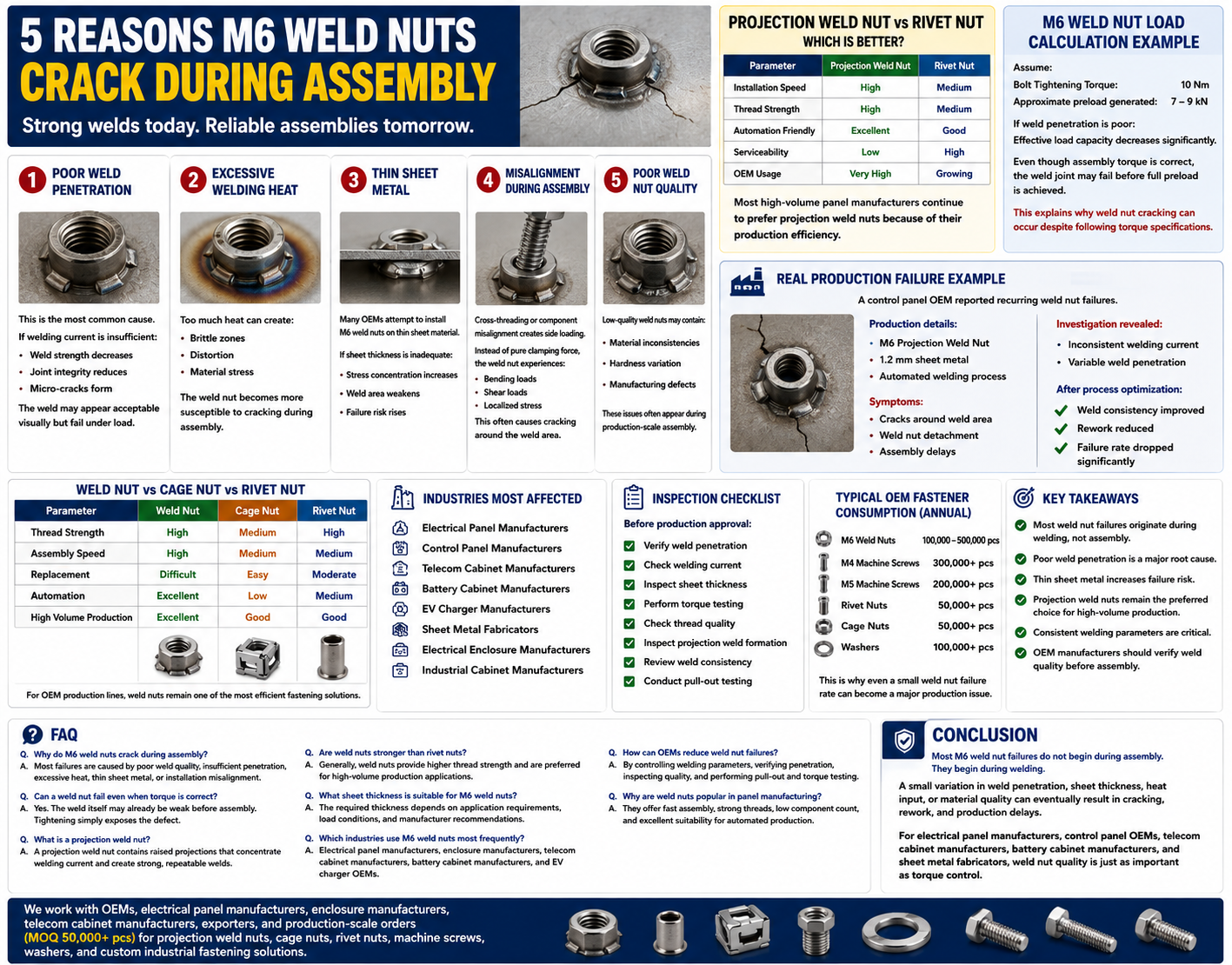
5 Reasons M6 Weld Nuts Crack During Assembly
1. Poor Weld Penetration
This is the most common cause.
If welding current is insufficient:
- Weld strength decreases
- Joint integrity reduces
- Micro-cracks form
The weld may appear acceptable visually but fail under load.
2. Excessive Welding Heat
Too much heat can create:
- Brittle zones
- Distortion
- Material stress
The weld nut becomes more susceptible to cracking during assembly.
3. Thin Sheet Metal
Many OEMs attempt to install M6 weld nuts on thin sheet material.
If sheet thickness is inadequate:
- Stress concentration increases
- Weld area weakens
- Failure risk rises
4. Misalignment During Assembly
Cross-threading or component misalignment creates side loading.
Instead of pure clamping force, the weld nut experiences:
- Bending loads
- Shear loads
- Localized stress
This often causes cracking around the weld area.
5. Poor Weld Nut Quality
Low-quality weld nuts may contain:
- Material inconsistencies
- Hardness variation
- Manufacturing defects
These issues often appear during production-scale assembly.
Projection Weld Nut vs Rivet Nut
Which Is Better?
| Parameter | Projection Weld Nut | Rivet Nut |
| Installation Speed | High | Medium |
| Thread Strength | High | Medium |
| Automation Friendly | Excellent | Good |
| Serviceability | Low | High |
| OEM Usage | Very High | Growing |
Most high-volume panel manufacturers continue to prefer projection weld nuts because of their production efficiency.
M6 Weld Nut Load Calculation Example
Assume:
Bolt Tightening Torque:
10 Nm
Approximate preload generated:
7–9 kN
If weld penetration is poor:
Effective load capacity decreases significantly.
Even though assembly torque is correct, the weld joint may fail before full preload is achieved.
This explains why weld nut cracking can occur despite following torque specifications.
Real Production Failure Example
A control panel OEM reported recurring weld nut failures.
Production details:
- M6 Projection Weld Nut
- 1.2 mm sheet metal
- Automated welding process
Symptoms:
- Cracks around weld area
- Weld nut detachment
- Assembly delays
Investigation revealed:
- Inconsistent welding current
- Variable weld penetration
After process optimization:
✔ Weld consistency improved
✔ Rework reduced
✔ Failure rate dropped significantly
Weld Nut vs Cage Nut vs Rivet Nut
| Parameter | Weld Nut | Cage Nut | Rivet Nut |
| Thread Strength | High | Medium | High |
| Assembly Speed | High | Medium | Medium |
| Replacement | Difficult | Easy | Moderate |
| Automation | Excellent | Low | Medium |
| High Volume Production | Excellent | Good | Good |
For OEM production lines, weld nuts remain one of the most efficient fastening solutions.
Industries Most Affected
Weld nut failures commonly impact:
- Electrical Panel Manufacturers
- Control Panel Manufacturers
- Telecom Cabinet Manufacturers
- Battery Cabinet Manufacturers
- EV Charger Manufacturers
- Sheet Metal Fabricators
- Electrical Enclosure Manufacturers
- Industrial Cabinet Manufacturers
Inspection Checklist
Before production approval:
✔ Verify weld penetration
✔ Check welding current
✔ Inspect sheet thickness
✔ Perform torque testing
✔ Check thread quality
✔ Inspect projection weld formation
✔ Review weld consistency
✔ Conduct pull-out testing
Typical OEM Fastener Consumption
A medium-sized panel manufacturer may consume annually:
- 100,000–500,000 M6 Weld Nuts
- 300,000+ M4 Machine Screws
- 200,000+ M5 Machine Screws
- 50,000+ Rivet Nuts
- 50,000+ Cage Nuts
- 100,000+ Washers
This is why even a small weld nut failure rate can become a major production issue.
Key Takeaways
- Most weld nut failures originate during welding, not assembly.
- Poor weld penetration is a major root cause.
- Thin sheet metal increases failure risk.
- Projection weld nuts remain the preferred choice for high-volume production.
- Consistent welding parameters are critical.
- OEM manufacturers should verify weld quality before assembly.
FAQ
Why do M6 weld nuts crack during assembly?
Most failures are caused by poor weld quality, insufficient penetration, excessive heat, thin sheet metal, or installation misalignment.
Can a weld nut fail even when torque is correct?
Yes. The weld itself may already be weak before assembly. Tightening simply exposes the defect.
What is a projection weld nut?
A projection weld nut contains raised projections that concentrate welding current and create strong, repeatable welds.
Are weld nuts stronger than rivet nuts?
Generally, weld nuts provide higher thread strength and are preferred for high-volume production applications.
What sheet thickness is suitable for M6 weld nuts?
The required thickness depends on application requirements, load conditions, and manufacturer recommendations.
Which industries use M6 weld nuts most frequently?
Electrical panel manufacturers, enclosure manufacturers, telecom cabinet manufacturers, battery cabinet manufacturers, and EV charger OEMs.
How can OEMs reduce weld nut failures?
By controlling welding parameters, verifying penetration, inspecting quality, and performing pull-out and torque testing.
Why are weld nuts popular in panel manufacturing?
They offer fast assembly, strong threads, low component count, and excellent suitability for automated production.
Conclusion
Most M6 weld nut failures do not begin during assembly.
They begin during welding.
A small variation in weld penetration, sheet thickness, heat input, or material quality can eventually result in cracking, rework, and production delays.
For electrical panel manufacturers, control panel OEMs, telecom cabinet manufacturers, battery cabinet manufacturers, and sheet metal fabricators, weld nut quality is just as important as torque control.