

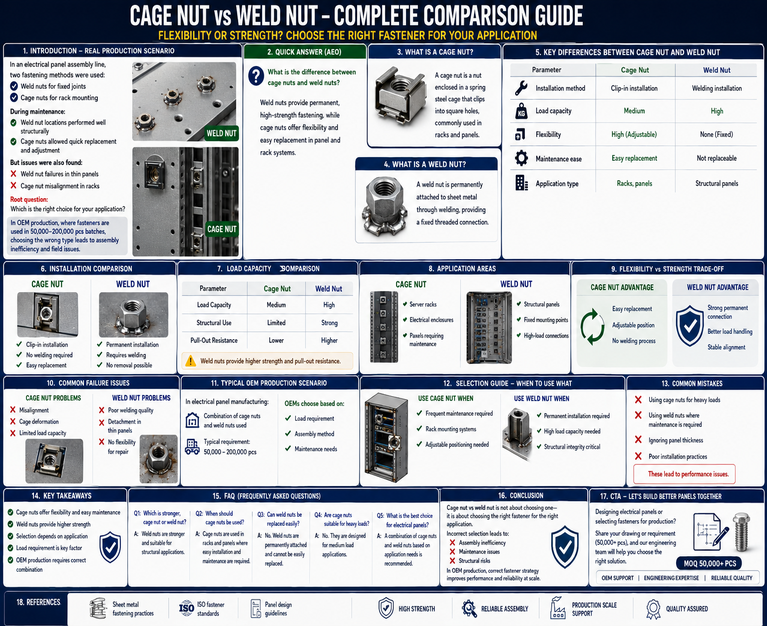
Introduction – Real Production Scenario
In an electrical panel assembly line, two fastening methods were used:
👉 Weld nuts for fixed joints
👉 Cage nuts for rack mounting
During maintenance:
- Weld nut locations performed well structurally
- Cage nuts allowed quick replacement and adjustment
But issues were also found:
👉 Weld nut failures in thin panels
👉 Cage nut misalignment in racks
Root question:
👉 Which is the right choice for your application?
In OEM production, where fasteners are used in 50,000–200,000 pcs batches, choosing the wrong type leads to assembly inefficiency and field issues.
Quick Answer
What is the difference between cage nuts and weld nuts?
Weld nuts provide permanent, high-strength fastening, while cage nuts offer flexibility and easy replacement in panel and rack systems.
What is a Cage Nut?
A cage nut is a nut enclosed in a spring steel cage that clips into square holes, commonly used in racks and panels.
What is a Weld Nut?
A weld nut is permanently attached to sheet metal through welding, providing a fixed threaded connection.
5 Key Differences Between Cage Nut and Weld Nut
- Installation method
- Load capacity
- Flexibility
- Maintenance ease
- Application type
Installation Comparison
Cage Nut
✔ Clip-in installation
✔ No welding required
✔ Easy replacement
Weld Nut
✔ Permanent installation
✔ Requires welding
✔ No removal possible
Load Capacity Comparison
| Parameter | Cage Nut | Weld Nut |
| Load Capacity | Medium | High |
| Structural Use | Limited | Strong |
| Pull-Out Resistance | Lower | Higher |
Application Areas
Cage Nut
✔ Server racks
✔ Electrical enclosures
✔ Panels requiring maintenance
Weld Nut
✔ Structural panels
✔ Fixed mounting points
✔ High-load connections
Flexibility vs Strength Trade-Off
Cage Nut Advantage
✔ Easy replacement
✔ Adjustable position
✔ No welding process
Weld Nut Advantage
✔ Strong permanent connection
✔ Better load handling
✔ Stable alignment
Common Failure Issues
Cage Nut Problems
- Misalignment
- Cage deformation
- Limited load capacity
Weld Nut Problems
- Poor welding quality
- Detachment in thin panels
- No flexibility for repair
Typical OEM Production Scenario
In electrical panel manufacturing:
- Combination of cage nuts and weld nuts used
- Typical requirement: 50,000–200,000 pcs
OEMs choose based on:
✔ Load requirement
✔ Assembly method
✔ Maintenance needs
Selection Guide – When to Use What
Use Cage Nut When
✔ Frequent maintenance required
✔ Rack mounting systems
✔ Adjustable positioning needed
Use Weld Nut When
✔ Permanent installation required
✔ High load capacity needed
✔ Structural integrity critical
Common Mistakes
- Using cage nuts for heavy loads
- Using weld nuts where maintenance is required
- Ignoring panel thickness
- Poor installation practices
👉 These lead to performance issues
Key Takeaways
• Cage nuts offer flexibility and easy maintenance
• Weld nuts provide higher strength
• Selection depends on application
• Load requirement is key factor
• OEM production requires correct combination
FAQ
Q1: Which is stronger, cage nut or weld nut?
Weld nuts are stronger and suitable for structural applications.
Q2: When should cage nuts be used?
Cage nuts are used in racks and panels where easy installation and maintenance are required.
Q3: Can weld nuts be replaced easily?
No. Weld nuts are permanently attached and cannot be easily replaced.
Q4: Are cage nuts suitable for heavy loads?
No. They are designed for medium load applications.
Q5: What is the best choice for electrical panels?
A combination of cage nuts and weld nuts based on application needs is recommended.
Conclusion
Cage nut vs weld nut is not about choosing one—it is about choosing the right fastener for the right application.
Incorrect selection leads to:
👉 Assembly inefficiency
👉 Maintenance issues
👉 Structural risks
In OEM production, correct fastener strategy improves performance and reliability at scale.
👉 We work with OEMs and production-scale orders (MOQ 50,000+ pcs) for panel and industrial fasteners.
Designing electrical panels or selecting fasteners for production?
Share your drawing or requirement (50,000+ pcs), and our engineering team will help you choose the right solution.
References
- Sheet metal fastening practices
- ISO fastener standards
- Panel design guidelines