

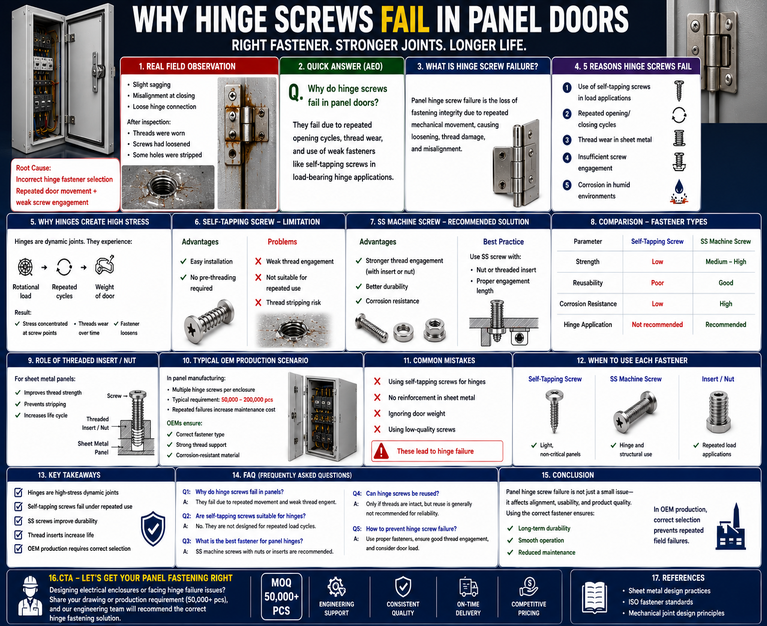
Introduction – Real Field Observation
In an electrical enclosure, panel doors started showing:
👉 Slight sagging
👉 Misalignment at closing
👉 Loose hinge connection
After inspection:
👉 Threads were worn
👉 Screws had loosened
👉 Some holes were stripped
Root cause:
👉 Incorrect hinge fastener selection
👉 Repeated door movement + weak screw engagement
Panel door hinges experience repeated load cycles, unlike static joints.
In OEM production, these screws are used in 50,000–200,000 pcs batches, where poor selection leads to long-term durability issues.
Quick Answer
Why do hinge screws fail in panel doors?
They fail due to repeated opening cycles, thread wear, and use of weak fasteners like self-tapping screws in load-bearing hinge applications.
What is Panel Hinge Screw Failure?
Panel hinge screw failure is the loss of fastening integrity due to repeated mechanical movement, causing loosening, thread damage, and misalignment.
5 Reasons Hinge Screws Fail
- Use of self-tapping screws in load applications
- Repeated opening/closing cycles
- Thread wear in sheet metal
- Insufficient screw engagement
- Corrosion in humid environments
Why Hinges Create High Stress
Hinges are dynamic joints.
They experience:
👉 Rotational load
👉 Repeated cycles
👉 Weight of door
Result
- Stress concentrated at screw points
- Threads wear over time
- Fastener loosens
Self-Tapping Screw – Limitation
Advantages
✔ Easy installation
✔ No pre-threading required
Problems
- Weak thread engagement
- Not suitable for repeated use
- Thread stripping risk
SS Machine Screw – Recommended Solution
Advantages
✔ Stronger thread engagement (with insert or nut)
✔ Better durability
✔ Corrosion resistance
Best Practice
Use SS screw with:
👉 Nut or threaded insert
👉 Proper engagement length
Comparison – Fastener Types
| Parameter | Self-Tapping Screw | SS Machine Screw |
| Strength | Low | Medium–High |
| Reusability | Poor | Good |
| Corrosion Resistance | Low | High |
| Hinge Application | Not recommended | Recommended |
Role of Threaded Insert / Nut
For sheet metal panels:
✔ Improves thread strength
✔ Prevents stripping
✔ Increases life cycle
Typical OEM Production Scenario
In panel manufacturing:
- Multiple hinge screws per enclosure
- Typical requirement: 50,000–200,000 pcs
- Repeated failures increase maintenance cost
OEMs ensure:
✔ Correct fastener type
✔ Strong thread support
✔ Corrosion-resistant material
Common Mistakes
- Using self-tapping screws for hinges
- No reinforcement in sheet metal
- Ignoring door weight
- Using low-quality screws
👉 These lead to hinge failure
When to Use Each Fastener
✔ Self-tapping screw → light, non-critical panels
✔ SS machine screw → hinge and structural use
✔ Insert/nut → repeated load applications
Key Takeaways
• Hinges are high-stress dynamic joints
• Self-tapping screws fail under repeated use
• SS screws improve durability
• Thread inserts increase life
• OEM production requires correct selection
FAQ
Q1: Why do hinge screws fail in panels?
They fail due to repeated movement and weak thread engagement.
Q2: Are self-tapping screws suitable for hinges?
No. They are not designed for repeated load cycles.
Q3: What is the best fastener for panel hinges?
SS machine screws with nuts or inserts are recommended.
Q4: Can hinge screws be reused?
Only if threads are intact, but reuse is generally not recommended for reliability.
Q5: How to prevent hinge screw failure?
Use proper fasteners, ensure good thread engagement, and consider door load.
Conclusion
Panel hinge screw failure is not just a small issue—it affects alignment, usability, and product quality.
Using the correct fastener ensures:
✔ Long-term durability
✔ Smooth operation
✔ Reduced maintenance
In OEM production, correct selection prevents repeated field failures.
👉 We work with OEMs and production-scale orders (MOQ 50,000+ pcs) for panel and industrial fasteners.
Designing electrical enclosures or facing hinge failure issues?
Share your drawing or production requirement (50,000+ pcs), and our engineering team will recommend the correct hinge fastening solution.
References
- Sheet metal design practices
- ISO fastener standards
- Mechanical joint design principles