

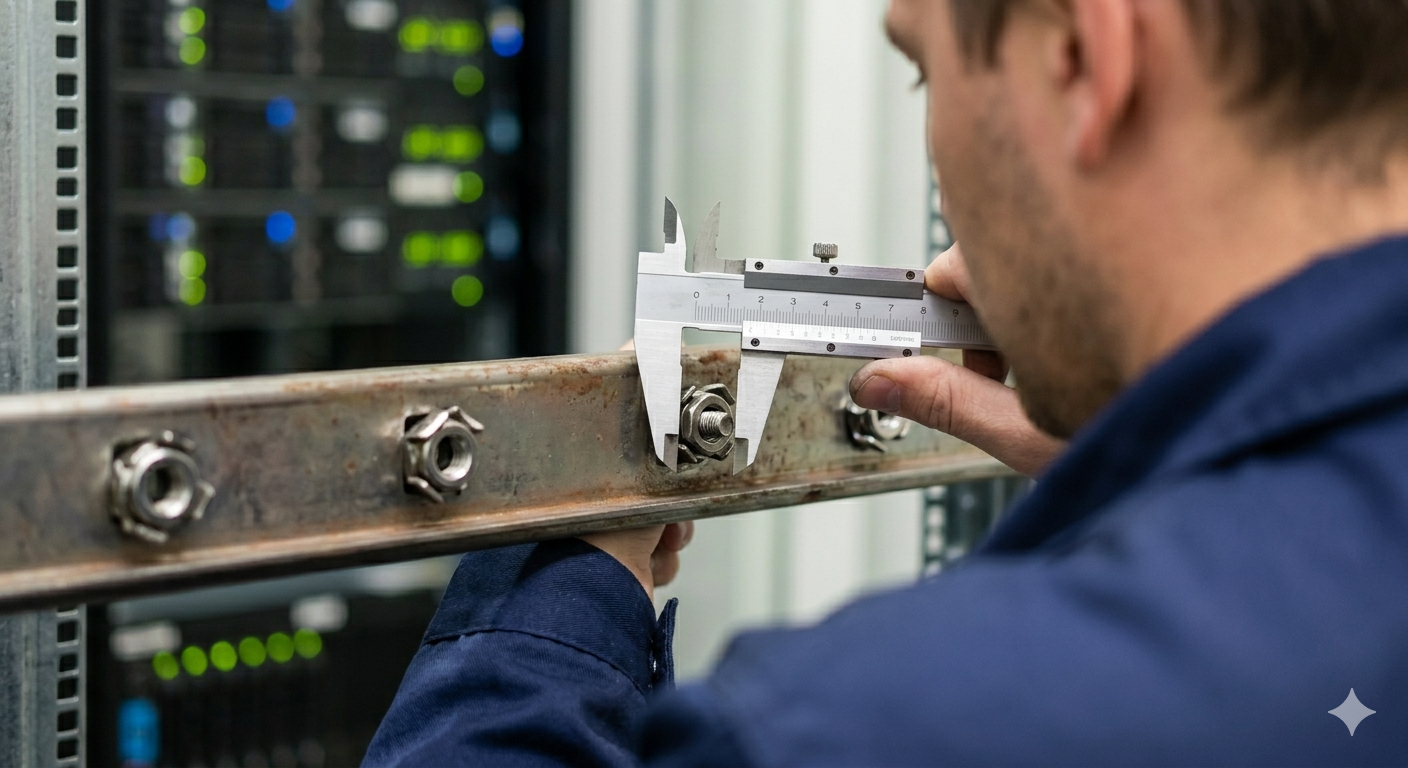
Introduction – A Small Fastener Caused a Big Failure
A control panel manufacturer received an urgent complaint.
Several mounted electrical components had shifted inside a panel during transportation.
Inspection found:
- No sheet metal damage
- No rack deformation
- No component failure
The actual problem was much smaller.
Two cage nuts had pulled out from the mounting rail.
The entire load was transferred to the remaining fasteners.
Within days, additional cage nuts failed.
The issue wasn’t the panel.
The issue wasn’t the component.
The issue was an incorrect understanding of cage nut strength.
This type of failure is commonly found in:
- Control Panels
- PLC Panels
- Server Racks
- Telecom Cabinets
- Electrical Enclosures
- Battery Cabinets
- EV Charger Cabinets
Quick Answer
What causes cage nut pull-out failure?
Cage nut pull-out failure occurs when the applied load exceeds the retention strength of the cage nut or when incorrect installation, sheet thickness, vibration, or poor load distribution reduces holding capacity.
What Is a Cage Nut?
A cage nut is a spring steel cage containing a captive nut that snaps into a square panel opening.
It allows threaded fastening where direct tapping is not possible.
Common sizes include:
- M4 Cage Nut
- M5 Cage Nut
- M6 Cage Nut
- M8 Cage Nut
They are widely used in:
- Control Panels
- Server Cabinets
- Telecom Racks
- Battery Enclosures
- Industrial Cabinets
- Switchgear Assemblies
Why Control Panel Manufacturers Use Cage Nuts
Control panel OEMs prefer cage nuts because:
✔ Easy installation
✔ Easy replacement
✔ No welding required
✔ Suitable for thin sheet metal
✔ Faster assembly
✔ Lower manufacturing cost
However, improper selection can create serious load problems.
Fasteners Commonly Used with Cage Nuts
Typical rack fasteners include:
- Cage Nuts
- Machine Screws
- Captive Screws
- Hex Bolts
- Rivet Nuts
- Weld Nuts
- Serrated Washers
- Spring Washers
- Flat Washers
Most control panel manufacturers combine:
M6 Cage Nut + M6 Machine Screw
for mounting heavier electrical equipment.
Why Cage Nuts Pull Out
1. Load Exceeds Cage Nut Capacity
This is the most common cause.
A cage nut is designed to support a specific load range.
When weight exceeds design limits:
- Spring cage deforms
- Retention force decreases
- Pull-out occurs
2. Thin Sheet Metal
The cage depends on the square hole for retention.
If sheet metal is too thin:
- Holding force reduces
- Deformation increases
- Failure risk rises
3. Improper Installation
Common mistakes include:
- Bent cage wings
- Damaged cage springs
- Incorrect hole size
- Partial engagement
These significantly reduce cage nut strength.
4. Dynamic Loads
Many engineers only consider static weight.
Actual conditions include:
- Transportation vibration
- Machine vibration
- Shock loading
- Repeated door opening
Dynamic loads can exceed static load ratings.
5. Uneven Load Distribution
One overloaded cage nut often fails first.
The remaining fasteners then carry extra load.
A chain reaction begins.
Cage Nut vs Rivet Nut
Which Is Better for Heavy Loads?
| Parameter | Cage Nut | Rivet Nut |
| Installation Speed | High | Medium |
| Replacement | Easy | Difficult |
| Load Capacity | Medium | High |
| Maintenance | Excellent | Moderate |
| OEM Usage | Very Common | Growing |
For extremely heavy equipment, many OEMs use rivet nuts instead of cage nuts.
Cage Nut Load Calculation Example
Assume:
Electrical Component Weight:
40 kg
Load:
40 × 9.81
= 392 N
Using:
4 M6 Cage Nuts
Load Per Cage Nut:
392 ÷ 4
= 98 N
Now apply:
Safety Factor = 3
Required Capacity:
98 × 3
= 294 N
Each cage nut should safely support at least 294 N.
Many engineers skip this simple calculation.
Real Failure Example
A PLC control panel was shipped to a project site.
Equipment mounted:
- PLC modules
- Power supplies
- Communication units
Fastening system:
- M6 Cage Nuts
- M6 Machine Screws
Issue:
Only two mounting points were used.
During transportation:
- Vibration increased
- Load concentrated
- Cage nuts deformed
One cage nut pulled out.
The entire assembly shifted.
The problem wasn’t vibration.
The problem was poor load distribution.
M6 Cage Nut vs M6 Rivet Nut
| Parameter | M6 Cage Nut | M6 Rivet Nut |
| Serviceability | Excellent | Good |
| Pull-Out Resistance | Medium | High |
| Installation Cost | Low | Medium |
| OEM Preference | Very High | Increasing |
| Rack Applications | Excellent | Good |
Industries Most Affected by Cage Nut Failures
This issue frequently affects:
- Control Panel Manufacturers
- PLC Panel Manufacturers
- Telecom Cabinet Manufacturers
- Server Rack Manufacturers
- Battery Cabinet Manufacturers
- EV Charger Manufacturers
- Electrical Enclosure Manufacturers
- Switchgear Manufacturers
Inspection Checklist
Before dispatch:
✔ Verify cage nut engagement
✔ Check hole dimensions
✔ Inspect cage spring condition
✔ Verify load distribution
✔ Review mounting locations
✔ Check machine screw torque
✔ Inspect vibration-prone assemblies
✔ Verify transportation requirements
Typical OEM Fastener Consumption
A medium-sized control panel manufacturer may consume annually:
- 50,000–200,000 Cage Nuts
- 50,000–300,000 Machine Screws
- 20,000–100,000 Captive Screws
- 50,000+ Rivet Nuts
- 100,000+ Washers
Proper standardization significantly improves assembly efficiency.
Key Takeaways
- Cage nut pull-out is usually a load distribution problem.
- Dynamic loads are often ignored during design.
- Proper sheet thickness improves retention strength.
- M6 cage nuts are widely used in control panels and racks.
- Rivet nuts may be preferred for higher loads.
- Simple load calculations prevent expensive failures.
FAQ
What is the load capacity of an M6 cage nut?
Load capacity varies by manufacturer, material, and sheet thickness. Always review supplier specifications and apply a suitable safety factor.
Why do cage nuts pull out during transportation?
Transportation creates vibration and shock loads that may exceed static design assumptions. Poor load distribution increases risk.
Are cage nuts stronger than rivet nuts?
Generally, rivet nuts provide higher pull-out resistance. Cage nuts offer better serviceability and easier replacement.
Which screw is commonly used with cage nuts?
M4, M5, and M6 machine screws are the most common choices depending on the application.
Can cage nuts be reused?
Yes, provided the cage spring remains undamaged and retention force is maintained.
What industries use cage nuts the most?
Control panel manufacturers, telecom cabinet manufacturers, battery cabinet manufacturers, and server rack manufacturers use cage nuts extensively.
How can OEMs prevent cage nut failures?
By verifying load calculations, improving load distribution, selecting proper sheet thickness, and inspecting installation quality.
Are cage nuts suitable for vibration-prone applications?
Yes, when properly selected and installed. Additional locking methods may be required for severe vibration environments.
Conclusion
Cage nut failures rarely occur because of defective fasteners.
Most failures occur because:
- Load capacity is misunderstood
- Dynamic loads are ignored
- Installation quality is poor
- Load distribution is inadequate
For control panel manufacturers, electrical enclosure manufacturers, telecom cabinet manufacturers, and battery cabinet OEMs, understanding cage nut strength is essential for long-term reliability.