

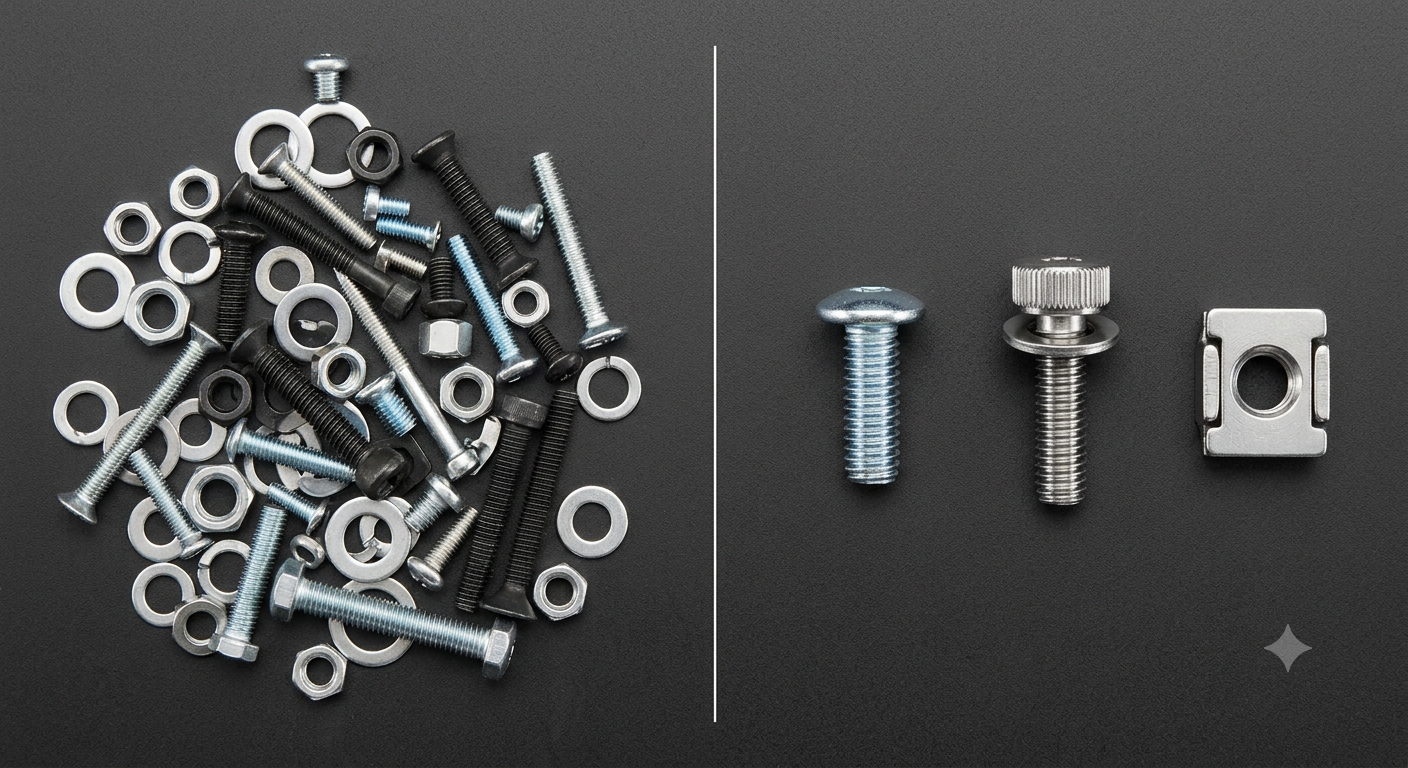
Introduction – The Hidden Cost Sitting Inside Most Panel Factories
A control panel manufacturer producing LT panels, MCC panels, and PCC panels was facing a common problem.
Not production.
Not quality.
Not sales.
The problem was inventory.
Their stores contained:
- M4 Machine Screws
- M5 Machine Screws
- M6 Machine Screws
- Multiple Hex Bolts
- Different Hex Nuts
- Various Spring Washers
- Several Plain Washer sizes
- Different Captive Screws
- Multiple Cage Nuts
More than 120 fastener SKUs were being managed.
Purchase orders increased.
Inventory carrying cost increased.
Stock shortages became common.
Yet production volume remained unchanged.
After a six-month review, the company reduced fastener inventory by nearly 60%.
The surprising part?
They did not redesign a single panel.
Quick Answer
What is panel fastener standardization?
Panel fastener standardization is the process of reducing the number of fastener types used across multiple products by selecting common screws, bolts, nuts, washers, cage nuts, rivet nuts, and captive screws wherever possible.
This reduces inventory, simplifies procurement, and improves manufacturing efficiency.
What Is Fastener Standardization?
Fastener standardization means using fewer fastener variations across multiple products.
Instead of using:
- 5 screw sizes
- 4 washer sizes
- 3 nut types
An OEM may standardize around:
- M4 Machine Screws
- M5 Machine Screws
- Captive Screws
- Cage Nuts
- Spring Washers
This creates a simpler manufacturing system.
Why Panel Manufacturers Face Inventory Problems
Many electrical panel manufacturers gradually add new fasteners over the years.
One customer requests:
👉 M4 Stainless Steel Screw
Another requests:
👉 M5 Zinc Plated Screw
A third project introduces:
👉 Captive Screw Assemblies
Eventually the factory ends up carrying hundreds of fastener combinations.
Common inventory problems include:
- Excess stock
- Duplicate fasteners
- Slow-moving inventory
- Purchasing complexity
- Assembly mistakes
Fasteners Commonly Used in Electrical Panels
Most panel manufacturers consume:
- M4 Machine Screws
- M5 Machine Screws
- M6 Machine Screws
- Captive Screws
- Cage Nuts
- Rivet Nuts
- Weld Nuts
- Hex Bolts
- Hex Nuts
- Spring Washers
- Plain Washers
- Serrated Washers
Used in:
- LT Panels
- HT Panels
- PCC Panels
- MCC Panels
- PLC Panels
- APFC Panels
- VFD Panels
- Control Panels
The OEM Standardization Project
The panel OEM reviewed:
Existing Situation
- 120+ Fastener SKUs
- Multiple suppliers
- Frequent stock-outs
- Excess inventory
Goal
Reduce inventory without changing panel design.
Step 1 – Identify High Consumption Fasteners
The first analysis showed:
Only a small number of fasteners represented most annual consumption.
Examples:
- M4 Machine Screws
- M5 Machine Screws
- M5 Captive Screws
- M6 Cage Nuts
- Spring Washers
These accounted for more than 80% of annual usage.
Step 2 – Eliminate Duplicate Sizes
The OEM found:
Several screws performed identical functions.
Examples:
Before:
- M4 × 10
- M4 × 12
- M4 × 14
After review:
Only:
- M4 × 12
was required for most applications.
This immediately reduced inventory.
Step 3 – Standardize Washer Selection
Many departments used different washers.
Examples:
- Plain Washer Type A
- Plain Washer Type B
- Spring Washer Type A
After engineering review:
Only approved standard washer combinations remained.
Inventory became easier to manage.
Step 4 – Consolidate Suppliers
The company reduced supplier count.
Benefits:
✔ Better pricing
✔ Improved quality consistency
✔ Easier procurement
✔ Faster replenishment
Inventory Reduction Results
| Parameter | Before | After |
| Fastener SKUs | 120+ | 48 |
| Suppliers | 14 | 5 |
| Inventory Value | 100% | 40% |
| Purchasing Complexity | High | Low |
| Assembly Errors | Frequent | Reduced |
Inventory reduction:
Approximately 60%
Without changing panel design.
Cost Reduction Calculation Example
Assume:
Inventory Value:
₹25 Lakhs
Reduction:
60%
Inventory Released:
₹15 Lakhs
This capital can be used for:
- Production
- New equipment
- Raw materials
- Working capital
Many OEMs underestimate the financial impact of fastener standardization.
Most Standardized Fasteners in Panel Manufacturing
The most commonly standardized products are:
Screws
- M4 Machine Screw
- M5 Machine Screw
- Captive Screw
Nuts
- Hex Nut
- Cage Nut
- Rivet Nut
Washers
- Spring Washer
- Plain Washer
- Serrated Washer
Bolts
- M6 Hex Bolt
- M8 Hex Bolt
These products cover a large percentage of panel applications.
Why OEMs Prefer Fastener Standardization
Benefits include:
✔ Lower inventory
✔ Lower procurement cost
✔ Faster assembly
✔ Better quality control
✔ Easier forecasting
✔ Reduced stock shortages
✔ Simplified BOM management
Industries Using Fastener Standardization
This strategy is widely used by:
- LT Panel Manufacturers
- HT Panel Manufacturers
- PCC Panel Manufacturers
- MCC Panel Manufacturers
- Control Panel Manufacturers
- Switchgear Manufacturers
- EV Charger Manufacturers
- Battery Cabinet Manufacturers
- Telecom Cabinet Manufacturers
Inspection Checklist
Before starting a standardization project:
✔ Review annual fastener consumption
✔ Identify duplicate sizes
✔ Review supplier list
✔ Check BOM variations
✔ Standardize washer combinations
✔ Standardize screw lengths
✔ Standardize approved fastener grades
✔ Review inventory carrying cost
Typical Annual Fastener Consumption
A medium-sized panel OEM may consume:
- 300,000+ M4 Machine Screws
- 200,000+ M5 Machine Screws
- 50,000+ Captive Screws
- 100,000+ Spring Washers
- 50,000+ Cage Nuts
- 50,000+ Rivet Nuts
This is why inventory optimization creates significant savings.
Key Takeaways
- Fastener standardization reduces inventory cost.
- Most OEMs carry more fastener SKUs than necessary.
- M4 and M5 machine screws often represent the majority of consumption.
- Standardized washers and captive screws simplify assembly.
- Inventory reduction can release significant working capital.
- Better standardization improves purchasing efficiency.
FAQ
What is panel fastener standardization?
It is the process of reducing the number of screws, bolts, nuts, washers, cage nuts, and captive screws used across multiple panel designs.
How much inventory can OEMs reduce?
Many manufacturers achieve 30–60% inventory reduction through engineering review and standardization
Which fasteners should be standardized first?
Typically high-volume items such as M4 machine screws, M5 machine screws, spring washers, cage nuts, and captive screws.
Does standardization require product redesign?
Not always. Many companies achieve large reductions simply by eliminating duplicate fastener sizes.
How does standardization reduce cost?
It reduces inventory carrying costs, purchasing complexity, supplier management effort, and assembly errors.
Which industries benefit most from fastener standardization?
Panel manufacturers, switchgear manufacturers, EV charger manufacturers, battery cabinet manufacturers, and enclosure manufacturers.
Can standardization improve assembly speed?
Yes. Fewer fastener types simplify production and reduce assembly mistakes.
Why do OEMs focus on fastener inventory?
Because fasteners are used in large volumes and often represent hundreds of inventory transactions every month.
Conclusion
Many electrical panel manufacturers focus on reducing material costs while ignoring fastener complexity.
Yet dozens of unnecessary fastener variations can quietly increase:
- Inventory cost
- Purchasing effort
- Assembly time
- Supplier management workload
The most successful OEMs standardize machine screws, captive screws, cage nuts, rivet nuts, washers, hex bolts, and hex nuts wherever possible.
The result is a simpler manufacturing system, lower inventory, and improved operational efficiency.