

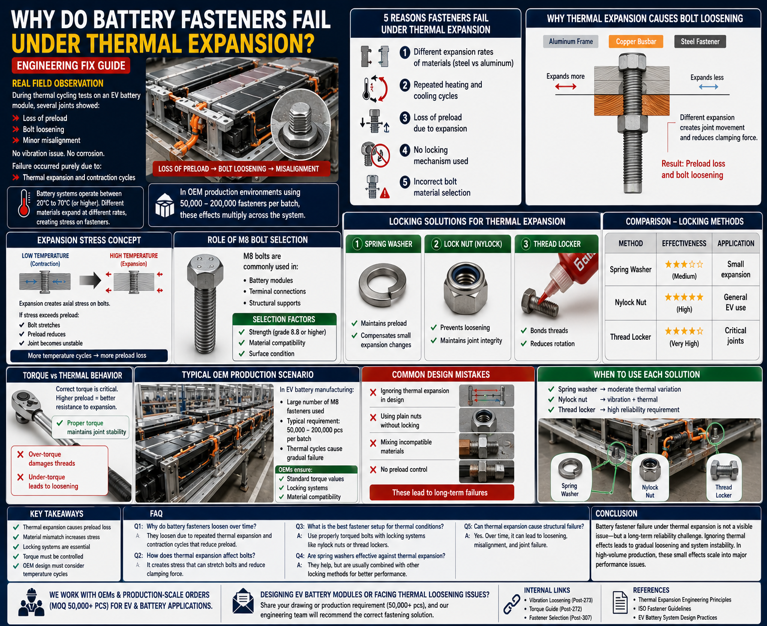
Introduction – Real Field Observation
During thermal cycling tests on an EV battery module, several joints showed:
👉 Loss of preload
👉 Bolt loosening
👉 Minor misalignment
No vibration issue. No corrosion.
Failure occurred purely due to:
👉 Thermal expansion and contraction cycles
Battery systems operate between 20°C to 70°C (or higher). Different materials expand at different rates, creating stress on fasteners.
In OEM production environments using 50,000–200,000 fasteners per batch, these effects multiply across the system.
Quick Answer
Why do fasteners fail under thermal expansion in battery systems?
Fasteners fail due to repeated expansion and contraction of materials, causing preload loss and joint loosening over time.
What is Thermal Expansion in Battery Systems?
Thermal expansion is the increase in material size due to temperature rise. In battery systems, different materials expand at different rates, creating stress at bolted joints.
5 Reasons Fasteners Fail Under Thermal Expansion
- Different expansion rates of materials (steel vs aluminum)
- Repeated heating and cooling cycles
- Loss of preload due to expansion
- No locking mechanism used
- Incorrect bolt material selection
Why Thermal Expansion Causes Bolt Loosening
Battery modules use:
- Aluminum frames
- Copper busbars
- Steel fasteners
Each expands differently.
Result
- Joint movement
- Reduction in clamping force
- Bolt loosening
Expansion Stress Concept
Expansion creates:
👉 Axial stress on bolts
If stress exceeds preload:
- Bolt stretches
- Preload reduces
- Joint becomes unstable
Simplified Insight
More temperature cycles → more preload loss
Role of M8 Bolt Selection
M8 bolts are commonly used in:
- Battery modules
- Terminal connections
- Structural supports
Selection Factors
✔ Strength (grade 8.8 or higher)
✔ Material compatibility
✔ Surface condition
Locking Solutions for Thermal Expansion
1. Spring Washer
✔ Maintains preload
✔ Compensates small expansion changes
2. Lock Nut (Nylock)
✔ Prevents loosening
✔ Maintains joint integrity
3. Thread Locker
✔ Bonds threads
✔ Reduces rotation
Comparison – Locking Methods
| Method | Effectiveness | Application |
| Spring Washer | Medium | Small expansion |
| Nylock Nut | High | General EV use |
| Thread Locker | Very High | Critical joints |
Torque vs Thermal Behavior
Correct torque is critical.
👉 Higher preload = better resistance to expansion
But:
❌ Over-torque damages threads
❌ Under-torque leads to loosening
Typical OEM Production Scenario
In EV battery manufacturing:
- Large number of M8 fasteners used
- Typical requirement: 50,000–200,000 pcs per batch
- Thermal cycles cause gradual failure
OEMs ensure:
✔ Standard torque values
✔ Locking systems
✔ Material compatibility
Common Design Mistakes
- Ignoring thermal expansion in design
- Using plain nuts without locking
- Mixing incompatible materials
- No preload control
👉 These lead to long-term failures
When to Use Each Solution
✔ Spring washer → moderate thermal variation
✔ Nylock nut → vibration + thermal
✔ Thread locker → high reliability requirement
Key Takeaways
• Thermal expansion causes preload loss
• Material mismatch increases stress
• Locking systems are essential
• Torque must be controlled
• OEM design must consider temperature cycles
FAQ
Q1: Why do battery fasteners loosen over time?
They loosen due to repeated thermal expansion and contraction cycles that reduce preload.
Q2: How does thermal expansion affect bolts?
It creates stress that can stretch bolts and reduce clamping force.
Q3: What is the best fastener setup for thermal conditions?
Use properly torqued bolts with locking systems like nylock nuts or thread lockers.
Q4: Are spring washers effective against thermal expansion?
They help, but are usually combined with other locking methods for better performance.
Q5: Can thermal expansion cause structural failure?
Yes. Over time, it can lead to loosening, misalignment, and joint failure.
Conclusion
Battery fastener failure under thermal expansion is not a visible issue—but a long-term reliability challenge.
Ignoring thermal effects leads to gradual loosening and system instability.
In high-volume production, these small effects scale into major performance issues.
👉 We work with OEMs and production-scale orders (MOQ 50,000+ pcs) for EV and battery applications.
Designing EV battery modules or facing thermal loosening issues?
Share your drawing or production requirement (50,000+ pcs), and our engineering team will recommend the correct fastening solution.
References
- Thermal expansion engineering principles
- ISO fastener guidelines
- EV battery system design practices