

Introduction – Real Site Hook
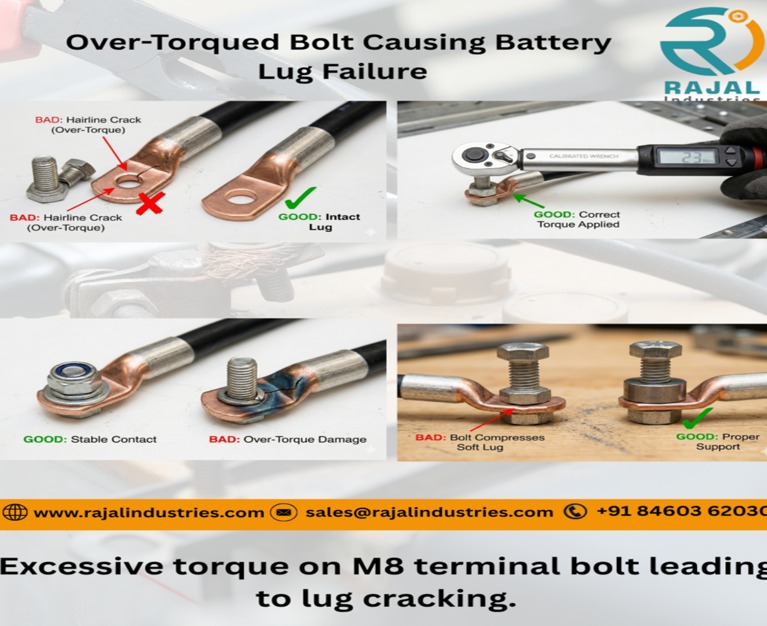
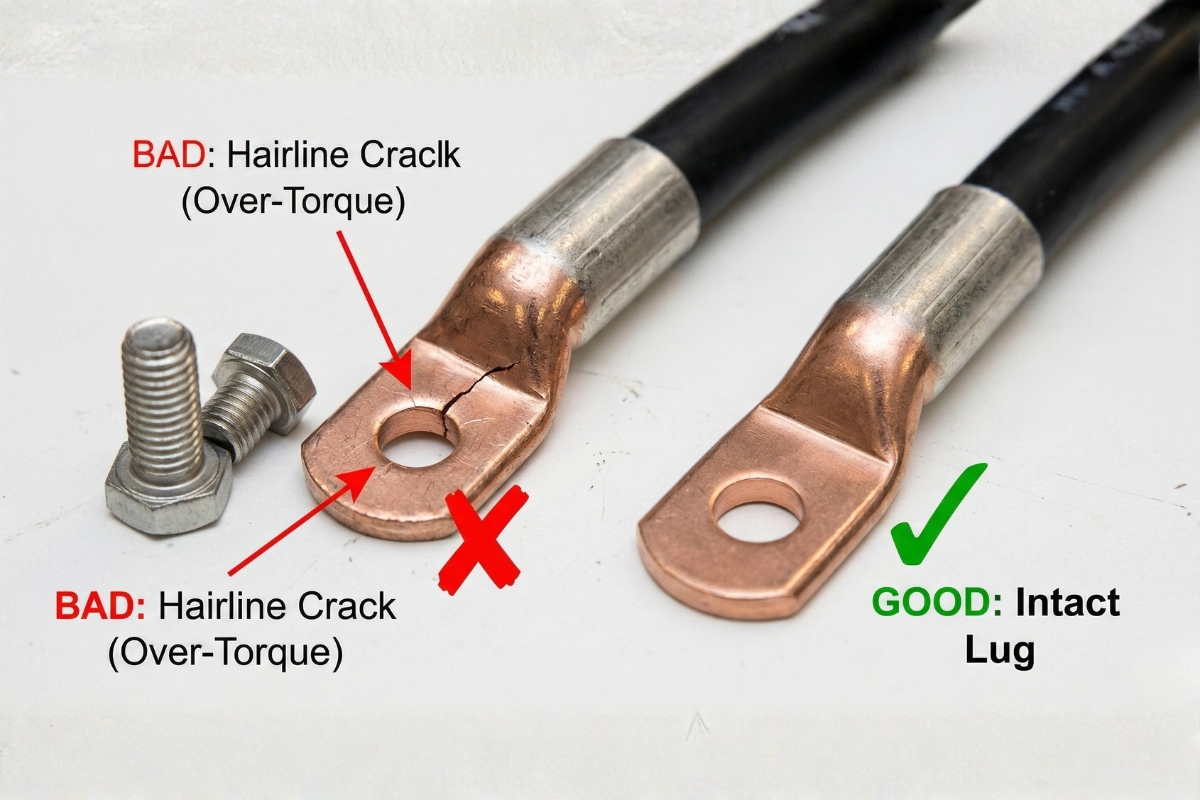
In a lithium battery pack servicing job, a technician noticed hairline cracks around a copper lug connection. The M8 hex bolt was intact. The cable size was correct. But the lug had fractured at the bolt hole.
Measured torque applied during installation: 38 Nm.
Recommended torque for that bolt: 22–25 Nm.
This is a classic case of battery lug failure caused by over-torquing.
Most engineers worry about loose terminals.
Few consider the damage caused by excessive torque.
Why Battery Lug Failure Happens Due to Over-Torque
Battery lugs are typically made of:
- • Copper
- • Tinned copper
- • Aluminum alloy
These materials are softer than steel bolts.
When an M8 bolt is over-tightened:
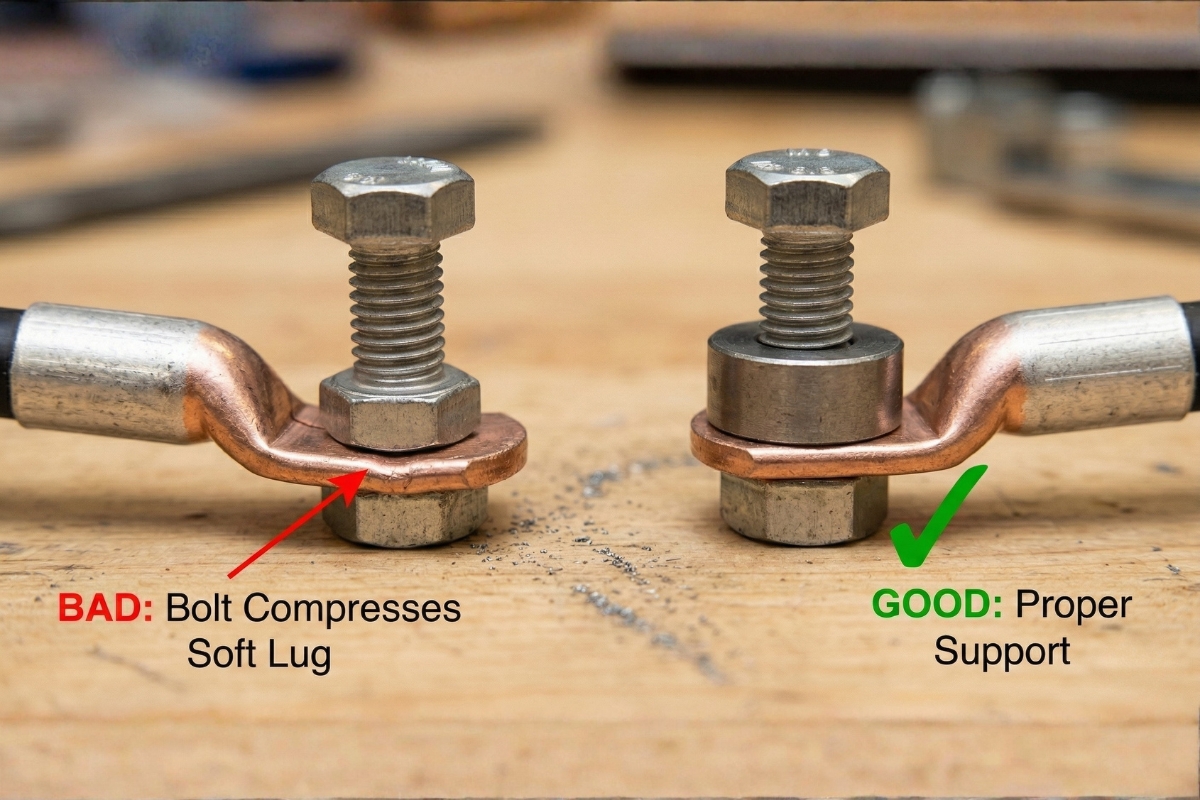
- • Bolt preload exceeds lug compressive capacity
- • Stress concentration forms at hole edge
- • Micro-cracks develop
- • Lug weakens
- • Under load, crack propagates
Electrical failure follows mechanical damage.
Case Study: Cracked Copper Lug in EV System
Observed conditions:
- • M8 stainless bolt used
- • No torque wrench used
- • Spring washer installed
- • Nylock nut installed
- • Torque applied manually
After 6 months:
- • Crack visible
- • Resistance increased
- • Heat observed during load test
The issue was not material selection.
It was incorrect torque specification.
Correct Torque Specification for M8 Terminal Bolts
Recommended torque depends on bolt material.
| Bolt Type | Recommended Torque |
| M8 Grade 8.8 | 20–25 Nm |
| M8 SS304 | 18–22 Nm |
| M8 Copper Bolt | 16–20 Nm |
Important:
- • Use calibrated torque wrench
- • Tighten gradually
- • Avoid impact tools
- • Follow manufacturer specification
Excess torque damages lug.
Low torque increases resistance.
Correct torque balances mechanical integrity and electrical contact.
Stress Calculation on M8 Bolt
Tensile stress area (M8 coarse) ≈ 36.6 mm²
For Grade 8.8:
Yield strength = 640 MPa
Yield load:
640 × 36.6 = 23,424 N
≈ 23.4 kN
When torque exceeds recommended value, bolt preload approaches yield load.
Lug material cannot handle that compressive stress.
Copper yield strength ≈ 70–200 MPa depending on grade.
Steel bolt is much stronger than copper lug.
Over-torque damages the softer component first.
Proper Fastener Setup for Battery Terminals
Recommended stack:
- • M8 Hex Bolt (Grade 8.8 or SS304)
- • Flat washer
- • Spring washer
- • Copper lug
- • Nylock nut
You can review full specifications for our
👉 M8 Hex Bolt for Battery Terminal Applications
For corrosion-prone environments use:
👉 M8 Stainless Steel Bolts for Electrical Connections
For vibration resistance use:
👉 M8 Nylock Nuts for Battery Systems
Proper stack ensures stable preload.
Why Spring Washer and Nylock Nut Matter
Spring washer:
- • Maintains tension under thermal expansion
- • Compensates minor preload loss
Nylock nut:
- • Prevents loosening due to vibration
- • Reduces torque relaxation
However, locking devices do not replace correct torque control.
Comparison: Over-Torque vs Under-Torque
| Condition | Effect |
| Over-Torque | Lug cracking, thread damage |
| Under-Torque | High resistance, overheating |
| Correct Torque | Stable contact, long-term reliability |
Both extremes are dangerous.
Torque must match bolt and lug material.
Inspection Checklist for Terminal Bolts
✔ Check torque annually
✔ Inspect for hairline cracks
✔ Look for discoloration
✔ Measure contact temperature
✔ Replace damaged lugs immediately
✔ Never reuse cracked lugs
Small crack today can lead to major failure tomorrow.
FAQ
Q1: Why does over-torquing cause battery lug failure?
Because steel bolt strength exceeds copper lug strength. Excess preload creates stress concentration and cracking.
Q2: What is correct torque for M8 battery terminal bolt?
Typically 20–25 Nm for grade 8.8 steel bolt. Stainless bolts may require slightly lower torque.
Q3: Can over-torque increase electrical performance?
No. Excess torque does not improve conductivity. It damages the lug and may increase long-term resistance.
Q4: Is spring washer enough to prevent lug cracking?
No. Correct torque is more important than locking devices.
Q5: Should impact drivers be used for terminal tightening?
No. Always use calibrated torque wrench for battery terminals.
Q6: What happens if lug crack is ignored?
Crack grows under load, resistance increases, overheating occurs, and fire risk rises.
Conclusion
Battery lug failure often happens because of excessive torque, not loose bolts.
Using:
- • Correct M8 hex bolt
- • Proper torque specification
- • Spring washer
- • Nylock nut
- • Calibrated tightening tools
Prevents cracking and overheating.
Need torque-based fastener guidance for your battery terminals?
Contact our engineering team for correct specification support.
References
ISO 898-1 – Mechanical properties of fasteners
IEC 61238 – Compression and mechanical connectors
IEEE 837 – Permanent electrical connections
Machinery’s Handbook – Bolt torque calculation