

Introduction – The Enclosure Passed Inspection, Then Failed During Final Assembly
An electrical enclosure manufacturer was producing cabinets for industrial automation systems.
The enclosure fabrication process included:
- Laser Cutting
- CNC Punching
- Bending
- Projection Welding
- Powder Coating
- Final Assembly
Everything appeared normal.
The weld nuts passed visual inspection.
The enclosure dimensions were correct.
The powder coating quality was acceptable.
However, during final assembly, operators began reporting issues:
- Weld Nuts Breaking Loose
- Thread Damage
- Nut Rotation
- Cracked Weld Points
- Bolt Tightening Failures
Production slowed down.
Rework increased.
Delivery schedules were affected.
The surprising part?
The entire issue was traced back to a component worth only a few rupees.
A Weld Nut
This problem is frequently found in:
- Electrical Enclosure Manufacturing
- Control Panel Manufacturing
- Telecom Cabinets
- Battery Cabinets
- EV Charger Cabinets
- Sheet Metal Fabrication Plants
- Industrial Equipment OEMs
Quick Answer
Why do weld nuts fail during electrical enclosure assembly?
Weld nuts typically fail because of poor welding parameters, insufficient sheet thickness, incorrect projection design, thread contamination, coating buildup, misalignment, or excessive tightening torque.
Why Weld Nuts Are Used in Electrical Enclosures
Electrical enclosures are often manufactured using:
- 1.0 mm Sheet Metal
- 1.2 mm Sheet Metal
- 1.6 mm Sheet Metal
- 2.0 mm Sheet Metal
These materials are usually too thin for direct tapping.
To create strong reusable threads, manufacturers use:
Weld Nuts
Weld nuts provide:
✔ Strong Internal Threads
✔ Faster Assembly
✔ Better Serviceability
✔ Repeated Maintenance Access
✔ High Production Efficiency
Common Weld Nuts Used by OEMs
Electrical enclosure manufacturers commonly use:
Projection Weld Nuts
- M4 Weld Nut
- M5 Weld Nut
- M6 Weld Nut
- M8 Weld Nut
- M10 Weld Nut
Hex Weld Nuts
Used where higher torque is required.
Square Weld Nuts
Common in enclosure frames.
Stainless Steel Weld Nuts
Used in corrosive environments.
Carbon Steel Weld Nuts
Most common for powder-coated enclosures.
Among these, M5 weld nuts and M6 weld nuts are the most widely used sheet metal fasteners in enclosure manufacturing.
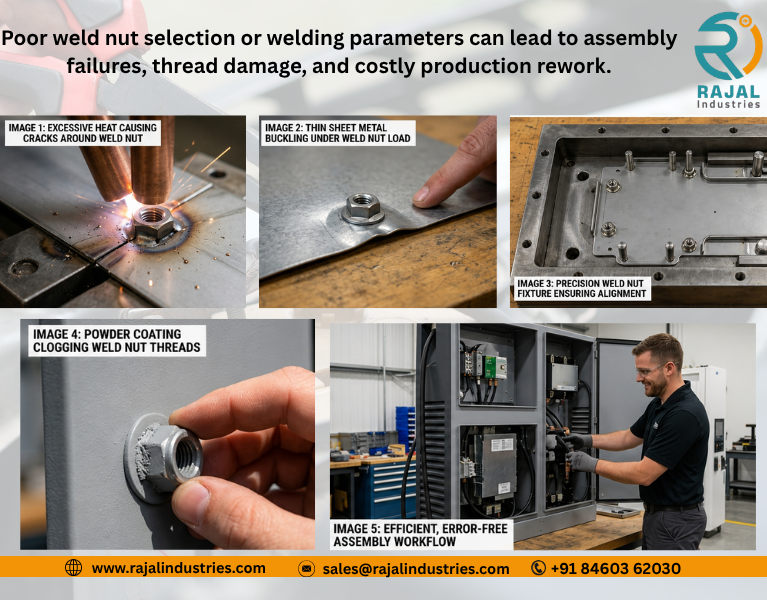
Failure #1 – Incorrect Projection Welding Parameters
This is the most common cause of weld nut failure.
Projection welding depends on:
- Current
- Pressure
- Weld Time
If the settings are incorrect:
Problems occur immediately.
Too little heat:
- Weak Weld
- Nut Pull-Off
Too much heat:
- Projection Collapse
- Thread Distortion
- Cracks
Many manufacturers focus on weld appearance rather than weld strength.
Failure #2 – Sheet Metal Too Thin
Weld nuts require sufficient support.
A common mistake is using large weld nuts on thin sheet metal.
Example:
M8 Weld Nut on 1.0 mm Sheet
Common results:
- Pull-Out Failure
- Sheet Distortion
- Cracked Weld Zone
The sheet becomes the weak point.
Not the weld nut.
Typical Sheet Thickness Guidelines
| Weld Nut Size | Recommended Sheet Thickness |
| M4 | 1.0 mm+ |
| M5 | 1.0 mm+ |
| M6 | 1.2 mm+ |
| M8 | 1.5 mm+ |
| M10 | 2.0 mm+ |
These values vary depending on load requirements.
Failure #3 – Weld Nut Misalignment
One of the biggest production headaches.
If the weld nut is slightly misaligned:
Operators experience:
- Cross Threading
- Bolt Jamming
- Slow Assembly
- Rework
Common causes:
- Poor Fixtures
- Inaccurate Positioning
- Worn Tooling
Even small misalignment can create major assembly issues.
Failure #4 – Powder Coating Inside Threads
A very common problem in enclosure manufacturing.
After welding:
The enclosure proceeds to powder coating.
If threads are not protected:
Powder enters the thread.
Results:
- Tight Assembly
- Thread Damage
- Cross Threading
- Increased Assembly Time
Many OEMs use:
Silicone Thread Protection Caps
before coating.
Failure #5 – Excessive Tightening Torque
Many operators assume:
Tighter Is Better
In reality:
Over-tightening can cause:
- Weld Cracks
- Nut Rotation
- Sheet Deformation
- Thread Failure
This is especially common with:
- M5 Weld Nuts
- M6 Weld Nuts
- Thin Sheet Assemblies
Real OEM Example
An enclosure manufacturer experienced repeated failures during final assembly.
Hardware Used:
- M6 Projection Weld Nut
- 1.2 mm Mild Steel Sheet
- Powder-Coated Enclosure
Observed Issues:
- Nut Rotation
- Cracked Welds
- Thread Damage
Investigation revealed:
Welding Current Too Low
The weld looked acceptable visually.
However, pull-off testing showed insufficient weld strength.
Corrective Action:
✔ Optimized Weld Parameters
✔ Added Pull-Off Testing
✔ Improved Fixture Accuracy
Result:
Assembly failures dropped significantly.
Failure #6 – Wrong Weld Nut Material
Not all weld nuts are equal.
Common materials include:
Low Carbon Steel Weld Nuts
Most common.
Stainless Steel Weld Nuts
Used for corrosion resistance.
Zinc-Plated Weld Nuts
Require special consideration during welding.
Incorrect material selection can create:
- Poor Weld Quality
- Corrosion Problems
- Reduced Strength
Failure #7 – Ignoring Pull-Out Strength Requirements
Many OEMs never calculate actual loads.
They simply select:
“Standard M6 Weld Nut”
without evaluating:
- Pull-Out Load
- Service Load
- Vibration Load
- Maintenance Requirements
This often leads to premature failures.
Weld Nut vs Rivet Nut
Many enclosure manufacturers compare these two options.
| Parameter | Weld Nut | Rivet Nut |
| Initial Strength | High | Medium |
| Installation Speed | Medium | High |
| Automation Friendly | High | Medium |
| Welding Required | Yes | No |
| Thread Quality | Excellent | Good |
| Maintenance Access | Excellent | Excellent |
Both have advantages depending on the application.
Most Common Sheet Metal Fasteners Used in Electrical Enclosures
Large enclosure manufacturers regularly purchase:
Weld Fasteners
- M4 Weld Nuts
- M5 Weld Nuts
- M6 Weld Nuts
- M8 Weld Nuts
- Projection Weld Nuts
Assembly Hardware
- Machine Screws
- Captive Screws
- Self-Tapping Screws
Threaded Components
- Rivet Nuts
- Threaded Inserts
- Cage Nuts
Structural Fasteners
These are among the most searched OEM sheet metal fasteners used worldwide.
Industries Most Affected
Weld nut failures commonly affect:
- Electrical Enclosure Manufacturers
- Control Panel Manufacturers
- Battery Cabinet Manufacturers
- Telecom Cabinet Manufacturers
- EV Charger Manufacturers
- Sheet Metal Fabricators
- Industrial Equipment OEMs
- Automation Equipment Manufacturers
Inspection Checklist
Before production approval:
✔ Verify weld parameters
✔ Inspect projection quality
✔ Check sheet thickness
✔ Verify nut alignment
✔ Protect threads before coating
✔ Perform pull-off testing
✔ Review torque requirements
✔ Validate weld strength
✔ Confirm material compatibility
Key Takeaways
- Most weld nut failures originate from process issues rather than nut quality.
- Incorrect welding parameters are the leading cause of failure.
- Thin sheet metal can limit joint strength.
- Powder coating contamination frequently damages threads.
- Alignment accuracy is critical for assembly efficiency.
- Pull-off testing should be part of quality control.
- Weld nut selection should be based on actual load requirements.
FAQ
What is a weld nut?
A weld nut is a threaded fastener permanently attached to sheet metal using resistance or projection welding to create strong reusable threads.
Why do weld nuts rotate during assembly?
Rotation is usually caused by weak weld strength, poor welding parameters, excessive torque, or insufficient sheet support.
Which weld nut sizes are commonly used in electrical enclosures?
M4, M5, M6, and M8 weld nuts are the most common sizes.
Why do weld nut threads get damaged after powder coating?
Powder coating can enter the threads if protective caps or masking systems are not used.
Are weld nuts stronger than rivet nuts?
In many applications, weld nuts provide higher pull-off strength and better thread quality than rivet nuts.
What causes weld nut cracking?
Excessive heat, improper welding settings, excessive torque, and poor sheet support are common causes.
Which industries use weld nuts most frequently?
Electrical enclosure manufacturers, battery cabinet manufacturers, telecom cabinet manufacturers, EV charger OEMs, and sheet metal fabricators.
How can OEMs reduce weld nut failures?
By optimizing welding parameters, verifying sheet thickness, protecting threads during coating, performing pull-off tests, and standardizing fastener specifications.
Conclusion
Most weld nut failures are not caused by defective hardware.
They are caused by process control failures.
A properly selected and properly welded M5 or M6 weld nut can survive years of service. A poorly installed one can fail during the first assembly operation.
For electrical enclosure manufacturers, EV charger cabinet manufacturers, telecom cabinet OEMs, and industrial equipment producers, weld nut engineering should be treated as a critical production process, not just a fastening operation.