
Introduction – The Battery Containers Were Perfect, But the Foundation Was Not
A 20 MW Battery Energy Storage System (BESS) project successfully completed commissioning.
Everything looked impressive.
The site included:
- Battery Containers
- PCS Units
- Transformers
- Switchgear Systems
- Control Buildings
- Cable Trays
- Fire Suppression Systems
Millions of dollars had been invested.
The electrical systems passed inspection.
Battery performance met expectations.
However, during a routine structural audit conducted twelve months later, inspectors discovered several critical issues.
The problem was not inside the batteries.
The problem was below them.
Several anchor bolt assemblies securing battery containers to concrete foundations showed signs of failure.
Some were loose.
Some were corroded.
Some had been installed incorrectly from day one.
Fortunately, the issues were discovered before a major weather event.
Had they gone unnoticed, the consequences could have included:
- Container movement
- Structural damage
- Water ingress
- Cable stress
- Equipment failure
- Major safety risks
This scenario is becoming increasingly common in:
- BESS Projects
- Battery Container Installations
- Utility Energy Storage Systems
- Solar + Storage Projects
- EV Charging Hubs
- Industrial Battery Facilities
Quick Answer
Why do anchor bolts fail in BESS projects?
Anchor bolt failures usually occur due to incorrect installation, insufficient embedment depth, preload loss, corrosion, improper washer selection, foundation movement, or poor maintenance practices.
What Are BESS Anchor Bolts?
Anchor bolts secure battery containers and heavy equipment to concrete foundations.
They are designed to resist:
- Wind Loads
- Seismic Loads
- Vibration
- Equipment Movement
- Thermal Expansion
Common anchor fasteners include:
Anchor Bolts
- M12 Anchor Bolts
- M16 Anchor Bolts
- M20 Anchor Bolts
- M24 Anchor Bolts
- Wedge Anchors
- Chemical Anchors
- Foundation Bolts
- J-Bolts
Hardware
Materials
- HDG Fasteners
- Grade 8.8 Fasteners
- Grade 10.9 Fasteners
- SS316 Fasteners
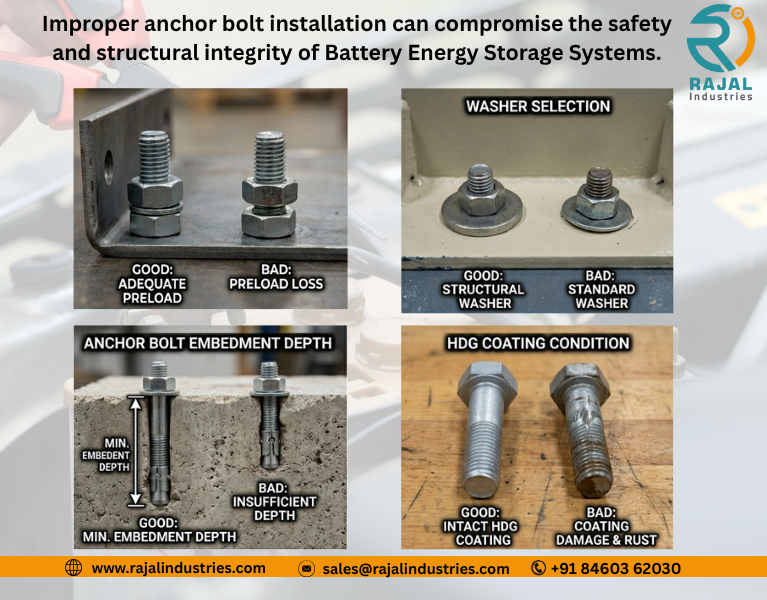
Failure #1 – Insufficient Embedment Depth
This was the most common issue found during inspection.
Several anchor bolts were installed shallower than specified.
Example:
Required Depth:
180 mm
Actual Depth:
120 mm
The result:
- Reduced pull-out resistance
- Lower load capacity
- Increased movement risk
Many failures start below the concrete surface where they cannot be seen.
Failure #2 – Missing Structural Washers
Inspectors found several anchor bolt assemblies using standard washers instead of structural washers.
Many installers assume:
“A washer is a washer.”
In reality, structural washers distribute load over a larger area.
Without them:
- Local stress increases
- Settlement occurs
- Clamp force decreases
This is especially important for:
- Battery Containers
- PCS Skids
- Transformer Foundations
Failure #3 – Hot-Dip Galvanized (HDG) Coating Damage
The project used:
HDG Anchor Bolts
However, many bolts showed:
- Damaged coating
- Installation scratches
- Thread damage
These exposed areas became corrosion initiation points.
Over time:
- Rust developed
- Thread condition deteriorated
- Maintenance became difficult
Failure #4 – Preload Loss
Many anchor bolts were initially tightened correctly.
However, preload gradually decreased due to:
- Concrete settlement
- Thermal cycling
- Vibration
- Structural movement
The bolts did not fall out.
They simply stopped clamping effectively.
This is one of the most dangerous failure modes because it often remains invisible.
Failure #5 – Wrong Anchor Type Selection
Several locations used wedge anchors where chemical anchors would have been more appropriate.
Each anchor type has specific limitations.
Wedge Anchors
Best for:
- High compression loads
- Solid concrete
- Fast installation
Chemical Anchors
Best for:
- Edge applications
- Cracked concrete
- High pull-out requirements
Improper selection reduced safety margins.
Real Inspection Example
During a 20 MW BESS inspection:
Inspectors checked:
1,200 Anchor Bolt Assemblies
Findings included:
- 8% loose bolts
- 3% corrosion concerns
- 2% insufficient embedment
- Multiple washer issues
Corrective actions included:
✔ Retorquing
✔ Replacing damaged hardware
✔ Installing structural washers
✔ Corrosion treatment
✔ Enhanced maintenance procedures
HDG Anchor Bolt vs Stainless Steel Anchor Bolt
| Parameter | HDG Anchor Bolt | SS316 Anchor Bolt |
| Corrosion Resistance | High | Excellent |
| Cost | Lower | Higher |
| Outdoor Use | Excellent | Excellent |
| Coastal Environment | Good | Outstanding |
| BESS Usage | Very Common | Growing |
Many BESS integrators use HDG hardware as the standard solution.
SS316 is often selected for coastal projects.
Structural Washer vs Standard Washer
| Parameter | Standard Washer | Structural Washer |
| Load Distribution | Medium | High |
| Settlement Resistance | Medium | High |
| Heavy Equipment Support | Limited | Excellent |
| BESS Applications | Limited | Preferred |
Structural washers are increasingly specified by utility-scale energy projects.
Anchor Bolt Load Example
Assume:
Battery Container Weight:
28,000 kg
Wind Uplift Force:
60 kN
Anchor Quantity:
24 Anchor Bolts
Load Per Anchor:
60 ÷ 24
= 2.5 kN
Now apply:
- Safety Factors
- Dynamic Loading
- Seismic Forces
Actual design requirements become significantly higher.
This is why anchor bolt design cannot rely on static weight alone.
Fasteners Commonly Used in BESS Projects
Large BESS installations regularly use:
Structural Fasteners
- M12 HDG Anchor Bolts
- M16 HDG Anchor Bolts
- M20 HDG Anchor Bolts
- M24 HDG Anchor Bolts
- Grade 8.8 Hex Bolts
- Grade 10.9 Hex Bolts
Washers
- Structural Washers
- Spring Washers
- Flat Washers
- Load Distribution Washers
Nuts
- Heavy Hex Nuts
- Lock Nuts
- Prevailing Torque Nuts
Other Hardware
- Threaded Rods
- Foundation Bolts
- U-Bolts
- Cable Tray Fasteners
These products are among the highest-volume fasteners used in utility-scale battery projects.
Industries Most Affected
Anchor bolt failures commonly impact:
- BESS Integrators
- Battery Container Manufacturers
- Battery Rack Manufacturers
- Battery Cabinet Manufacturers
- Solar EPC Companies
- Utility Energy Storage Developers
- EV Charging Infrastructure Companies
- Electrical Contractors
Inspection Checklist
Before BESS commissioning:
✔ Verify embedment depth
✔ Inspect HDG coating condition
✔ Check anchor bolt torque
✔ Confirm structural washer usage
✔ Verify anchor type selection
✔ Review concrete quality
✔ Inspect corrosion protection
✔ Validate installation records
Typical BESS Fastener Quantities
A utility-scale BESS project may consume:
- 5,000–20,000 HDG Anchor Bolts
- 10,000–40,000 Structural Washers
- 10,000–40,000 Heavy Hex Nuts
- 20,000–100,000 Grade 8.8 Fasteners
- 20,000–100,000 Spring Washers
- Thousands of threaded rod assemblies
Fastener reliability directly impacts long-term project safety.
Key Takeaways
- Most anchor bolt failures originate during installation.
- Embedment depth is critical.
- Structural washers improve load distribution.
- HDG coating damage often becomes a corrosion starting point.
- Preload loss can occur even when installation torque is correct.
- Proper anchor selection is essential for long-term reliability.
- BESS projects should include anchor bolt inspection in maintenance programs.
FAQ
What are BESS anchor bolts?
BESS anchor bolts secure battery containers, transformers, PCS units, and structural equipment to concrete foundations.
Why do anchor bolts loosen over time?
Concrete settlement, vibration, thermal expansion, and preload relaxation can gradually reduce clamp force.
What is the most common anchor bolt failure?
Insufficient embedment depth is one of the most frequently discovered installation issues.
Why are structural washers important?
Structural washers distribute load more effectively and reduce localized stress around anchor bolt connections.
Are HDG anchor bolts suitable for outdoor BESS projects?
Yes. HDG anchor bolts are widely used because they provide strong corrosion protection and long service life.
When should SS316 anchor bolts be used?
SS316 anchor bolts are often preferred in coastal, marine, or highly corrosive environments where maximum corrosion resistance is required.
What fasteners are commonly used in BESS projects?
HDG anchor bolts, structural washers, heavy hex nuts, threaded rods, grade 8.8 bolts, grade 10.9 bolts, lock nuts, and foundation bolts are commonly used.
How often should anchor bolts be inspected?
Anchor bolts should be inspected during commissioning, periodic maintenance, and after significant weather, seismic, or operational events.
Conclusion
When people think about BESS reliability, they usually focus on batteries, inverters, and software.
But a utility-scale battery project is only as secure as the hardware holding it to the foundation.
A loose anchor bolt, damaged HDG coating, missing structural washer, or insufficient embedment depth can compromise millions of dollars of equipment.
For BESS integrators, battery container manufacturers, EPC contractors, and utility-scale energy developers, anchor bolt inspection should be treated as a critical reliability activity, not a routine checklist item.