

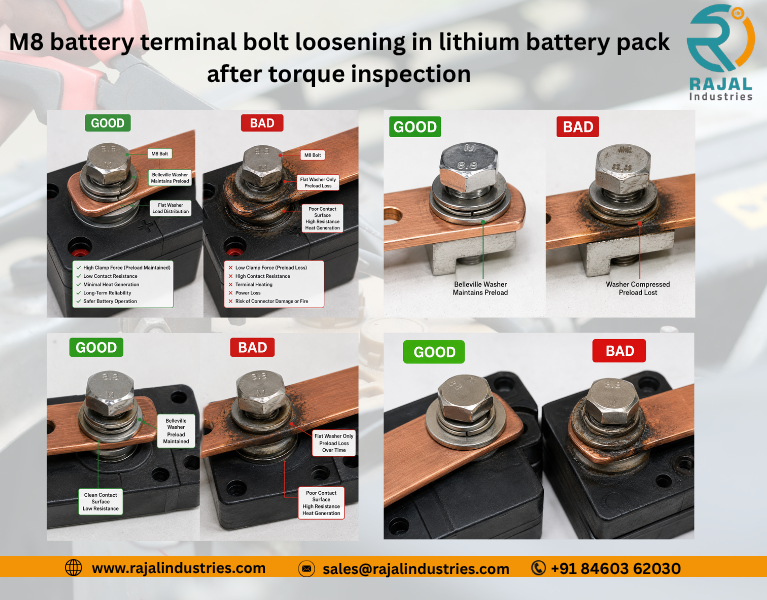
Introduction – The Torque Test Passed, Yet the Failure Still Happened
A lithium battery pack manufacturer supplying battery systems for industrial equipment received a warranty claim.
The battery pack had passed:
✔ Incoming inspection
✔ Assembly inspection
✔ Torque verification
✔ Final quality checks
The M8 terminal bolts were tightened according to specification.
Everything appeared correct.
However, six months later the customer reported:
- Terminal heating
- Voltage fluctuation
- High resistance connection
- Burn marks around the battery terminal
When engineers opened the battery pack, they found the problem.
The M8 terminal bolt was loose.
The immediate question was:
How can a bolt loosen after passing torque inspection?
This issue is becoming increasingly common in:
- Lithium Battery Packs
- EV Battery Packs
- Battery Cabinets
- Battery Racks
- Energy Storage Systems (BESS)
- Telecom Battery Systems
- Solar Battery Banks
- Industrial UPS Systems
The answer lies in understanding the difference between torque and preload.
Quick Answer
Why do battery terminal bolts loosen after torque inspection?
Battery terminal bolts usually loosen because preload decreases after installation. Thermal expansion, vibration, copper creep, aluminum relaxation, washer compression, and joint settlement gradually reduce clamp force even when torque values were initially correct.
What Are Battery Terminal Fasteners?
Battery terminal fasteners are the hardware used to create electrical and mechanical connections between battery cells, modules, busbars, terminals, and electrical conductors.
Common battery fasteners include:
Bolts
- M4 Battery Bolts
- M5 Battery Bolts
- M6 Battery Bolts
- M8 Terminal Bolts
- M10 Hex Bolts
- Flange Bolts
- Socket Head Cap Screws
Nuts
- Hex Nuts
- Nylock Nuts
- Flange Nuts
- Prevailing Torque Nuts
Washers
- Spring Washers
- Belleville Washers
- Serrated Washers
- Flat Washers
- Nord-Lock Washers
Electrical Hardware
- Copper Busbars
- Battery Terminal Lugs
- Copper Connectors
- Nickel-Plated Connectors
Among all these components, the M8 terminal bolt remains one of the most widely used battery fasteners in industrial battery systems.
Torque Is Not the Same as Clamp Force
This is one of the biggest misconceptions in battery assembly.
Many manufacturers believe:
Correct Torque = Reliable Joint
In reality:
Correct Torque ≠ Guaranteed Preload
Torque is only a method of generating clamp force.
The actual goal is:
Preload
Preload is the force that keeps the battery terminals compressed together.
If preload decreases, the joint begins to fail.
Why Battery Terminal Fasteners Loosen
1. Copper Creep and Joint Relaxation
Battery terminals often use:
- Copper Lugs
- Copper Busbars
- Copper Connectors
Copper is softer than steel.
After installation:
- Copper slowly deforms
- Contact surfaces settle
- Joint thickness changes
This process is called:
Relaxation
As relaxation increases:
Preload decreases.
The bolt becomes loose even though nobody touched it.
2. Thermal Expansion in Lithium Battery Packs
Battery systems continuously heat and cool.
During charging:
- Temperature rises
During discharge:
- Temperature changes
During idle periods:
- Temperature drops
Each cycle causes:
- Expansion
- Contraction
- Micro movement
Over thousands of cycles, preload gradually reduces.
3. Vibration in EV and Battery Systems
Battery packs experience constant vibration.
Sources include:
- Electric Motors
- Road Shock
- Cooling Systems
- Compressors
- Transportation
Even small vibrations can reduce clamp force over time.
This is why many EV manufacturers use advanced locking systems.
4. Wrong Washer Selection
Many battery manufacturers still use:
Flat Washer Only
Flat washers distribute load but do not prevent loosening.
Better options include:
- Belleville Washers
- Spring Washers
- Nord-Lock Washers
- Serrated Washers
These help maintain preload during thermal cycling.
5. Surface Settlement
Battery terminals often contain:
- Coatings
- Nickel Plating
- Tin Plating
- Surface Roughness
After tightening:
Surface peaks collapse.
Joint thickness reduces.
Clamp force decreases.
This is called:
Embedment Relaxation
And it is one of the biggest causes of torque loss.
Why Loose Battery Terminal Bolts Are Dangerous
A loose battery bolt does more than create mechanical problems.
It affects electrical performance.
Possible consequences include:
- High Contact Resistance
- Terminal Heating
- Voltage Drop
- Power Loss
- Arc Formation
- Connector Damage
- Battery Failure
- Fire Risk
In large BESS projects, a single loose connection can affect an entire battery string.
Real Failure Example – 20 MW BESS Project
A utility-scale BESS installation reported abnormal thermal readings.
Thermal camera inspection found:
Normal terminal temperature:
32°C
Problem terminal temperature:
76°C
Investigation revealed:
- M8 Terminal Bolt
- Copper Busbar
- Correct installation torque
Root cause:
Clamp force relaxation after thermal cycling
Corrective action:
- Re-torque procedure
- Belleville washer installation
- Updated assembly specification
The issue disappeared.
M8 Terminal Bolt vs Flange Bolt
| Parameter | M8 Hex Bolt | M8 Flange Bolt |
| Load Distribution | Medium | High |
| Washer Requirement | Usually Yes | Often Reduced |
| Assembly Speed | Medium | High |
| Battery Use | Common | Growing |
| OEM Adoption | High | Increasing |
Many battery OEMs are switching to flange bolts to improve load distribution.
Spring Washer vs Belleville Washer
| Parameter | Spring Washer | Belleville Washer |
| Vibration Resistance | Medium | High |
| Preload Retention | Medium | Excellent |
| Thermal Cycling Performance | Medium | High |
| Battery Industry Use | Common | Preferred |
| BESS Applications | Growing | High |
For critical battery connections, Belleville washers often outperform traditional spring washers.
Simple Torque Loss Example
Assume:
M8 Bolt Installation Torque:
20 Nm
Initial Preload:
12 kN
After relaxation:
Preload Loss:
25%
Remaining Clamp Force:
9 kN
The torque value has not changed significantly.
However, the actual clamping force has reduced dramatically.
This is why torque inspection alone is not enough.
Battery Fasteners Commonly Used in Production
Large lithium battery manufacturers commonly purchase:
Battery Bolts
- M4 Battery Bolts
- M5 Battery Bolts
- M6 Battery Bolts
- M8 Terminal Bolts
- M10 Hex Bolts
Battery Nuts
- Hex Nuts
- Nylock Nuts
- Flange Nuts
Battery Washers
- Belleville Washers
- Spring Washers
- Flat Washers
- Nord-Lock Washers
Battery Hardware
- Copper Busbars
- Copper Lugs
- Battery Connectors
- Threaded Inserts
These products are widely used in EV batteries, BESS containers, telecom batteries, and industrial battery systems.
Industries Most Affected
This issue frequently affects:
- Lithium Battery Pack Manufacturers
- EV Battery Manufacturers
- Battery Rack Manufacturers
- Battery Cabinet Manufacturers
- Battery Enclosure Manufacturers
- BESS Integrators
- Telecom Battery Manufacturers
- UPS System Manufacturers
- Solar Battery System Manufacturers
Typical Production Quantities
A medium-sized battery manufacturer may consume annually:
- 500,000+ M6 Battery Bolts
- 300,000+ M8 Terminal Bolts
- 300,000+ Flat Washers
- 200,000+ Belleville Washers
- 150,000+ Flange Nuts
- 100,000+ Copper Terminal Hardware
Large BESS projects often require:
50,000–200,000+ fasteners per project
This is why fastener reliability directly impacts project performance.
Inspection Checklist
Before battery pack approval:
✔ Verify torque values
✔ Verify preload requirements
✔ Check washer selection
✔ Inspect copper busbar surfaces
✔ Review thermal cycling conditions
✔ Check vibration exposure
✔ Evaluate relaxation risk
✔ Perform thermal inspection
Key Takeaways
- Torque and preload are not the same thing.
- Copper relaxation is a major cause of bolt loosening.
- Thermal cycling gradually reduces clamp force.
- Vibration accelerates preload loss.
- Belleville washers often outperform standard spring washers.
- A loose M8 battery bolt can create overheating and safety risks.
- Battery fastener selection is critical for long-term reliability.
FAQ
Why do battery terminal bolts loosen after torque inspection?
Because preload decreases over time due to relaxation, thermal cycling, vibration, and material settlement.
What is the most common battery terminal bolt size?
M6 and M8 terminal bolts are among the most widely used sizes in lithium battery packs and BESS systems.
Why do battery terminals overheat?
Loose connections increase electrical resistance, generating additional heat during operation.
Are spring washers enough for battery terminals?
In many applications, Belleville washers or advanced locking systems provide better preload retention.
What is preload in a battery connection?
Preload is the clamping force created when a bolt is tightened. It keeps electrical connections secure.
What fasteners are commonly used in battery packs?
Battery bolts, flange bolts, hex bolts, nylock nuts, Belleville washers, spring washers, and copper terminal hardware.
Which industries face this issue most often?
EV battery manufacturers, lithium battery pack manufacturers, battery cabinet manufacturers, BESS integrators, and telecom battery OEMs.
How can OEMs reduce battery terminal loosening?
By selecting proper fasteners, using preload-retaining washers, controlling torque, and validating connections through testing.
Conclusion
A battery terminal bolt that passes inspection today can still fail months later.
The reason is simple:
Torque creates preload, but preload does not always remain.
As lithium battery systems become larger and more powerful, battery terminal fasteners play a critical role in safety, reliability, and long-term performance.
For lithium battery pack manufacturers, EV battery OEMs, battery cabinet manufacturers, and BESS integrators, understanding preload loss is just as important as selecting the correct torque value.