

Introduction – The Bolt Cost ₹15, The Shutdown Cost ₹15 Lakhs
A lithium battery manufacturer faced an unexpected production interruption.
The issue wasn’t related to:
- Battery Cells
- BMS Systems
- Formation Equipment
- Testing Machines
- Automation Software
Instead, the problem started with a simple M10 bolt.
A support structure carrying battery module handling equipment suddenly loosened.
Inspection revealed severe corrosion around the bolt assembly.
The fastener had lost strength long before the failure became visible.
Production stopped.
Equipment was inspected.
Repairs were completed.
The cost of downtime exceeded several lakhs.
The failed bolt cost less than ₹15.
This scenario is surprisingly common inside:
- Lithium Battery Manufacturing Plants
- EV Battery Factories
- Cell Manufacturing Facilities
- Battery Pack Assembly Plants
- Battery Module Production Lines
- BESS Manufacturing Facilities
- Energy Storage Equipment Plants
As battery production expands worldwide, fastener corrosion is becoming a hidden reliability challenge.
Quick Answer
Why do M10 bolts fail in battery manufacturing plants?
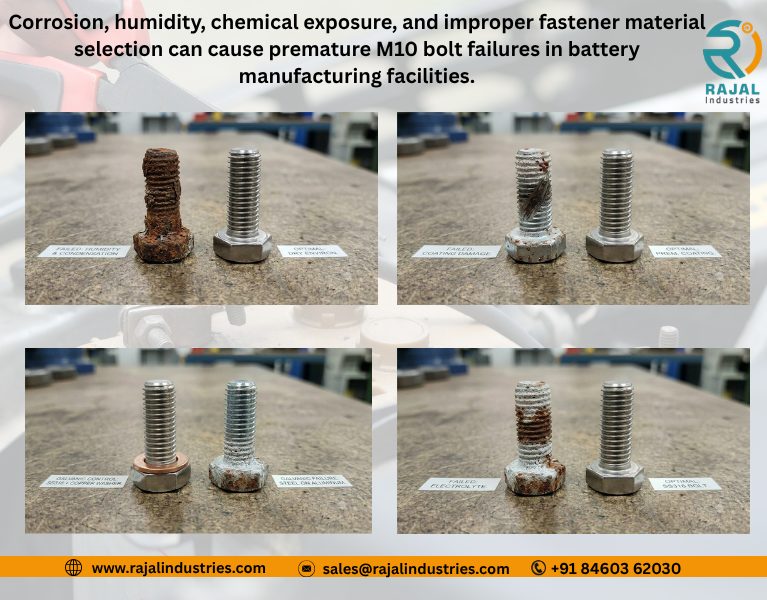
M10 bolts typically fail because of corrosion caused by humidity, chemical vapors, electrolyte exposure, cleaning chemicals, condensation, coating damage, galvanic corrosion, or incorrect fastener material selection.
Why Battery Manufacturing Plants Are Different
Many engineers assume battery plants are similar to standard factories.
They are not.
Battery facilities often contain:
- Controlled Humidity Zones
- Electrolyte Handling Areas
- Chemical Storage Areas
- Clean Rooms
- Dry Rooms
- Formation Rooms
- Aging Chambers
- Battery Testing Stations
These environments create unique corrosion challenges.
Common Fasteners Used in Battery Manufacturing Plants
Battery manufacturers regularly use:
Bolts
- M6 Hex Bolts
- M8 Hex Bolts
- M10 Hex Bolts
- M12 Hex Bolts
- Flange Bolts
- Socket Head Cap Screws
- Structural Bolts
Nuts
- Hex Nuts
- Flange Nuts
- Nylock Nuts
- Lock Nuts
Washers
- Flat Washers
- Spring Washers
- Structural Washers
- Serrated Washers
Other Fasteners
- Threaded Rods
- Anchor Bolts
- Rivet Nuts
- Weld Nuts
- Cage Nuts
- Self-Tapping Screws
- Captive Screws
Among these, M10 bolts are widely used for:
- Equipment Mounting
- Battery Rack Structures
- Conveyor Systems
- Machine Frames
- Cable Tray Supports
- Structural Assemblies
The 5 Most Common Reasons M10 Bolts Fail
1. Chemical Exposure
Modern battery production uses chemicals that can create aggressive environments.
Common exposure sources include:
- Electrolyte Vapors
- Cleaning Chemicals
- Solvents
- Process Fluids
Over time:
- Coatings degrade
- Corrosion accelerates
- Fastener strength decreases
This problem is especially common near electrolyte filling areas.
2. Humidity and Condensation
Even climate-controlled facilities experience:
- Temperature variation
- Condensation cycles
- Moisture accumulation
Water trapped around:
- Bolt Heads
- Washers
- Threads
can gradually initiate corrosion.
Many failures begin beneath washers where corrosion remains hidden.
3. Zinc Plating Breakdown
Many factories use:
Zinc-Plated M10 Bolts
because of their low initial cost.
However, zinc coatings can eventually deteriorate in aggressive environments.
Typical issues include:
- White Rust
- Coating Damage
- Red Rust Formation
- Thread Corrosion
Once the coating is compromised, corrosion accelerates rapidly.
4. Galvanic Corrosion
Battery plants frequently combine different materials.
Examples:
- Copper Busbars
- Aluminum Structures
- Stainless Steel Components
- Zinc-Plated Fasteners
When moisture is present:
An electrochemical reaction may occur.
This process is called:
Galvanic Corrosion
The result can be rapid fastener degradation.
5. Incorrect Material Selection
One of the most expensive mistakes.
Many OEMs choose fasteners based only on price.
They ignore:
- Environment
- Humidity
- Chemicals
- Maintenance Requirements
A fastener suitable for a warehouse may fail inside a battery production area.
Zinc-Plated Bolt vs SS304 Bolt
Which One Performs Better?
| Parameter | Zinc-Plated Bolt | SS304 Bolt |
| Initial Cost | Lower | Higher |
| Corrosion Resistance | Medium | High |
| Humidity Resistance | Medium | High |
| Chemical Resistance | Limited | Better |
| Maintenance Requirement | Higher | Lower |
| Battery Plant Usage | Common | Growing |
Many battery manufacturers are gradually shifting toward stainless steel hardware.
SS304 Bolt vs SS316 Bolt
| Parameter | SS304 Bolt | SS316 Bolt |
| Corrosion Resistance | High | Very High |
| Chloride Resistance | Medium | Excellent |
| Chemical Resistance | Good | Better |
| Battery Manufacturing Use | Common | Premium Applications |
| Cost | Lower | Higher |
For aggressive environments, SS316 often provides superior long-term performance.
Real Failure Example
An EV battery manufacturer experienced repeated failures in a battery module assembly line.
Inspection revealed:
Fastener Type
- M10 Zinc-Plated Bolt
- Spring Washer
- Hex Nut
Problem:
- Coating degradation
- Corrosion beneath washer
- Reduced preload
- Joint loosening
Corrective action:
✔ Upgraded to SS304 Bolts
✔ Added stainless steel washers
✔ Revised maintenance schedule
Result:
- Improved reliability
- Reduced maintenance
- Lower downtime
Hidden Corrosion Under Washers
One of the most overlooked issues.
Corrosion frequently develops beneath:
- Flat Washers
- Spring Washers
- Structural Washers
Why?
These locations trap:
- Moisture
- Dirt
- Chemical residue
The bolt may appear acceptable externally while significant corrosion exists underneath.
This is why visual inspection alone is often insufficient.
Why Corrosion Causes Mechanical Failure
Corrosion doesn’t simply create rust.
It reduces:
- Cross-sectional area
- Thread integrity
- Clamp force
- Fatigue strength
A corroded M10 bolt can lose significant load capacity long before visible failure occurs.
Load Capacity Example
Assume:
M10 Grade 8.8 Bolt
Approximate tensile capacity:
~36 kN
Now assume corrosion removes:
15% of effective cross-section
Actual load capacity drops significantly.
Combined with vibration and fatigue:
Failure risk increases dramatically.
Fasteners Commonly Used in Battery Manufacturing Facilities
Large battery manufacturers consume:
Structural Fasteners
- M8 Hex Bolts
- M10 Hex Bolts
- M12 Hex Bolts
- Grade 8.8 Bolts
- Grade 10.9 Bolts
Stainless Fasteners
- SS304 Bolts
- SS304 Nuts
- SS304 Washers
- SS316 Bolts
- SS316 Washers
Panel Fasteners
- Captive Screws
- Machine Screws
- Rivet Nuts
- Cage Nuts
- Self-Tapping Screws
Foundation Fasteners
- Anchor Bolts
- Chemical Anchors
- Threaded Rods
These are among the highest-volume fasteners used in battery manufacturing infrastructure.
Industries Most Affected
This issue frequently impacts:
- Lithium Battery Pack Manufacturers
- EV Battery Manufacturers
- Battery Cell Manufacturers
- Battery Module Manufacturers
- Battery Rack Manufacturers
- Battery Cabinet Manufacturers
- BESS Manufacturers
- Energy Storage Equipment Manufacturers
Inspection Checklist
Before approving fasteners for battery production areas:
✔ Review chemical exposure
✔ Check humidity levels
✔ Verify coating quality
✔ Inspect washer interfaces
✔ Review galvanic compatibility
✔ Evaluate maintenance intervals
✔ Inspect corrosion-prone locations
✔ Consider stainless steel alternatives
Typical Fastener Consumption in Battery Plants
A medium-sized battery manufacturing facility may consume annually:
- 300,000+ M8 Bolts
- 250,000+ M10 Bolts
- 150,000+ M12 Bolts
- 500,000+ Washers
- 200,000+ Hex Nuts
- 100,000+ Threaded Rod Assemblies
Even a small corrosion rate can affect thousands of fasteners.
Key Takeaways
- Battery plants create unique corrosion challenges.
- M10 bolt failures are often caused by environment rather than load.
- Zinc-plated bolts may not provide sufficient long-term protection.
- SS304 bolts offer improved corrosion resistance.
- SS316 bolts are preferred for aggressive environments.
- Corrosion beneath washers is a common hidden failure mode.
- Fastener material selection should consider lifecycle cost, not just purchase price.
FAQ
Why do M10 bolts fail in battery manufacturing plants?
Most failures are caused by corrosion, humidity, chemical exposure, galvanic reactions, and incorrect material selection.
Are zinc-plated bolts suitable for battery factories?
They may be suitable in some areas, but aggressive environments often require higher corrosion resistance.
Is SS304 better than zinc-plated fasteners?
For many battery manufacturing applications, SS304 offers significantly better corrosion resistance and longer service life.
When should SS316 fasteners be used?
SS316 fasteners are often preferred where chemical exposure, chlorides, or severe corrosion risks exist.
Why does corrosion occur beneath washers?
Washers can trap moisture and contaminants, creating ideal conditions for hidden corrosion.
What fasteners are commonly used in battery plants?
M8 bolts, M10 bolts, M12 bolts, anchor bolts, threaded rods, machine screws, captive screws, rivet nuts, and stainless steel hardware.
How can OEMs reduce fastener corrosion?
By selecting appropriate materials, improving inspection procedures, protecting coatings, and controlling environmental exposure.
Which battery industry sectors face this issue most often?
Battery cell manufacturers, battery module manufacturers, EV battery plants, battery cabinet manufacturers, and BESS equipment producers.
Conclusion
Most battery manufacturers focus heavily on cells, modules, automation, and quality systems.
But a corroded M10 bolt can stop production just as effectively as a failed machine.
As lithium battery manufacturing continues to expand globally, fastener reliability is becoming an increasingly important part of plant design and maintenance.
For battery manufacturers, battery rack OEMs, battery cabinet manufacturers, and BESS equipment suppliers, choosing the right fastener material today can prevent expensive failures years later.