

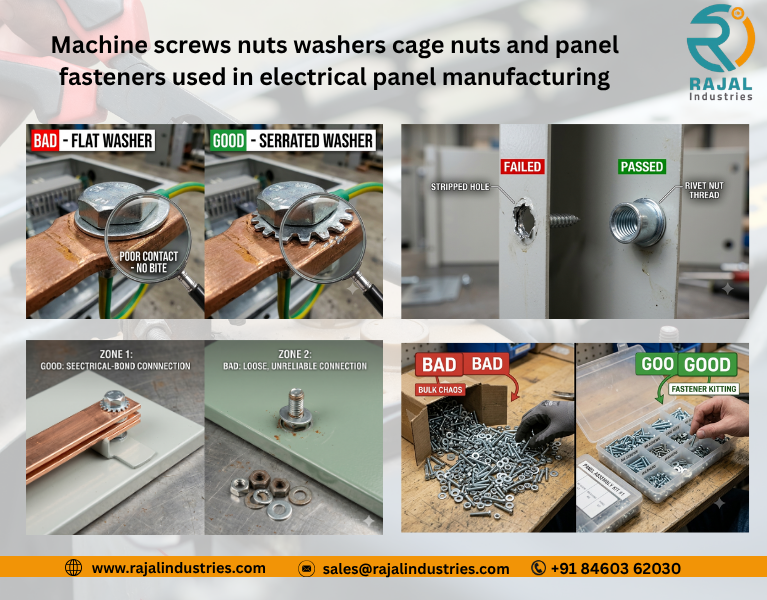
Introduction – Most OEMs Track Steel, But Ignore Fasteners
Ask an electrical panel manufacturer where most of their money goes.
The common answers are:
- Sheet metal
- Copper busbars
- Powder coating
- Electrical components
- Labor
Very few mention fasteners.
Yet after reviewing procurement data from multiple electrical panel manufacturers, a surprising pattern appears.
Typically:
10 fastener products account for nearly 80% of total fastener consumption.
These products are purchased every month.
Used in every panel.
Installed by every assembly operator.
And when supply is interrupted, production stops immediately.
For LT panel manufacturers, HT panel manufacturers, MCC panel manufacturers, PCC panel manufacturers, and control panel OEMs, understanding these high-volume fasteners is essential for inventory planning and cost reduction.
Quick Answer
Which fasteners consume the majority of a panel manufacturer’s budget?
In most panel manufacturing facilities, M4 machine screws, M5 machine screws, cage nuts, captive screws, rivet nuts, hex bolts, hex nuts, spring washers, serrated washers, and self-tapping screws account for most annual fastener consumption.
What Is a Panel Fastener Kit?
A panel fastener kit refers to the standard group of fasteners repeatedly used across electrical panel production.
A typical kit may include:
- Machine Screws
- Hex Bolts
- Hex Nuts
- Spring Washers
- Serrated Washers
- Cage Nuts
- Rivet Nuts
- Captive Screws
Many OEMs standardize these products to simplify inventory management.
Why Fastener Consumption Matters
A medium-sized panel manufacturer may produce:
10,000–50,000 Panels Per Year
Each panel may contain:
20–100 Fasteners
Annual fastener consumption can easily exceed:
500,000–2,000,000 Pieces
This is why fastener management directly affects:
- Inventory Cost
- Production Efficiency
- Procurement Planning
- Supplier Performance
- Assembly Speed
The Top 10 Fasteners Consuming Most OEM Budgets
1. M4 Machine Screws
Typical Applications
- Terminal Covers
- Internal Components
- DIN Rail Accessories
- Control Modules
Why They Matter
M4 machine screws are found in almost every electrical panel.
Typical annual consumption:
200,000–500,000 Pieces
2. M5 Machine Screws
Typical Applications
- Door Hardware
- Component Mounting
- Cable Management Systems
Why They Matter
Many OEMs standardize around M5 screws because they offer a good balance of strength and size.
Typical annual consumption:
100,000–300,000 Pieces
3. Captive Screws
Typical Applications
- Access Panels
- Maintenance Doors
- Service Covers
Why They Matter
Captive screws reduce lost hardware and improve serviceability.
Adoption is growing rapidly among panel OEMs.
4. Cage Nuts
Typical Applications
- Rack Mounting
- PLC Installation
- Equipment Supports
Why They Matter
Cage nuts simplify assembly and maintenance.
Typical consumption:
50,000–200,000 Pieces
5. Rivet Nuts
Typical Applications
- Thin Sheet Metal
- Door Assemblies
- Equipment Mounting
Why They Matter
Rivet nuts provide strong threads without welding.
Their use continues to increase in modern enclosure manufacturing.
6. M6 Hex Bolts
Typical Applications
- Structural Connections
- Internal Supports
- Mounting Brackets
Why They Matter
M6 bolts are among the most versatile fasteners in panel manufacturing.
7. Hex Nuts
Typical Applications
- Grounding Systems
- Bracket Mounting
- Mechanical Assemblies
Why They Matter
Nearly every bolt assembly requires matching nuts.
8. Spring Washers
Typical Applications
- Busbar Connections
- Vibration-Prone Areas
- Grounding Assemblies
Why They Matter
Spring washers help maintain preload and reduce loosening.
Typical annual consumption often exceeds:
100,000 Pieces
9. Serrated Washers
Typical Applications
- Grounding Hardware
- Electrical Bonding
- Earthing Systems
Why They Matter
Serrated washers create reliable metal-to-metal electrical contact.
10. Self-Tapping Screws
Typical Applications
- Sheet Metal Assemblies
- Cable Covers
- Auxiliary Components
Why They Matter
Self-tapping screws reduce assembly complexity and eliminate separate threading operations.
Typical Fastener Consumption Breakdown
| Fastener | Typical Annual Consumption |
| M4 Machine Screws | 200,000–500,000 |
| M5 Machine Screws | 100,000–300,000 |
| Captive Screws | 50,000–150,000 |
| Cage Nuts | 50,000–200,000 |
| Rivet Nuts | 50,000–100,000 |
| M6 Hex Bolts | 50,000–100,000 |
| Hex Nuts | 50,000–100,000 |
| Spring Washers | 100,000–200,000 |
| Serrated Washers | 50,000–100,000 |
| Self-Tapping Screws | 50,000–200,000 |
Real OEM Example
An MCC panel manufacturer analyzed annual procurement data.
Results showed:
Only 12 Fasteners
represented:
82% of annual fastener purchases.
The company used this information to:
✔ Reduce inventory
✔ Negotiate better pricing
✔ Improve supplier performance
✔ Simplify forecasting
Inventory Cost Calculation Example
Assume:
Annual Fastener Spend:
₹50 Lakhs
If 80% of spending is concentrated in:
10 Fasteners
Then:
₹50,00,000 × 80%
= ₹40,00,000
Managing just these ten products effectively can significantly improve purchasing performance.
Why OEMs Standardize Fastener Kits
Benefits include:
✔ Lower inventory
✔ Faster assembly
✔ Better supplier pricing
✔ Simplified purchasing
✔ Easier training
✔ Reduced stock shortages
✔ Better production planning
Panel Fastener Kit Example
Many electrical panel manufacturers standardize around:
Screws
- M4 Machine Screw
- M5 Machine Screw
- Captive Screw
Nuts
- Cage Nut
- Rivet Nut
- Hex Nut
Washers
- Spring Washer
- Serrated Washer
Bolts
- M6 Hex Bolt
- M8 Hex Bolt
This combination covers a large percentage of production requirements.
Industries Most Dependent on These Fasteners
The highest consumption is found among:
- LT Panel Manufacturers
- HT Panel Manufacturers
- MCC Panel Manufacturers
- PCC Panel Manufacturers
- Control Panel Manufacturers
- Switchgear Manufacturers
- Telecom Cabinet Manufacturers
- Battery Cabinet Manufacturers
- EV Charger Manufacturers
Inspection Checklist
Before finalizing a fastener strategy:
✔ Review annual consumption
✔ Identify top 10 fasteners
✔ Analyze inventory turnover
✔ Review supplier performance
✔ Standardize screw sizes
✔ Standardize washer types
✔ Reduce duplicate SKUs
✔ Monitor stock availability
Key Takeaways
- A small number of fasteners usually represent most annual consumption.
- M4 and M5 machine screws are among the highest-volume products.
- Cage nuts, rivet nuts, and captive screws are increasingly important.
- Standardization improves purchasing efficiency.
- Managing top fasteners effectively reduces inventory cost.
- OEMs should focus on lifecycle value, not just fastener price.
FAQ
What is a panel fastener kit?
A panel fastener kit is a standardized collection of screws, nuts, bolts, washers, cage nuts, and rivet nuts used repeatedly in panel manufacturing.
Which fastener is used most in electrical panels?
M4 machine screws and M5 machine screws are among the most commonly used fasteners.
Why are captive screws becoming popular?
Captive screws improve maintenance efficiency and reduce lost hardware.
What are cage nuts used for?
Cage nuts are commonly used for rack mounting and serviceable equipment installation.
Why do OEMs use rivet nuts?
Rivet nuts provide strong threads in thin sheet metal without welding.
How can panel manufacturers reduce fastener cost?
By standardizing high-volume fasteners, consolidating suppliers, and improving inventory planning.
Which industries consume the most panel fasteners?
Electrical panel manufacturers, switchgear manufacturers, telecom cabinet manufacturers, battery cabinet manufacturers, and EV charger OEMs.
What should OEMs track most closely?
The top 10 fasteners that represent the majority of annual consumption and purchasing spend.
Conclusion
Most panel manufacturers focus heavily on major components while overlooking one of the most frequently purchased categories in the factory.
Fasteners.
In many cases, just ten products account for the majority of annual fastener spending and inventory movement.
The manufacturers who understand these numbers make better purchasing decisions, reduce inventory costs, simplify production, and improve supply chain reliability.