
Introduction – Two Identical Panels, Two Very Different Results
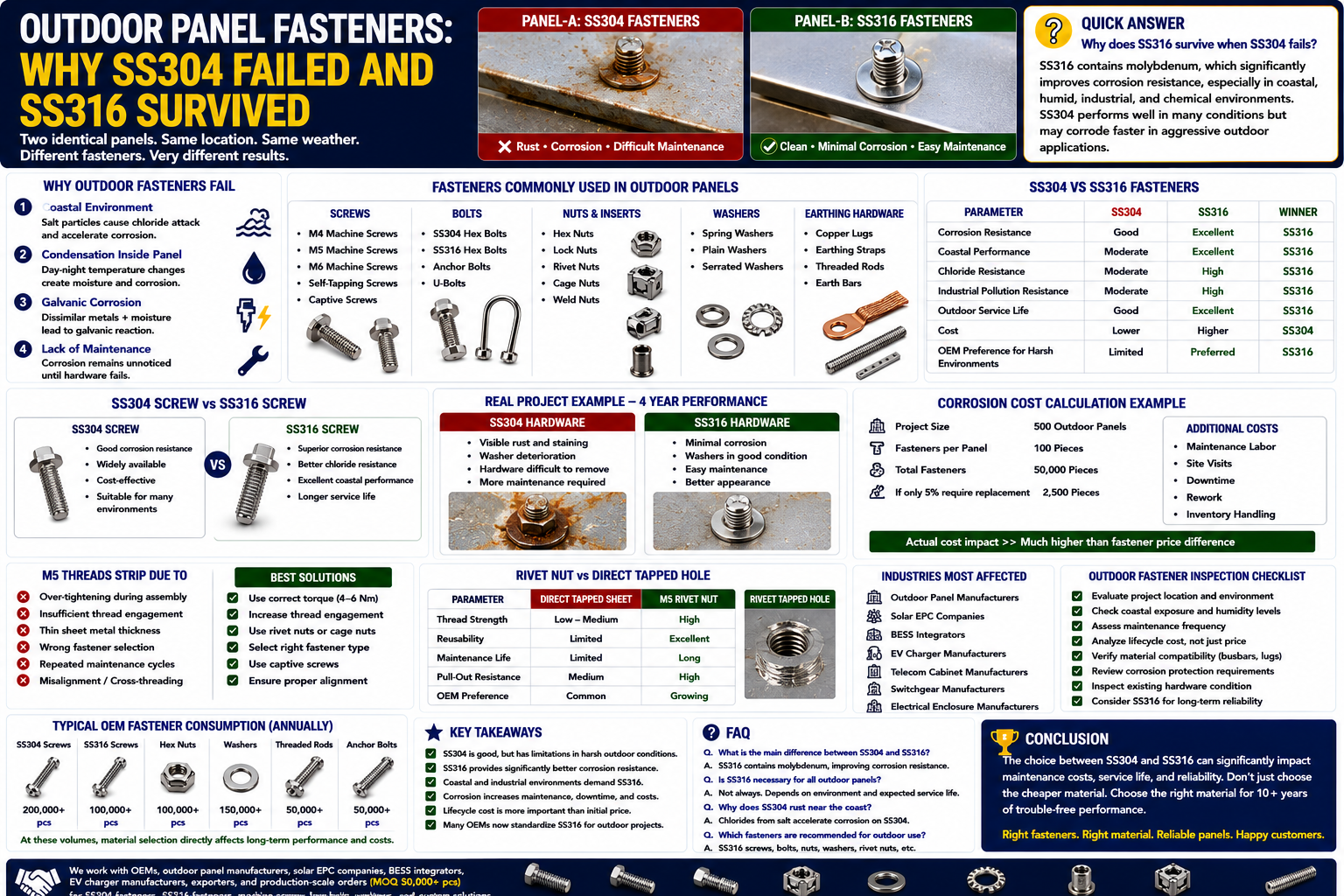
A solar EPC contractor installed two outdoor electrical panels at the same project site.
Both panels were:
- Installed on the same day
- Exposed to the same weather
- Carrying similar electrical loads
- Manufactured using similar designs
Three years later, maintenance engineers discovered a major difference.
Panel-A showed:
- Rust around screws
- Corroded washers
- Staining around fasteners
- Difficulty removing hardware
Panel-B showed:
- Clean fasteners
- Minimal corrosion
- Easy maintenance
The difference wasn’t the panel.
The difference wasn’t the location.
The difference was the fastener material.
Panel-A used:
SS304 Screws
Panel-B used:
SS316 Screws
This is one of the most common material selection mistakes made in outdoor electrical equipment.
Quick Answer
Why does SS316 survive when SS304 fails?
SS316 contains molybdenum, which significantly improves corrosion resistance, especially in coastal, humid, industrial, and chemical environments. SS304 performs well in many conditions but may corrode faster in aggressive outdoor applications.
What Are Outdoor Panel Fasteners?
Outdoor panel fasteners are the bolts, screws, nuts, washers, and hardware used in outdoor electrical equipment.
Common examples include:
Screws
- SS304 Machine Screws
- SS316 Machine Screws
- Self-Tapping Screws
- Captive Screws
Bolts
- SS304 Hex Bolts
- SS316 Hex Bolts
- Anchor Bolts
- U-Bolts
Hardware
- Hex Nuts
- Spring Washers
- Serrated Washers
- Rivet Nuts
- Cage Nuts
- Earthing Hardware
These fasteners are widely used in:
- Outdoor Electrical Panels
- Solar Junction Boxes
- EV Chargers
- Battery Energy Storage Systems (BESS)
- Telecom Cabinets
- Switchgear Systems
Why Outdoor Fasteners Fail
Outdoor environments create challenges that indoor equipment never experiences.
Examples include:
- Rain
- Humidity
- Condensation
- Salt Exposure
- Industrial Pollution
- Temperature Cycling
- UV Exposure
Over time, these conditions attack metal surfaces.
What Is SS304?
SS304 is the most commonly used stainless steel fastener material.
Common products include:
- SS304 Screws
- SS304 Hex Bolts
- SS304 Nuts
- SS304 Washers
Benefits:
✔ Good corrosion resistance
✔ Widely available
✔ Cost-effective
✔ Suitable for many environments
However, it has limitations in aggressive outdoor conditions.
What Is SS316?
SS316 is an upgraded stainless steel containing molybdenum.
Common products include:
- SS316 Screws
- SS316 Hex Bolts
- SS316 Nuts
- SS316 Washers
- SS316 Threaded Rods
Benefits:
✔ Superior corrosion resistance
✔ Better chloride resistance
✔ Excellent coastal performance
✔ Longer service life
Why SS304 Failed
1. Coastal Environment
The project site was located near the coast.
Salt particles continuously settled on the fasteners.
Over time:
- Surface contamination increased
- Corrosion initiated
- Rust staining appeared
SS304 struggled under continuous chloride exposure.
2. Condensation Inside the Panel
Many outdoor panels experience:
- Day-night temperature changes
- Internal condensation
- Moisture accumulation
Even without direct water entry, corrosion can begin.
3. Galvanic Corrosion
The panel contained:
- Copper Busbars
- Stainless Steel Fasteners
Moisture created conditions for galvanic corrosion.
The wrong material combination accelerated deterioration.
4. Lack of Maintenance
Many outdoor panels receive limited maintenance.
Corrosion remained unnoticed until hardware removal became difficult.
Why SS316 Survived
The key difference was:
Molybdenum Content
Molybdenum improves resistance against:
- Chlorides
- Salt Spray
- Moisture
- Industrial Chemicals
As a result:
- Corrosion developed much more slowly
- Fastener strength remained intact
- Maintenance became easier
SS304 vs SS316 Fasteners
| Parameter | SS304 Fasteners | SS316 Fasteners |
| Corrosion Resistance | Good | Excellent |
| Coastal Performance | Moderate | Excellent |
| Chloride Resistance | Moderate | High |
| Industrial Pollution Resistance | Moderate | High |
| Outdoor Service Life | Good | Excellent |
| Cost | Lower | Higher |
| OEM Preference for Harsh Environments | Limited | Preferred |
Real Project Example
A BESS integrator compared fastener performance over four years.
System
- Battery Container
- Outdoor Installation
- High Humidity
Results:
SS304 Hardware
- Visible corrosion
- Washer deterioration
- Increased maintenance
SS316 Hardware
- Minimal corrosion
- Easier servicing
- Better appearance
The OEM later standardized SS316 fasteners for future projects.
Corrosion Cost Calculation Example
Assume:
Project Size:
500 Outdoor Panels
Each panel uses:
100 Fasteners
Total Fasteners:
50,000 Pieces
If only 5% require replacement:
2,500 Fasteners
Now add:
- Maintenance labor
- Site visits
- Downtime
- Inventory handling
The actual cost becomes much higher than the original fastener price difference.
SS304 Screw vs SS316 Screw
| Parameter | SS304 Screw | SS316 Screw |
| Corrosion Resistance | Good | Excellent |
| Salt Exposure | Moderate | Excellent |
| Humidity Resistance | Good | Excellent |
| Outdoor Panels | Good | Excellent |
| EV Chargers | Good | Excellent |
| BESS Projects | Acceptable | Preferred |
Industries Most Affected
Fastener material selection is critical for:
- Outdoor Panel Manufacturers
- Solar EPC Companies
- BESS Integrators
- EV Charger Manufacturers
- Telecom Cabinet Manufacturers
- Battery Cabinet Manufacturers
- Switchgear Manufacturers
- Electrical Enclosure Manufacturers
Fasteners Commonly Upgraded to SS316
OEMs often upgrade:
- M4 Machine Screws
- M5 Machine Screws
- M6 Machine Screws
- Hex Bolts
- Hex Nuts
- Spring Washers
- Serrated Washers
- Threaded Rods
- Earthing Hardware
Especially in coastal and high-humidity applications.
Inspection Checklist
Before selecting outdoor fasteners:
✔ Evaluate project location
✔ Check coastal exposure
✔ Assess humidity levels
✔ Review maintenance intervals
✔ Analyze lifecycle cost
✔ Verify compatibility with busbars
✔ Review corrosion requirements
✔ Consider service life expectations
Typical OEM Fastener Consumption
A medium-sized outdoor panel manufacturer may consume annually:
- 200,000+ SS304 Screws
- 100,000+ SS316 Screws
- 100,000+ Hex Nuts
- 150,000+ Washers
- 50,000+ Threaded Rods
- 50,000+ Anchor Bolts
At these volumes, material selection directly affects long-term performance.
Key Takeaways
- SS304 performs well in many environments but has limitations in aggressive outdoor conditions.
- SS316 provides significantly better corrosion resistance.
- Coastal projects often justify the higher cost of SS316.
- Corrosion increases maintenance costs and downtime.
- Lifecycle cost is more important than initial fastener cost.
- Many OEMs now standardize SS316 hardware for outdoor projects.
FAQ
What is the difference between SS304 and SS316 fasteners?
SS316 contains molybdenum, which improves corrosion resistance, particularly in chloride-rich environments.
Is SS316 better for outdoor electrical panels?
Yes. SS316 generally offers superior long-term performance in outdoor applications.
Why does SS304 rust near coastal areas?
Salt and chlorides accelerate corrosion and can overwhelm the protective layer on SS304 over time.
Are SS316 screws worth the additional cost?
In harsh environments, many OEMs find that reduced maintenance and longer service life justify the additional cost.
Which fasteners are commonly available in SS316?
Machine screws, hex bolts, hex nuts, washers, threaded rods, captive screws, and anchor bolts.
Do EV charger manufacturers use SS316 fasteners?
Many outdoor EV charger manufacturers prefer SS316 hardware because of exposure to weather and moisture.
What industries benefit most from SS316 fasteners?
Solar EPC companies, BESS integrators, telecom cabinet manufacturers, outdoor panel manufacturers, and EV charger OEMs.
How can OEMs select the correct stainless steel grade?
The decision should be based on environmental conditions, maintenance expectations, corrosion risk, and lifecycle cost analysis.
Conclusion
Many outdoor fastener failures are not caused by poor manufacturing.
They are caused by incorrect material selection.
A fastener that performs perfectly indoors may fail outdoors within a few years.
For outdoor electrical panels, EV chargers, solar installations, telecom cabinets, and BESS projects, the choice between SS304 and SS316 can significantly impact maintenance costs, service life, and reliability.
The most successful OEMs do not ask:
“Which fastener is cheaper?”
They ask:
“Which fastener will still be performing after 10 years?”