

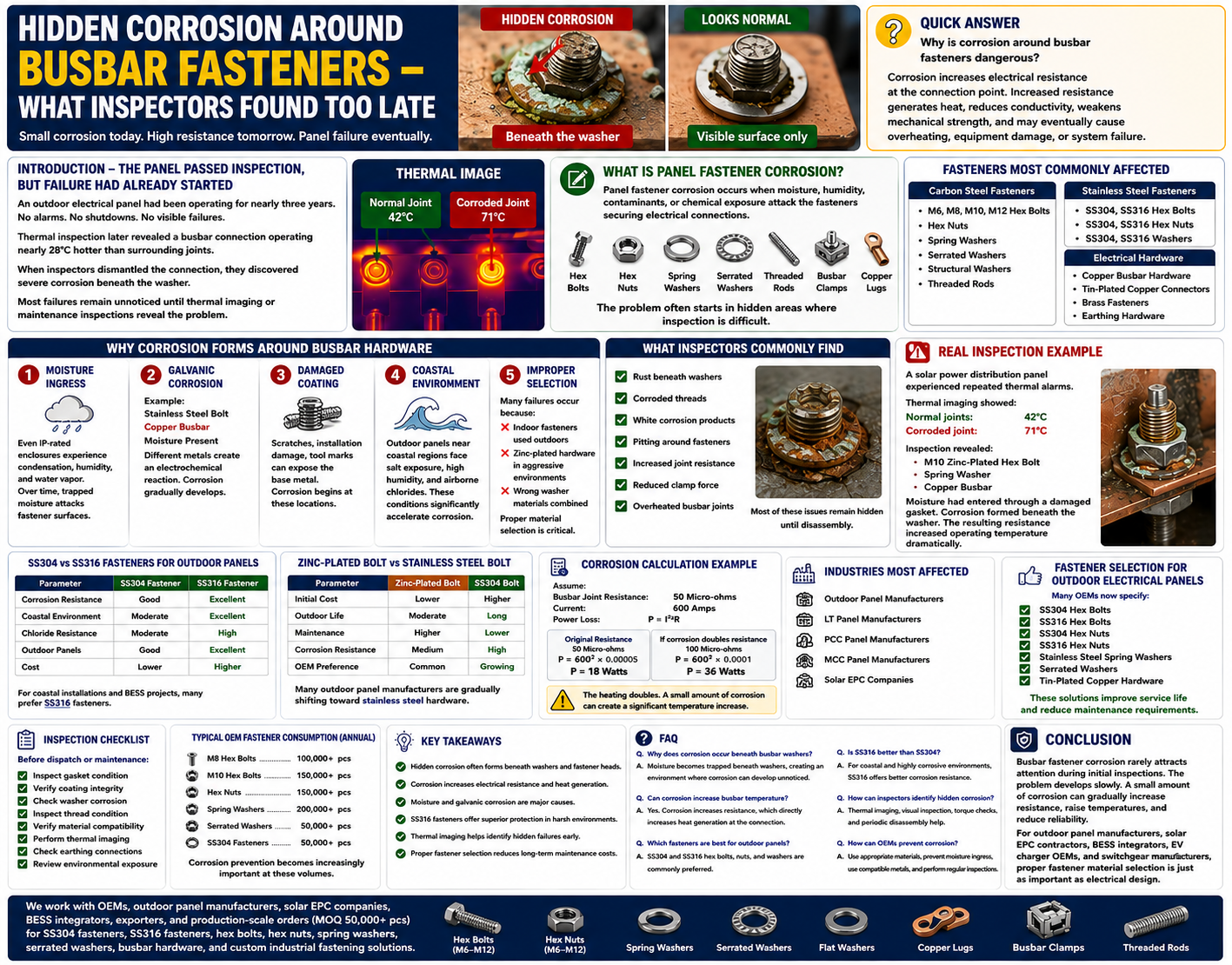
Introduction – The Panel Passed Inspection, But Failure Had Already Started
An outdoor electrical panel had been operating for nearly three years.
No alarms.
No shutdowns.
No visible failures.
Routine thermal inspection later revealed a busbar connection operating nearly 28°C hotter than surrounding joints.
When inspectors dismantled the connection, they discovered something unexpected.
The M10 hex bolt looked acceptable.
The hex nut appeared intact.
The spring washer seemed normal.
However, hidden beneath the washer was severe corrosion.
The corrosion had slowly increased electrical resistance, creating heat that eventually threatened the entire panel.
Unfortunately, this is not an isolated incident.
Hidden corrosion around busbar fasteners is commonly found in:
- Outdoor Electrical Panels
- LT Panels
- PCC Panels
- MCC Panels
- Solar Combiner Boxes
- EV Charging Stations
- Battery Energy Storage Systems (BESS)
- Switchgear Assemblies
Most failures remain unnoticed until thermal imaging or maintenance inspections reveal the problem.
Quick Answer
Why is corrosion around busbar fasteners dangerous?
Corrosion increases electrical resistance at the connection point. Increased resistance generates heat, reduces conductivity, weakens mechanical strength, and may eventually cause overheating, equipment damage, or system failure.
What Is Panel Fastener Corrosion?
Panel fastener corrosion occurs when moisture, humidity, contaminants, or chemical exposure attack the fasteners securing electrical connections.
Commonly affected components include:
- Hex Bolts
- Hex Nuts
- Spring Washers
- Serrated Washers
- Structural Washers
- Threaded Rods
- Busbar Clamps
- Copper Lugs
The problem often starts in hidden areas where inspection is difficult.
Fasteners Most Commonly Affected
Outdoor panel manufacturers frequently use:
Carbon Steel Fasteners
- M6 Hex Bolts
- M8 Hex Bolts
- M10 Hex Bolts
- M12 Hex Bolts
- Hex Nuts
- Spring Washers
Stainless Steel Fasteners
- SS304 Hex Bolts
- SS304 Hex Nuts
- SS316 Hex Bolts
- SS316 Hex Nuts
- SS304 Washers
- SS316 Washers
Electrical Hardware
- Copper Busbar Hardware
- Tin-Plated Copper Connectors
- Brass Fasteners
- Earthing Hardware
Why Corrosion Forms Around Busbar Hardware
1. Moisture Ingress
Even IP-rated enclosures experience:
- Condensation
- Humidity
- Water vapor
Over time, trapped moisture attacks fastener surfaces.
2. Galvanic Corrosion
One of the most overlooked problems.
Example:
- Stainless Steel Bolt
- Copper Busbar
- Moisture Present
Different metals create an electrochemical reaction.
Corrosion gradually develops.
3. Damaged Coating
A zinc-plated bolt may look protected.
However:
- Scratches
- Installation damage
- Tool marks
can expose the base metal.
Corrosion begins at these locations.
4. Coastal Environment
Outdoor panels near coastal regions face:
- Salt exposure
- High humidity
- Airborne chlorides
These conditions significantly accelerate corrosion.
5. Improper Fastener Selection
Many failures occur because:
❌ Indoor fasteners are used outdoors
❌ Zinc-plated hardware is selected for aggressive environments
❌ Wrong washer materials are combined
Proper material selection is critical.
What Inspectors Commonly Find
During maintenance inspections, engineers often discover:
✔ Rust beneath washers
✔ Corroded threads
✔ White corrosion products
✔ Pitting around fasteners
✔ Increased joint resistance
✔ Reduced clamp force
✔ Overheated busbar joints
Most of these issues remain hidden until disassembly.
Real Inspection Example
A solar power distribution panel experienced repeated thermal alarms.
Thermal imaging showed:
Normal joints:
42°C
Corroded joint:
71°C
Inspection revealed:
- M10 Zinc-Plated Hex Bolt
- Spring Washer
- Copper Busbar
Moisture had entered through a damaged gasket.
Corrosion formed beneath the washer.
The resulting resistance increased operating temperature dramatically.
SS304 vs SS316 Fasteners for Outdoor Panels
Which Performs Better?
| Parameter | SS304 Fastener | SS316 Fastener |
| Corrosion Resistance | Good | Excellent |
| Coastal Environment | Moderate | Excellent |
| Chloride Resistance | Moderate | High |
| Outdoor Panels | Good | Excellent |
| Cost | Lower | Higher |
For coastal installations and BESS projects, many OEMs prefer SS316 fasteners.
Zinc-Plated Bolt vs Stainless Steel Bolt
| Parameter | Zinc-Plated Bolt | SS304 Bolt |
| Initial Cost | Lower | Higher |
| Outdoor Life | Moderate | Long |
| Maintenance | Higher | Lower |
| Corrosion Resistance | Medium | High |
| OEM Preference | Common | Growing |
Many outdoor panel manufacturers are gradually shifting toward stainless steel hardware.
Corrosion Calculation Example
Assume:
Busbar Joint Resistance:
50 Micro-ohms
Current:
600 Amps
Power Loss:
P = I²R
P = 600² × 0.00005
P = 18 Watts
If corrosion doubles resistance:
Resistance:
100 Micro-ohms
Power Loss:
P = 600² × 0.0001
P = 36 Watts
The heating doubles.
A small amount of corrosion can create a significant temperature increase.
Industries Most Affected
This issue commonly affects:
- Outdoor Panel Manufacturers
- LT Panel Manufacturers
- PCC Panel Manufacturers
- MCC Panel Manufacturers
- Solar EPC Companies
- BESS Integrators
- EV Charger Manufacturers
- Switchgear Manufacturers
- Battery Cabinet Manufacturers
Fastener Selection for Outdoor Electrical Panels
Many OEMs now specify:
Preferred Hardware
- SS304 Hex Bolts
- SS316 Hex Bolts
- SS304 Hex Nuts
- SS316 Hex Nuts
- Stainless Steel Spring Washers
- Serrated Washers
- Tin-Plated Copper Hardware
These solutions improve service life and reduce maintenance requirements.
Inspection Checklist
Before dispatch or maintenance:
✔ Inspect gasket condition
✔ Verify coating integrity
✔ Check washer corrosion
✔ Inspect thread condition
✔ Verify material compatibility
✔ Perform thermal imaging
✔ Check earthing connections
✔ Review environmental exposure
Typical OEM Fastener Consumption
A medium-sized outdoor panel manufacturer may consume annually:
- 100,000+ M8 Hex Bolts
- 150,000+ M10 Hex Bolts
- 150,000+ Hex Nuts
- 200,000+ Spring Washers
- 50,000+ Serrated Washers
- 50,000+ SS304 Fasteners
Corrosion prevention becomes increasingly important at these volumes.
Key Takeaways
- Hidden corrosion often forms beneath washers and fastener heads.
- Corrosion increases electrical resistance and heat generation.
- Moisture and galvanic corrosion are major causes.
- SS316 fasteners offer superior protection in harsh environments.
- Thermal imaging helps identify hidden failures early.
- Proper fastener selection reduces long-term maintenance costs.
FAQ
Why does corrosion occur beneath busbar washers?
Moisture often becomes trapped beneath washers, creating an environment where corrosion can develop unnoticed.
Can corrosion increase busbar temperature?
Yes. Corrosion increases electrical resistance, which directly increases heat generation at the connection.
Which fasteners are best for outdoor electrical panels?
SS304 and SS316 hex bolts, nuts, and washers are commonly preferred for outdoor applications.
Is SS316 better than SS304?
For coastal and highly corrosive environments, SS316 generally offers better corrosion resistance than SS304.
How can inspectors identify hidden corrosion?
Thermal imaging, visual inspection, torque checks, and periodic disassembly help identify hidden corrosion.
Why are spring washers affected by corrosion?
Spring washers often trap moisture and contaminants, making them vulnerable to corrosion if incorrect materials are used.
Which industries face this issue most often?
Outdoor panel manufacturers, solar EPC companies, BESS integrators, EV charger manufacturers, and switchgear OEMs frequently encounter this problem.
How can OEMs prevent busbar fastener corrosion?
By selecting appropriate materials, preventing moisture ingress, using compatible metals, and performing regular inspections.
Conclusion
Busbar fastener corrosion rarely attracts attention during initial inspections.
The problem develops slowly.
A small amount of corrosion beneath a washer or bolt head can gradually increase resistance, raise temperatures, and reduce reliability.
For outdoor panel manufacturers, solar EPC contractors, BESS integrators, EV charger OEMs, and switchgear manufacturers, proper fastener material selection is just as important as electrical design.