

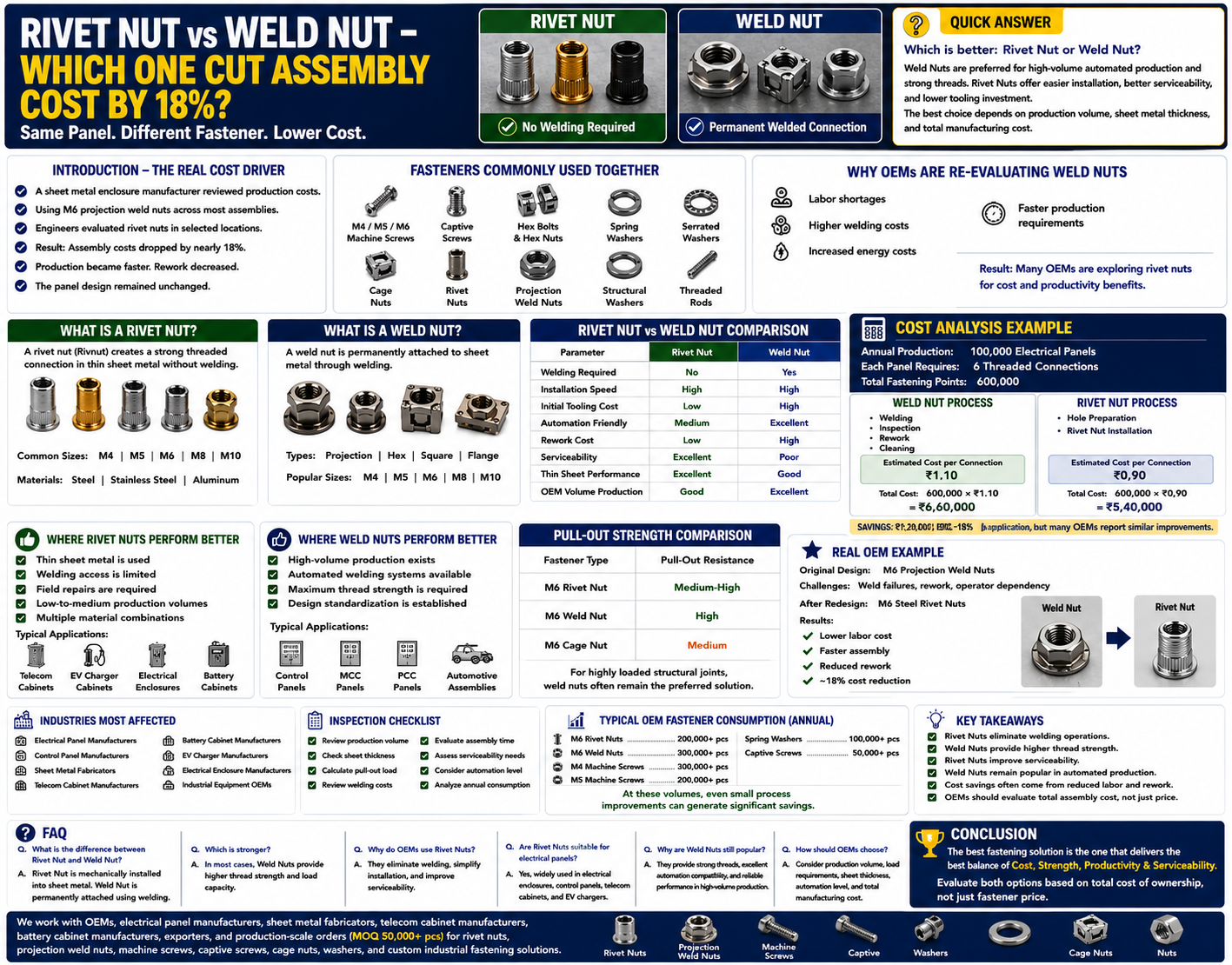
Introduction – Same Panel, Different Fastener, Lower Cost
A sheet metal enclosure manufacturer was facing increasing production costs.
The panels were selling well.
Quality was acceptable.
Customer complaints were low.
Yet profit margins were shrinking.
After reviewing production data, engineers discovered an unexpected cost driver.
It wasn’t steel.
It wasn’t labor.
It wasn’t powder coating.
It was the fastening system.
The company was using M6 Projection Weld Nuts across most assemblies.
During a value engineering project, engineers evaluated whether Rivet Nuts could replace Weld Nuts in selected locations.
The results surprised everyone.
Assembly costs dropped by nearly 18%.
Production became faster.
Rework decreased.
The panel design remained unchanged.
This raises an important question for OEM manufacturers:
Should you use Rivet Nuts or Weld Nuts?
Quick Answer
Which is better: Rivet Nut or Weld Nut?
Weld Nuts are generally preferred for high-volume automated production because they provide strong threads and fast assembly. Rivet Nuts offer easier installation, better serviceability, and lower tooling investment, making them attractive for low-to-medium volume production and field modifications.
The best choice depends on production volume, sheet metal thickness, assembly process, and total manufacturing cost.
What Is a Rivet Nut?
A Rivet Nut (also called a Rivnut or Threaded Insert) creates a strong threaded connection in thin sheet metal without welding.
Common sizes include:
- M4 Rivet Nut
- M5 Rivet Nut
- M6 Rivet Nut
- M8 Rivet Nut
- M10 Rivet Nut
Common materials:
- Steel Rivet Nut
- Stainless Steel Rivet Nut
- Aluminum Rivet Nut
What Is a Weld Nut?
A Weld Nut is permanently attached to sheet metal through welding.
Common types include:
- Projection Weld Nut
- Hex Weld Nut
- Square Weld Nut
- Flange Weld Nut
Popular sizes:
- M4 Weld Nut
- M5 Weld Nut
- M6 Weld Nut
- M8 Weld Nut
Weld Nuts are heavily used in:
- Electrical Panels
- Control Panels
- Battery Cabinets
- Telecom Cabinets
- Automotive Components
Fasteners Commonly Used Alongside Rivet Nuts and Weld Nuts
OEM manufacturers typically combine:
- M4 Machine Screws
- M5 Machine Screws
- M6 Machine Screws
- Captive Screws
- Hex Bolts
- Hex Nuts
- Spring Washers
- Serrated Washers
- Cage Nuts
- Rivet Nuts
- Projection Weld Nuts
These fasteners are widely used across sheet metal assemblies.
Why OEMs Are Re-Evaluating Weld Nuts
For years, weld nuts were considered the default solution.
However, modern manufacturers face new challenges:
- Labor shortages
- Higher welding costs
- Increased energy costs
- Faster production requirements
As a result, many OEMs are evaluating alternative fastening systems.
Rivet Nut vs Weld Nut Comparison
| Parameter | Rivet Nut | Weld Nut |
| Welding Required | No | Yes |
| Installation Speed | High | High |
| Initial Tooling Cost | Low | High |
| Automation Friendly | Medium | Excellent |
| Rework Cost | Low | High |
| Serviceability | Excellent | Poor |
| Thin Sheet Performance | Excellent | Good |
| OEM Volume Production | Good | Excellent |
Cost Analysis Example
Assume annual production:
100,000 Electrical Panels
Each panel requires:
6 Threaded Connections
Total:
600,000 Fastening Points
Weld Nut Process
- Welding
- Inspection
- Rework
- Cleaning
Estimated cost:
₹1.10 per connection
Total:
₹6,60,000
Rivet Nut Process
- Hole preparation
- Rivet nut installation
Estimated cost:
₹0.90 per connection
Total:
₹5,40,000
Savings:
₹1,20,000
Reduction:
Approximately 18%
Actual savings vary by application, but many OEMs report similar improvements.
Where Rivet Nuts Perform Better
Rivet Nuts are often preferred when:
✔ Thin sheet metal is used
✔ Welding access is limited
✔ Field repairs are required
✔ Low-to-medium production volumes exist
✔ Multiple material combinations are used
Typical applications:
- Telecom Cabinets
- EV Charger Cabinets
- Electrical Enclosures
- Battery Cabinets
Where Weld Nuts Perform Better
Weld Nuts remain the preferred choice when:
✔ High-volume production exists
✔ Automated welding systems are available
✔ Maximum thread strength is required
✔ Design standardization is established
Typical applications:
- Control Panels
- MCC Panels
- PCC Panels
- Automotive Assemblies
- Large OEM Production Lines
Real OEM Example
A control panel manufacturer reviewed annual production costs.
Original design:
- M6 Projection Weld Nuts
- Manual inspection
- Welding rework
Challenges:
- Weld failures
- Rework time
- Operator dependency
After redesigning selected assemblies:
- M6 Steel Rivet Nuts
- Simplified installation
- Reduced welding operations
Results:
✔ Lower labor cost
✔ Faster assembly
✔ Reduced rework
✔ Approximately 18% cost reduction
Not every application was converted.
However, strategic replacement delivered measurable savings.
Pull-Out Strength Comparison
| Fastener Type | Pull-Out Resistance |
| M6 Rivet Nut | Medium-High |
| M6 Weld Nut | High |
| M6 Cage Nut | Medium |
For highly loaded structural joints, weld nuts often remain the preferred solution.
Industries Most Affected
This decision frequently impacts:
- Electrical Panel Manufacturers
- Control Panel Manufacturers
- Sheet Metal Fabricators
- Telecom Cabinet Manufacturers
- Battery Cabinet Manufacturers
- EV Charger Manufacturers
- Electrical Enclosure Manufacturers
- Industrial Equipment OEMs
Inspection Checklist
Before choosing Rivet Nuts or Weld Nuts:
✔ Review production volume
✔ Check sheet thickness
✔ Calculate pull-out load
✔ Review welding costs
✔ Evaluate assembly time
✔ Assess serviceability requirements
✔ Consider automation level
✔ Analyze annual fastener consumption
Typical OEM Fastener Consumption
A medium-sized panel OEM may consume annually:
- 200,000+ M6 Rivet Nuts
- 300,000+ M6 Weld Nuts
- 300,000+ M4 Machine Screws
- 200,000+ M5 Machine Screws
- 100,000+ Spring Washers
- 50,000+ Captive Screws
At these volumes, even small process improvements can generate significant savings.
Key Takeaways
- Rivet Nuts eliminate welding operations.
- Weld Nuts provide higher thread strength.
- Rivet Nuts improve serviceability.
- Weld Nuts remain popular in automated production.
- Cost savings often come from reduced labor and rework.
- OEMs should evaluate total assembly cost, not just fastener price.
FAQ
What is the difference between a Rivet Nut and a Weld Nut?
A Rivet Nut is mechanically installed into sheet metal, while a Weld Nut is permanently attached using a welding process.
Which is stronger, a Rivet Nut or a Weld Nut?
In most applications, Weld Nuts provide higher thread strength and load capacity.
Why do OEMs use Rivet Nuts?
Rivet Nuts eliminate welding, simplify installation, and improve serviceability.
Are Rivet Nuts suitable for electrical panels?
Yes. Rivet Nuts are widely used in electrical enclosures, control panels, telecom cabinets, and EV charger cabinets.
Why are Weld Nuts still popular?
Weld Nuts provide strong threads, excellent automation compatibility, and reliable performance in high-volume production.
Can Rivet Nuts reduce manufacturing cost?
Yes. In many applications, reduced labor, rework, and welding costs result in lower overall assembly cost.
Which industries use Rivet Nuts most frequently?
Electrical enclosure manufacturers, telecom cabinet manufacturers, EV charger manufacturers, and battery cabinet manufacturers.
How should OEMs choose between Rivet Nuts and Weld Nuts?
The decision should consider production volume, load requirements, sheet thickness, automation level, and total manufacturing cost.
Conclusion
The best fastening solution is not always the strongest one.
It is the solution that delivers the best balance of:
- Cost
- Strength
- Productivity
- Serviceability
For many OEM manufacturers, Rivet Nuts provide an opportunity to reduce assembly cost and simplify production.
For others, Weld Nuts remain the best choice for high-volume automated manufacturing.
The smartest manufacturers evaluate both options based on total cost of ownership rather than fastener price alone.