

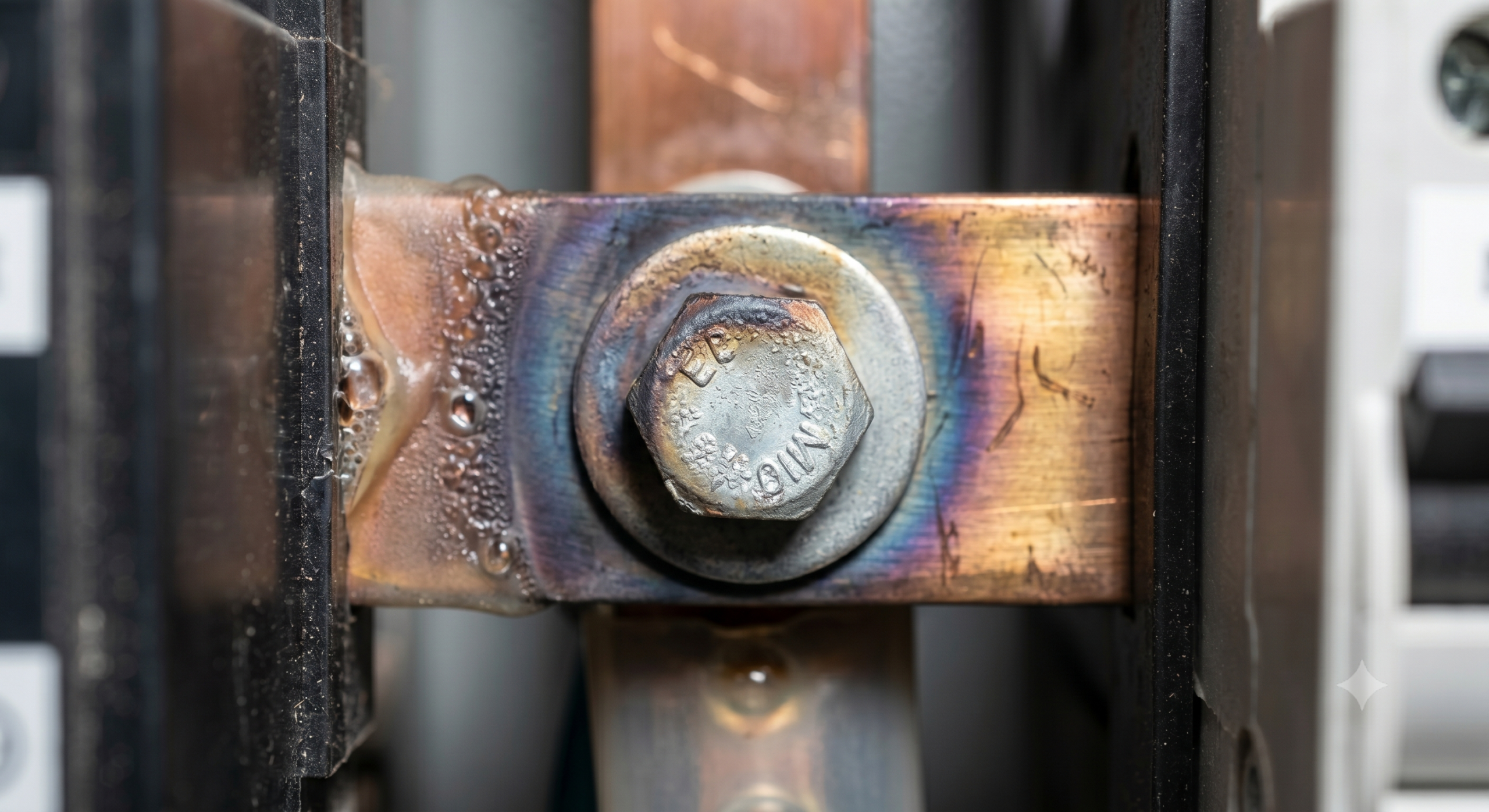
Introduction – A Failure That Starts with Just a Few Degrees
A newly installed LT panel was operating normally.
Load current remained within design limits.
The MCC panel passed inspection.
All electrical connections looked secure.
Three months later, thermal imaging revealed something unusual.
One busbar joint was operating at:
78°C
Nearby joints were operating at:
42°C
Nothing appeared loose.
Nothing appeared damaged.
Yet the connection was overheating.
After investigation, the root cause was discovered:
👉 Incorrect busbar bolt torque.
This is one of the most common causes of heating failures in LT panels, PCC panels, MCC panels, APFC panels, switchboards, and power distribution systems.
The problem often starts with a simple mistake that remains invisible until thermal damage begins.
Quick Answer
Why do busbar joints heat up in LT panels?
Busbar joints heat up when improper bolt torque reduces clamp force between conductors. Reduced contact pressure increases electrical resistance, generating heat that can lead to overheating, insulation damage, and system failure.
What Is Busbar Joint Heating?
Busbar joint heating occurs when electrical resistance increases at the connection point between conductors.
This resistance converts electrical energy into heat.
The most common causes include:
- Incorrect bolt torque
- Loose fasteners
- Preload loss
- Poor contact surfaces
- Missing spring washers
- Corrosion
- Thermal cycling
Even a small increase in resistance can significantly increase operating temperature.
Fasteners Commonly Used in Busbar Assemblies
Typical busbar hardware includes:
- Hex Head Bolts
- Hex Nuts
- Spring Washers
- Plain Washers
- Serrated Washers
- Flange Nuts
- Structural Washers
- Copper Bolts
- Brass Bolts
- Stainless Steel Fasteners
Common sizes:
- M6 Hex Bolts
- M8 Hex Bolts
- M10 Hex Bolts
- M12 Hex Bolts
These fasteners are widely used in:
- LT Panels
- HT Panels
- PCC Panels
- MCC Panels
- APFC Panels
- Distribution Boards
- Switchgear Assemblies
- Bus Duct Systems
Why Correct Busbar Bolt Torque Matters
Electrical current transfers through the contact area between busbars.
Higher contact pressure:
✔ Lower resistance
✔ Lower temperature
✔ Better conductivity
Lower contact pressure:
❌ Higher resistance
❌ More heat
❌ Increased energy loss
A properly tightened M10 bolt creates preload that keeps busbars tightly compressed.
When preload drops, heating begins.
The Hidden Torque Mistake Most OEMs Miss
Many panel manufacturers focus only on tightening torque.
However, torque itself is not the goal.
Preload is the goal.
Torque simply creates preload.
If friction changes because of:
- Coating
- Surface finish
- Lubrication
- Washer type
The same torque may create very different preload values.
Two identical bolts tightened to the same torque can produce significantly different clamp forces.
5 Common Causes of Busbar Joint Heating
1. Under-Tightened Bolts
Insufficient torque creates low preload.
Low preload reduces contact pressure.
Electrical resistance increases.
Heat generation begins.
2. Missing Spring Washers
Many overheating failures involve:
- Missing spring washers
- Incorrect washer selection
- Flattened washers
Spring washers help maintain preload during thermal cycling.
3. Thermal Expansion
Busbars heat and cool continuously.
During operation:
- Copper expands
- Aluminum expands
- Fasteners expand
Repeated thermal cycling can reduce preload over time.
4. Oxidized Contact Surfaces
Oxidation creates additional resistance.
Common examples:
- Copper oxidation
- Aluminum oxidation
Even when torque is correct, poor contact surfaces can create overheating.
5. Vibration-Induced Loosening
Nearby transformers and rotating equipment create vibration.
Over time:
- Bolt preload decreases
- Contact pressure drops
- Heating develops
Busbar Bolt Torque Chart
| Bolt Size | Typical Torque Range |
| M6 Bolt | 8–12 Nm |
| M8 Bolt | 18–25 Nm |
| M10 Bolt | 35–50 Nm |
| M12 Bolt | 60–80 Nm |
Actual values depend on:
- Material
- Washer type
- Surface finish
- Manufacturer specification
Always verify design requirements.
Calculation Example – Why Small Resistance Increases Cause Big Problems
Assume:
Current:
500 Amps
Joint Resistance:
50 Micro-ohms
Power Loss:
P = I²R
P = 500² × 0.00005
P = 12.5 Watts
Now resistance doubles because preload decreases:
Resistance:
100 Micro-ohms
Power Loss:
P = 500² × 0.0001
P = 25 Watts
The heating doubles.
The difference may seem small, but over thousands of operating hours it becomes significant.
Spring Washer vs Plain Washer
Which Is Better for Busbar Assemblies?
| Washer Type | Maintains Preload | OEM Usage |
| Plain Washer | Low | Common |
| Spring Washer | High | Preferred |
| Serrated Washer | High | Growing |
| Structural Washer | High | Heavy-Duty Applications |
Many LT panel manufacturers prefer spring washers or serrated washers to reduce preload loss.
Thermal Imaging Case Example
An MCC panel manufacturer reported repeated overheating alarms.
Inspection found:
- M10 Hex Bolts
- Plain washers only
- No preload verification
Thermal image results:
Normal joints:
40–45°C
Failed joint:
78°C
Corrective action:
- Re-torqued connections
- Installed spring washers
- Verified preload
Temperature returned to normal range.
Industries Most Affected
This problem frequently affects:
- LT Panel Manufacturers
- PCC Panel Manufacturers
- MCC Panel Manufacturers
- APFC Panel Manufacturers
- Switchgear Manufacturers
- Busbar Trunking Manufacturers
- Distribution Board Manufacturers
- EV Charger Manufacturers
- Battery Energy Storage System Integrators
Inspection Checklist
Before dispatch:
✔ Verify torque values
✔ Check washer selection
✔ Inspect contact surfaces
✔ Remove oxidation
✔ Verify spring washer installation
✔ Confirm preload
✔ Perform thermal inspection
✔ Document torque records
Typical Fastener Consumption
A medium-sized panel manufacturer may consume annually:
- 50,000–150,000 M8 Hex Bolts
- 50,000–200,000 M10 Hex Bolts
- 100,000+ Spring Washers
- 100,000+ Plain Washers
- 50,000+ Hex Nuts
- 20,000+ Serrated Washers
Fastener standardization improves assembly consistency and maintenance performance.
Key Takeaways
- Busbar heating often starts with preload loss.
- Correct torque is critical for reliable electrical contact.
- Spring washers help maintain clamp force.
- Thermal expansion can gradually reduce preload.
- Even small resistance increases can significantly increase heating.
- Regular thermal inspection helps identify failures early.
FAQ
What causes busbar joint heating in LT panels?
The most common causes are insufficient bolt torque, preload loss, oxidation, vibration, and thermal cycling. All of these increase electrical resistance.
Why is bolt torque important for busbar connections?
Bolt torque creates preload. Preload increases contact pressure between conductors and reduces electrical resistance.
Which fasteners are commonly used in busbar joints?
M6, M8, M10, and M12 Hex Bolts with Hex Nuts, Spring Washers, Plain Washers, and Serrated Washers are commonly used.
Are spring washers necessary in busbar assemblies?
In many applications, yes. Spring washers help maintain preload and reduce loosening caused by vibration and thermal expansion.
How can overheating busbar joints be detected?
Thermal imaging is one of the most effective methods. Hot spots often appear before visible damage occurs.
Can loose bolts increase electrical resistance?
Yes. Reduced preload decreases contact pressure and increases resistance, which generates additional heat.
How often should busbar joints be inspected?
Critical power systems should be inspected periodically using thermal imaging and torque verification, especially before peak load seasons.
Why do some busbar joints overheat while others remain cool?
Small differences in preload, washer selection, oxidation, or installation quality can significantly affect joint resistance and temperature.
Conclusion
Busbar joint heating rarely starts with a major electrical failure.
It usually starts with a simple fastening mistake.
A loose M8 bolt, an incorrectly torqued M10 bolt, a missing spring washer, or gradual preload loss can create resistance that eventually becomes a thermal problem.
For LT panel manufacturers, MCC panel manufacturers, PCC panel manufacturers, and switchgear OEMs, proper fastener selection and torque control remain critical to long-term system reliability.