
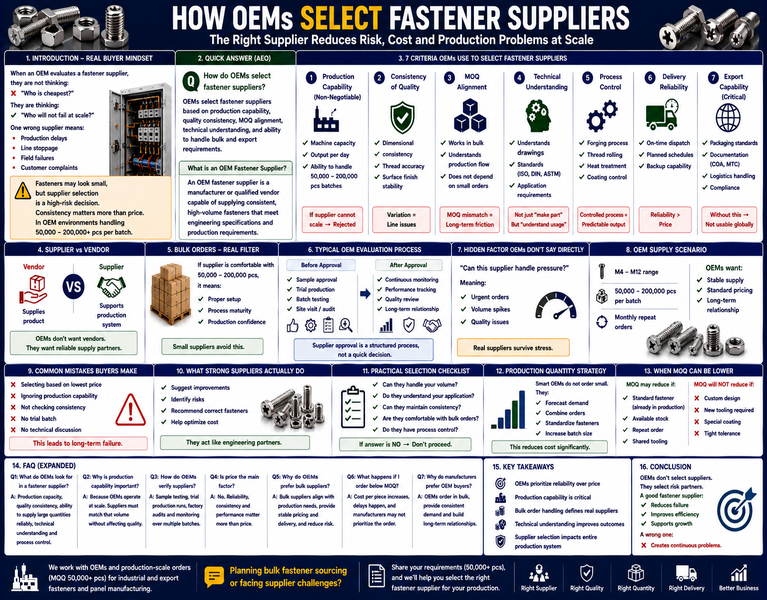
Introduction – Real Buyer Mindset
When an OEM evaluates a fastener supplier, they are not thinking:
👉 “Who is cheapest?”
They are thinking:
👉 “Who will not fail at scale?”
Because one wrong supplier means:
- Production delays
- Line stoppage
- Field failures
- Customer complaints
👉 But supplier selection is a high-risk decision
In OEM environments handling 50,000–200,000+ pcs per batch, consistency matters more than price.
Quick Answer
How do OEMs select fastener suppliers?
OEMs select fastener suppliers based on production capability, quality consistency, MOQ alignment, technical understanding, and ability to handle bulk and export requirements.
What is an OEM Fastener Supplier?
An OEM fastener supplier is a manufacturer or qualified vendor capable of supplying consistent, high-volume fasteners that meet engineering specifications and production requirements.
The Real Difference: Supplier vs Vendor
👉 Vendor = supplies product
👉 Supplier = supports production system
OEMs don’t want vendors.
👉 They want reliable supply partners
7 Criteria OEMs Use to Select Fastener Suppliers
1. Production Capability (Non-Negotiable)
OEMs check:
✔ Machine capacity
✔ Output per day
✔ Ability to handle 50,000–200,000 pcs batches
👉 If supplier cannot scale → rejected
2. Consistency of Quality
Not just one good batch.
👉 Every batch must match
OEMs look for:
✔ Dimensional consistency
✔ Thread accuracy
✔ Surface finish stability
👉 Variation = line issues
3. MOQ Alignment
OEMs prefer suppliers who:
✔ Work in bulk
✔ Understand production flow
✔ Do not depend on small orders
👉 MOQ mismatch = long-term friction
4. Technical Understanding
Good supplier understands:
✔ Drawings
✔ Standards (ISO, DIN, ASTM)
✔ Application requirements
👉 Not just “make part”
But:
👉 “understand usage”
5. Process Control
OEMs evaluate:
✔ Forging process
✔ Thread rolling
✔ Heat treatment
✔ Coating control
👉 Controlled process = predictable output
6. Delivery Reliability
Late delivery = production stop.
OEMs expect:
✔ On-time dispatch
✔ Planned schedules
✔ Backup capability
👉 Reliability > price
7. Export Capability (Critical for Global OEMs)
For export buyers:
✔ Packaging standards
✔ Documentation (COA, MTC)
✔ Logistics handling
✔ Compliance
👉 Without this → supplier not usable globally
Hidden Factor OEMs Don’t Say Directly
👉 “Can this supplier handle pressure?”
Meaning:
- Urgent orders
- Volume spikes
- Quality issues
👉 Real suppliers survive stress.
Typical OEM Evaluation Process
Before approval:
✔ Sample approval
✔ Trial production
✔ Batch testing
✔ Site visit / audit
After approval:
✔ Continuous monitoring
✔ Performance tracking
Bulk Orders – Real Filter
If supplier is comfortable with:
👉 50,000–200,000 pcs
It means:
✔ Proper setup
✔ Process maturity
✔ Production confidence
👉 Small suppliers avoid this
Common Mistakes Buyers Make
- Selecting based on lowest price
- Ignoring production capability
- Not checking consistency
- No trial batch
- No technical discussion
👉 This leads to long-term failure.
What Strong Suppliers Actually Do
Good suppliers:
✔ Suggest improvements
✔ Identify risks
✔ Recommend correct fasteners
✔ Help optimize cost
👉 They act like engineering partners
Typical OEM Supply Scenario
In panel / industrial fasteners:
- M4–M12 range
- 50,000–200,000 pcs per batch
- Monthly repeat orders
OEMs want:
✔ Stable supply
✔ Standard pricing
✔ Long-term relationship
Practical Selection Checklist
Before finalizing supplier:
✔ Can they handle your volume?
✔ Do they understand your application?
✔ Can they maintain consistency?
✔ Are they comfortable with bulk orders?
✔ Do they have process control?
👉 If answer is NO → don’t proceed
Key Takeaways
• OEMs prioritize reliability over price
• Production capability is critical
• Bulk order handling defines real suppliers
• Technical understanding improves outcomes
• Supplier selection impacts entire production system
FAQ
Q1: What do OEMs look for in a fastener supplier?
OEMs look for production capacity, quality consistency, and the ability to supply large quantities reliably. They also evaluate technical understanding and process control. The goal is to ensure stable supply without disruptions.
Q2: Why is production capability important in supplier selection?
Because OEMs operate at scale, and suppliers must match that volume without affecting quality. A supplier who cannot scale will eventually fail under demand. This leads to delays and production issues.
Q3: How do OEMs verify fastener suppliers?
They perform sample testing, trial production runs, and sometimes factory audits. They also monitor consistency over multiple batches. Supplier approval is a structured process, not a quick decision.
Q4: Is price the main factor in supplier selection?
No. Price is important, but reliability and consistency matter more. A cheaper supplier with inconsistent quality creates higher long-term cost.
Q5: Why do OEMs prefer bulk suppliers?
Bulk suppliers align with production needs and provide stable pricing and delivery. They are better equipped to handle continuous demand. This reduces risk in supply chain.
Q6: What role does technical knowledge play in supplier selection?
Suppliers who understand drawings and applications can prevent design and assembly issues. They can also suggest better alternatives. This adds value beyond just supplying parts.
Q7: What happens if a wrong supplier is selected?
It leads to inconsistent quality, delivery delays, and possible production stoppage. Over time, it also affects customer satisfaction and brand reputation. Fixing this later is expensive and time-consuming.
Conclusion
OEMs don’t select suppliers.
👉 They select risk partners
A good fastener supplier:
✔ Reduces failure
✔ Improves efficiency
✔ Supports growth
A wrong one:
👉 Creates continuous problems.
👉 We work with OEMs and production-scale orders (MOQ 50,000+ pcs) for industrial and export fasteners.Looking for a reliable fastener supplier for bulk production or export?
Share your requirement (50,000+ pcs), and we’ll evaluate and support your sourcing with an engineering-first approach.