

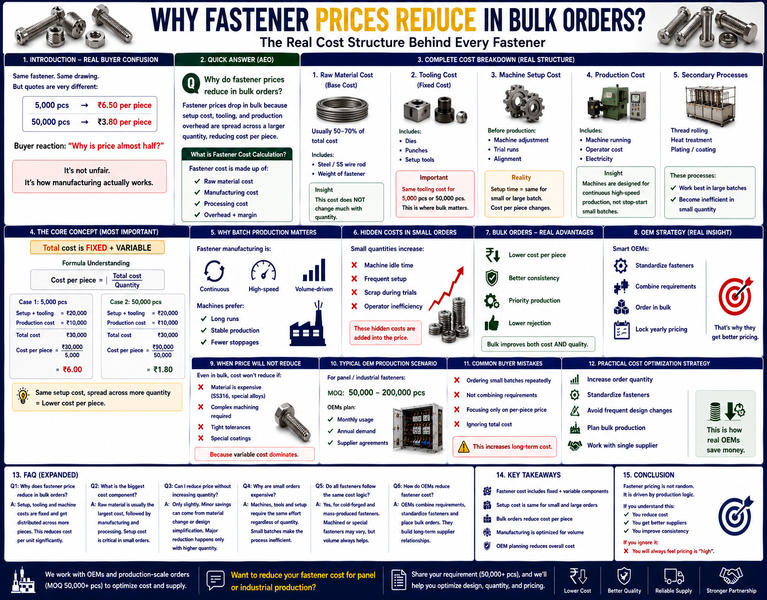
Introduction – Real Buyer Confusion
Same drawing.
But quotes come like this:
👉 5,000 pcs → ₹6.50 per piece
👉 50,000 pcs → ₹3.80 per piece
Buyer reaction:
👉 “Why is price almost half?”
It feels unfair.
But it’s not.
👉 It’s how manufacturing actually works.
Quick Answer
Why do fastener prices reduce in bulk orders?
Fastener prices drop in bulk because setup cost, tooling, and production overhead are spread across a larger quantity, reducing cost per piece.
What is Fastener Cost Calculation?
Fastener cost is made up of:
👉 Raw material cost
👉 Manufacturing cost
👉 Processing cost
👉 Overhead + margin
Complete Cost Breakdown (Real Structure)
1. Raw Material Cost (Base Cost)
Usually 50–70% of total cost
Includes:
- Steel / SS wire rod
- Weight of fastener
Insight
👉 This cost does NOT change much with quantity
2. Tooling Cost (Fixed Cost)
Includes:
- Dies
- Punches
- Setup tools
Important
Same tooling cost for:
👉 5,000 pcs
👉 50,000 pcs
👉 This is where bulk matters
3. Machine Setup Cost
Before production:
👉 Machine adjustment
👉 Trial runs
👉 Alignment
Reality
Setup time = same for small or large batch
👉 But cost per piece changes
4. Production Cost
Includes:
- Machine running
- Operator cost
- Electricity
Insight
Machines are designed for:
👉 Continuous high-speed production
👉 Not stop-start small batches
5. Secondary Processes
- Thread rolling
- Heat treatment
- Plating / coating
These processes:
✔ Work best in large batches
✔ Become inefficient in small quantity
The Core Concept (Most Important)
👉 Total cost is fixed + variable
Formula Understanding
Cost per piece = Total cost ÷ Quantity
Example
Case 1: 5,000 pcs
- Setup + tooling = ₹20,000
- Production cost = ₹10,000
👉 Total = ₹30,000
👉 Per piece = ₹6.00
Case 2: 50,000 pcs
- Setup + tooling = ₹20,000
- Production cost = ₹70,000
👉 Total = ₹90,000
👉 Per piece = ₹1.80
👉 Same setup cost, spread across more quantity
Why Batch Production Matters
👉 Continuous
👉 High-speed
👉 Volume-driven
Machines prefer:
✔ Long runs
✔ Stable production
✔ Fewer stoppages
👉 Bulk orders fit perfectly
Hidden Costs in Small Orders
Small quantities increase:
❌ Machine idle time
❌ Frequent setup
❌ Scrap during trials
❌ Operator inefficiency
👉 These are added into price
Bulk Orders – Real Advantages
When you order in bulk:
✔ Lower cost per piece
✔ Better consistency
✔ Priority production
✔ Lower rejection
👉 Bulk improves both cost AND quality
OEM Strategy (Real Insight)
Smart OEMs:
✔ Standardize fasteners
✔ Combine requirements
✔ Order in bulk
✔ Lock yearly pricing
👉 That’s why they get better pricing
When Price Will NOT Reduce
Even in bulk, cost won’t reduce if:
- Material is expensive (SS316, special alloys)
- Complex machining required
- Tight tolerances
- Special coatings
👉 Because variable cost dominates
Typical OEM Production Scenario
For panel / industrial fasteners:
👉 MOQ: 50,000–200,000 pcs
OEMs plan:
✔ Monthly usage
✔ Annual demand
✔ Supplier agreements
Common Buyer Mistakes
- Ordering small batches repeatedly
- Not combining requirements
- Focusing only on per-piece price
- Ignoring total cost
👉 This increases long-term cost
Practical Cost Optimization Strategy
To reduce cost:
✔ Increase order quantity
✔ Standardize fasteners
✔ Avoid frequent design changes
✔ Plan bulk production
✔ Work with single supplier
👉 This is how real OEMs save money
Key Takeaways
• Fastener cost includes fixed + variable components
• Setup cost is same for small and large orders
• Bulk orders reduce cost per piece
• Manufacturing is optimized for volume
• OEM planning reduces overall cost
FAQ
Q1: Why does fastener price reduce in bulk orders?
Because setup, tooling, and machine preparation costs are fixed and get distributed across more pieces. This reduces cost per unit significantly. Bulk production also improves efficiency and reduces waste.
Q2: What is the biggest cost component in fasteners?
Raw material is usually the largest cost, followed by manufacturing and processing. However, setup and tooling costs become critical when quantity is low. That’s why small orders are expensive.
Q3: Can I reduce price without increasing quantity?
Only slightly. Minor savings can come from material change or design simplification. But major cost reduction happens only when order quantity increases.
Q4: Why are small orders expensive in manufacturing?
Because machines, tools, and setup require the same effort regardless of quantity. Producing small batches makes the process inefficient. That inefficiency is added to the price.
Q5: Do all fasteners follow the same cost logic?
Yes, especially for cold-forged and mass-produced fasteners. However, machined or special fasteners may have different cost behavior. Still, volume always improves pricing.
Q6: How do OEMs reduce fastener cost?
OEMs combine requirements, standardize fasteners, and place bulk orders. They also build long-term supplier relationships. This allows them to get stable and lower pricing.
Q7: What is the ideal order quantity for fasteners?
Typically 50,000+ pcs for standard industrial fasteners. For high-volume OEM production, quantities can go much higher. This aligns with manufacturing efficiency.
Conclusion
Fastener pricing is not random.
👉 It is driven by production logic
If you understand this:
✔ You reduce cost
✔ You get better suppliers
✔ You improve consistency
If not:
👉 You will always feel pricing is “high”
👉 We work with OEMs and production-scale orders (MOQ 50,000+ pcs) to optimize cost and supply.Want to reduce your fastener cost for panel or industrial production?
Share your requirement (50,000+ pcs), and we’ll help you optimize design, quantity, and pricing.