
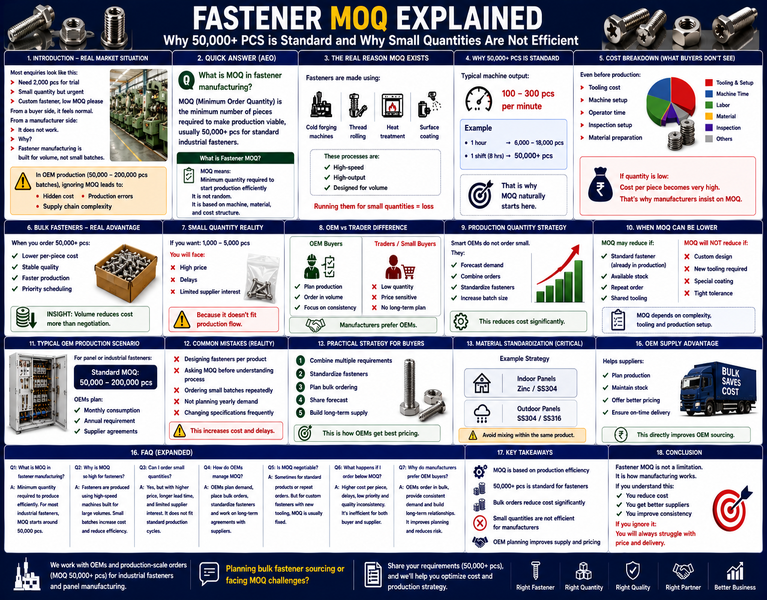
Introduction – Real Market Situation
Most enquiries look like this:
👉 “Need 2,000 pcs for trial”
👉 “Small quantity but urgent”
👉 “Custom fastener, low MOQ please”
From a buyer side, it feels normal.
From a manufacturer side:
👉 It does not work.
Why?
👉 Fastener manufacturing is built for volume, not small batches
This is where most buyers misunderstand MOQ.
Quick Answer
What is MOQ in fastener manufacturing?
MOQ (Minimum Order Quantity) is the minimum number of pieces required to make production viable, usually 50,000+ pcs for standard industrial fasteners.
What is Fastener MOQ?
MOQ means:
👉 Minimum quantity required to start production efficiently
It is not random.
👉 It is based on machine, material, and cost structure
The Real Reason MOQ Exists
Fasteners are made using:
👉 Cold forging machines
👉 Thread rolling
👉 Bulk heat treatment
👉 Surface coating processes
These processes are:
✔ High-speed
✔ High-output
✔ Designed for volume
👉 Running them for small quantities = loss
Why 50,000+ pcs is Standard
Typical machine output:
👉 100–300 pieces per minute
Example
- 1 hour → 6,000–18,000 pcs
- 1 shift → 50,000+ pcs
👉 That is why MOQ naturally starts here
Cost Breakdown (What Buyers Don’t See)
Even before production:
👉 Tooling cost
👉 Machine setup
👉 Operator time
👉 Inspection setup
If quantity is low:
👉 Cost per piece becomes very high
👉 That’s why manufacturers insist on MOQ
Bulk Fasteners – Real Advantage
When you order 50,000+ pcs:
✔ Lower per-piece cost
✔ Stable quality
✔ Faster production
✔ Priority scheduling
👉 Volume solves most problems
Small Quantity Reality
If you want:
👉 1,000–5,000 pcs
You will face:
❌ High price
❌ Delays
❌ Limited supplier interest
👉 Because it doesn’t fit production flow
OEM vs Trader Difference
OEM Buyers
✔ Plan production
✔ Order in volume
✔ Focus on consistency
Traders / Small Buyers
✔ Low quantity
✔ Price sensitive
✔ No long-term plan
👉 Manufacturers prefer OEMs
Production Quantity Strategy
Smart OEMs do not order small.
They:
✔ Forecast demand
✔ Combine orders
✔ Standardize fasteners
✔ Increase batch size
👉 This reduces cost significantly
When MOQ Can Be Lower
MOQ may reduce if:
✔ Standard fastener (already in production)
✔ Available stock
✔ Repeat order
✔ Shared tooling
MOQ will NOT reduce if:
- Custom design
- New tooling required
- Special coating
- Tight tolerance
Typical OEM Production Scenario
For panel or industrial fasteners:
👉 Standard MOQ: 50,000–200,000 pcs
OEMs plan:
✔ Monthly consumption
✔ Annual requirement
✔ Supplier agreements
Common Mistakes Buyers Make
- Asking MOQ before understanding process
- Ordering small batches repeatedly
- Not planning yearly demand
- Changing specifications frequently
👉 This increases cost and delays.
Practical Strategy for Buyers
To work efficiently with manufacturers:
✔ Combine multiple requirements
✔ Standardize fasteners
✔ Plan bulk ordering
✔ Share forecast
✔ Build long-term supply
👉 This is how OEMs get best pricing
Key Takeaways
• MOQ is based on production efficiency
• 50,000+ pcs is standard for fasteners
• Bulk orders reduce cost significantly
• Small quantities are not efficient for manufacturers
• OEM planning improves supply and pricing
FAQ
Q1: What is MOQ in fastener manufacturing?
MOQ is the minimum quantity required to produce fasteners efficiently without increasing cost per piece. It is based on machine capacity, setup cost, and production flow. For most industrial fasteners, MOQ starts around 50,000 pcs.
Q2: Why is MOQ so high for fasteners?
Fasteners are produced using high-speed machines designed for large volumes. Running these machines for small batches increases setup cost and reduces efficiency. That’s why manufacturers prefer larger quantities.
Q3: Can I order small quantities of fasteners?
Yes, but it usually comes with higher pricing, longer lead times, and limited supplier options. Small orders do not fit standard production cycles. OEM buyers typically avoid this by planning bulk requirements.
Q4: How do OEMs manage MOQ requirements?
OEMs plan their demand in advance and place bulk orders based on production needs. They standardize fasteners and work with suppliers on long-term agreements. This helps them reduce cost and ensure consistent supply.
Q5: Is MOQ negotiable?
MOQ can sometimes be adjusted for standard products or repeat orders. However, for custom fasteners or new designs, MOQ is usually fixed due to tooling and setup requirements. It depends on the production complexity.
Q6: What happens if I order below MOQ?
The cost per piece increases significantly, and manufacturers may not prioritize the order. You may also face delays and quality inconsistencies. It becomes inefficient for both buyer and supplier.
Q7: Why do manufacturers prefer OEM buyers?
OEM buyers order in bulk, provide consistent demand, and build long-term relationships. This aligns with the manufacturing process and improves production planning. It also reduces risk for the supplier.
Conclusion
Fastener MOQ is not a limitation.
👉 It is how manufacturing works.
If you understand this:
✔ You reduce cost
✔ You get better suppliers
✔ You improve consistency
If you ignore it:
👉 You will always struggle with price and delivery.
👉 We work with OEMs and production-scale orders (MOQ 50,000+ pcs) for industrial fasteners and panel manufacturing.Planning bulk fastener sourcing or facing MOQ challenges?
Share your requirements (50,000+ pcs), and we’ll help you optimize cost and production strategy.