

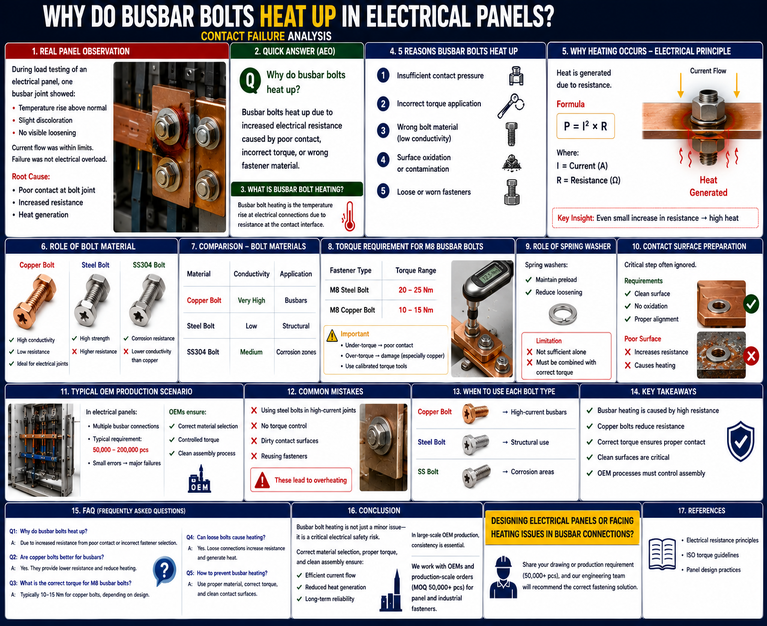
Introduction – Real Panel Observation
During load testing of an electrical panel, one busbar joint showed:
👉 Temperature rise above normal 👉 Slight discoloration 👉 No visible loosening
Current flow was within limits.
Failure was not electrical overload.
Root cause:
👉 Poor contact at bolt joint 👉 Increased resistance 👉 Heat generation
Busbar joints carry high current, and even a small increase in resistance creates significant heating.
In OEM panel manufacturing, these connections exist in 50,000–200,000 pcs scale, where improper fastening leads to safety risks.
Quick Answer
Why do busbar bolts heat up? Busbar bolts heat up due to increased electrical resistance caused by poor contact, incorrect torque, or wrong fastener material.
What is Busbar Bolt Heating?
Busbar bolt heating is the temperature rise at electrical connections due to resistance at the contact interface.
5 Reasons Busbar Bolts Heat Up
- Insufficient contact pressure
- Incorrect torque application
- Wrong bolt material (low conductivity)
- Surface oxidation or contamination
- Loose or worn fasteners
Why Heating Occurs – Electrical Principle
Heat is generated due to resistance.
Formula
👉 P = I² × R
Where:
- I = Current
- R = Resistance
Key Insight
Even small increase in resistance → high heat
Role of Bolt Material
Copper Bolt
✔ High conductivity ✔ Low resistance ✔ Ideal for electrical joints
Steel Bolt
✔ High strength ❌ Higher resistance
SS304 Bolt
✔ Corrosion resistance ❌ Lower conductivity than copper
Comparison – Bolt Materials
| Material | Conductivity | Application |
| Copper Bolt | Very High | Busbars |
| Steel Bolt | Low | Structural |
| SS304 Bolt | Medium | Corrosion zones |
Torque Requirement for M8 Busbar Bolts
| Fastener Type | Torque Range |
| M8 Steel Bolt | 20–25 Nm |
| M8 Copper Bolt | 10–15 Nm |
Important
- Under-torque → poor contact
- Over-torque → damage (especially copper)
- Use calibrated torque tools
Role of Spring Washer
Spring washers:
✔ Maintain preload ✔ Reduce loosening
Limitation
- Not sufficient alone
- Must be combined with correct torque
Contact Surface Preparation
Critical step often ignored.
Requirements
✔ Clean surface ✔ No oxidation ✔ Proper alignment
Poor Surface
- Increases resistance
- Causes heating
Typical OEM Production Scenario
In electrical panels:
- Multiple busbar connections
- Typical requirement: 50,000–200,000 pcs
- Small errors → major failures
OEMs ensure:
✔ Correct material selection ✔ Controlled torque ✔ Clean assembly process
Common Mistakes
- Using steel bolts in high-current joints
- No torque control
- Dirty contact surfaces
- Reusing fasteners
👉 These lead to overheating
When to Use Each Bolt Type
✔ Copper bolt → high-current busbars ✔ Steel bolt → structural use ✔ SS bolt → corrosion areas
Key Takeaways
• Busbar heating is caused by high resistance • Copper bolts reduce resistance • Correct torque ensures proper contact • Clean surfaces are critical • OEM processes must control assembly
FAQ
Q1: Why do busbar bolts heat up?
Due to increased resistance from poor contact or incorrect fastener selection.
Q2: Are copper bolts better for busbars?
Yes. They provide lower resistance and reduce heating.
Q3: What is the correct torque for M8 busbar bolts?
Typically 10–15 Nm for copper bolts, depending on design.
Q4: Can loose bolts cause heating?
Yes. Loose connections increase resistance and generate heat.
Q5: How to prevent busbar heating?
Use proper material, correct torque, and clean contact surfaces.
Conclusion
Busbar bolt heating is not just a minor issue—it is a critical electrical safety risk.
Correct material selection, proper torque, and clean assembly ensure:
✔ Efficient current flow ✔ Reduced heat generation ✔ Long-term reliability
In large-scale OEM production, consistency is essential.
👉 We work with OEMs and production-scale orders (MOQ 50,000+ pcs) for electrical and industrial fasteners.
Designing electrical panels or facing heating issues in busbar connections? Share your drawing or production requirement (50,000+ pcs), and our engineering team will recommend the correct fastening solution.
References
- Electrical resistance principles
- ISO torque guidelines
- Panel design practices