

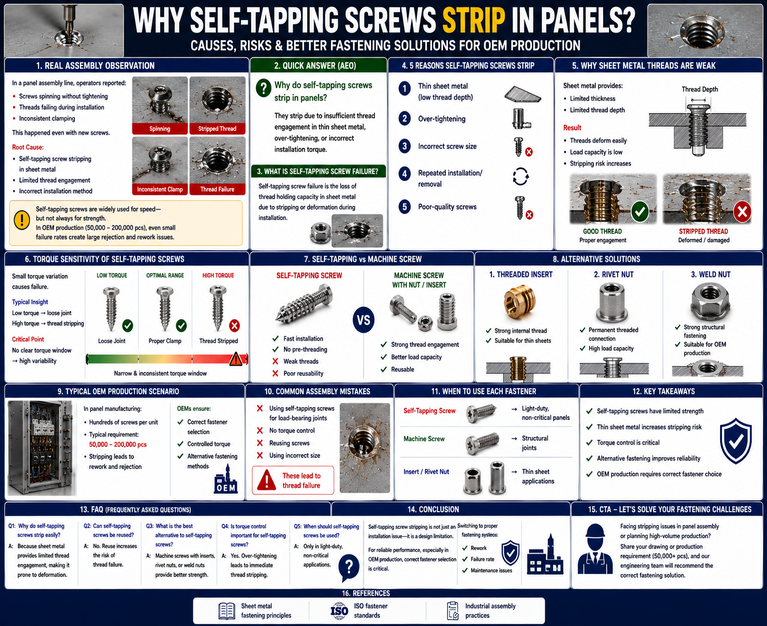
Introduction – Real Assembly Observation
In a panel assembly line, operators reported:
👉 Screws spinning without tightening
👉 Threads failing during installation
👉 Inconsistent clamping
This happened even with new screws.
Root causes:
👉 Self-tapping screw stripping in sheet metal
👉 Limited thread engagement
👉 Incorrect installation method
Self-tapping screws are widely used for speed—but not always for strength.
In OEM production, where these are used in 50,000–200,000 pcs batches, even small failure rates create large rejection and rework issues.
Quick Answer
Why do self-tapping screws strip in panels?
They strip due to insufficient thread engagement in thin sheet metal, over-tightening, or incorrect installation torque.
What is Self-Tapping Screw Failure?
Self-tapping screw failure is the loss of thread holding capacity in sheet metal due to stripping or deformation during installation.
5 Reasons Self-Tapping Screws Strip
- Thin sheet metal (low thread depth)
- Over-tightening
- Incorrect screw size
- Repeated installation/removal
- Poor-quality screws
Why Sheet Metal Threads Are Weak
Sheet metal provides:
👉 Limited thickness
👉 Limited thread depth
Result
- Threads deform easily
- Load capacity is low
- Stripping risk increases
Torque Sensitivity of Self-Tapping Screws
Small torque variation causes failure.
Typical Insight
- Low torque → loose joint
- High torque → thread stripping
Critical Point
No clear torque window → high variability
Self-Tapping vs Machine Screw
Self-Tapping Screw
✔ Fast installation
✔ No pre-threading
❌ Weak threads
❌ Poor reusability
Machine Screw with Nut/Insert
✔ Strong thread engagement
✔ Better load capacity
✔ Reusable
Comparison – Fastener Options
| Parameter | Self-Tapping Screw | Machine Screw + Nut |
| Strength | Low | High |
| Reusability | Poor | Good |
| Installation Speed | High | Medium |
| Failure Risk | High | Low |
Alternative Solutions
1. Threaded Insert
✔ Strong internal thread
✔ Suitable for thin sheets
2. Rivet Nut
✔ Permanent threaded connection
✔ High load capacity
3. Weld Nut
✔ Strong structural fastening
✔ Suitable for OEM production
Typical OEM Production Scenario
In panel manufacturing:
- Hundreds of screws per unit
- Typical requirement: 50,000–200,000 pcs
- Stripping leads to rework and rejection
OEMs ensure:
✔ Correct fastener selection
✔ Controlled torque
✔ Alternative fastening methods
Common Assembly Mistakes
- Using self-tapping screws for load-bearing joints
- No torque control
- Reusing screws
- Using incorrect size
👉 These lead to thread failure
When to Use Each Fastener
✔ Self-tapping screw → light-duty, non-critical panels
✔ Machine screw → structural joints
✔ Insert/rivet nut → thin sheet applications
Key Takeaways
• Self-tapping screws have limited strength
• Thin sheet metal increases stripping risk
• Torque control is critical
• Alternative fastening improves reliability
• OEM production requires correct fastener choice
FAQ
Q1: Why do self-tapping screws strip easily?
Because sheet metal provides limited thread engagement, making it prone to deformation.
Q2: Can self-tapping screws be reused?
No. Reuse increases the risk of thread failure.
Q3: What is the best alternative to self-tapping screws?
Machine screws with inserts, rivet nuts, or weld nuts provide better strength.
Q4: Is torque control important for self-tapping screws?
Yes. Over-tightening leads to immediate thread stripping.
Q5: When should self-tapping screws be used?
Only in light-duty, non-critical applications.
Conclusion
Self-tapping screw stripping is not just an installation issue—it is a design limitation.
For reliable performance, especially in OEM production, correct fastener selection is critical.
Switching to proper fastening systems reduces:
✔ Rework
✔ Failure rate
✔ Maintenance issues
👉 We work with OEMs and production-scale orders (MOQ 50,000+ pcs) for panel and industrial fasteners.
Facing stripping issues in panel assembly or planning high-volume production?
Share your drawing or production requirement (50,000+ pcs), and our engineering team will recommend the correct fastening solutions.
References
- Sheet metal fastening principles
- ISO fastener standards
- Industrial assembly practices