

Introduction – Real Plant Observation
In a battery manufacturing facility, an earthing inspection showed high resistance values across multiple grounding points. The wiring was intact, but grounding performance was unstable.
Failure point:
👉 M10 grounding bolt connection
👉 Loose joint + oxidized surface
👉 Poor electrical continuity
This is a critical issue.
Unlike structural bolts, grounding fasteners must ensure consistent electrical contact, not just mechanical clamping.
In OEM battery plants, grounding systems involve 50,000–200,000 fastener connections, where improper setup leads to system-wide safety risks.
Quick Answer
What causes grounding bolt failure in battery plants?
Grounding bolt failure occurs due to poor contact surfaces, insufficient torque, and incorrect fastener setup, leading to increased resistance and unreliable earthing performance.
What is a Battery Grounding Bolt?
A battery grounding bolt is a fastener used to establish electrical continuity between equipment and earth, ensuring safe dissipation of fault currents.
5 Reasons Grounding Bolts Fail
- Oxidized or painted contact surfaces
- Loose M10 bolt (low torque)
- No serrated washer for contact penetration
- Use of incorrect fastener materials
- Reuse of bolts or washers
Why Grounding Requires Special Fastener Setup
Grounding joints depend on:
👉 Metal-to-metal contact
If surfaces are:
- Painted
- Oxidized
- Contaminated
👉 Electrical resistance increases
Result
- Poor earthing
- Voltage buildup
- Safety risk
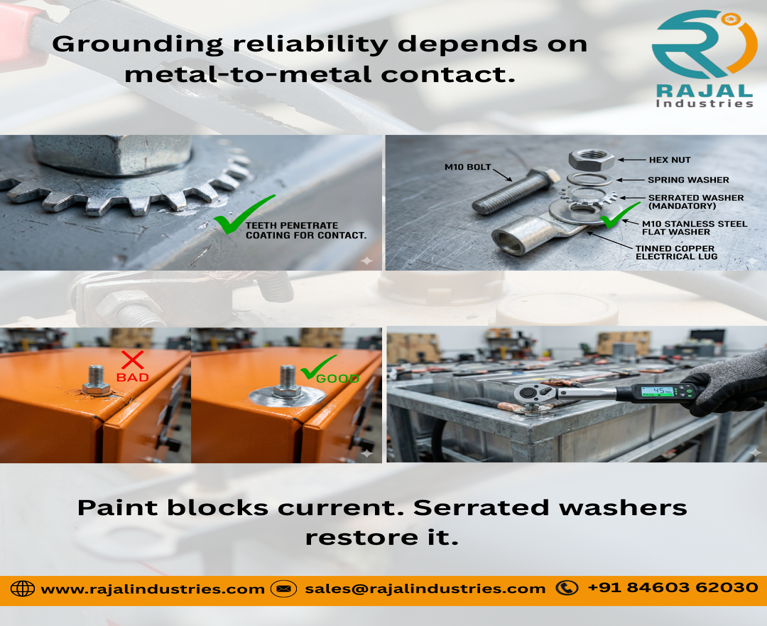
- Role of Serrated Washer (Critical)
Serrated washers are essential for grounding.
Function
- Teeth penetrate surface coating
- Ensure metal-to-metal contact
- Improve electrical continuity
Without Serrated Washer
- Contact is weak
- Resistance increases
- Grounding becomes unreliable
Correct M10 Grounding Fastener Setup
Recommended configuration:
- M10 grounding bolt
- Serrated washer (mandatory)
- Flat washer (optional, if needed)
- Hex nut
- Spring washer (to maintain preload)
Torque Requirement
| Fastener Type | Torque Range |
| M10 Steel Bolt | 40–50 Nm |
| M10 Stainless Bolt | 35–45 Nm |
Important
- Under-torque → poor contact
- Over-torque → thread damage
- Use calibrated torque tools
Electrical Contact vs Mechanical Strength
Grounding bolts are different:
👉 Mechanical bolts → load-bearing
👉 Grounding bolts → conductivity critical
Key Insight
Higher torque improves:
✔ Contact pressure
✔ Conductivity
But must stay within safe limits.
Typical OEM Production Scenario
In battery plants:
- Grounding points across racks, panels, and equipment
- Typical requirement: 50,000–200,000 pcs
- Consistency critical for safety compliance
OEMs focus on:
✔ Standardized grounding setup
✔ Reliable fastener supply
✔ Controlled torque procedures
Common Installation Mistakes
- Installing bolts on painted surfaces
- Skipping serrated washers
- Using mixed materials (steel + aluminum mismatch)
- Reusing grounding fasteners
👉 These lead to grounding failure
When to Use Each Component
✔ Serrated washer → mandatory for grounding
✔ Spring washer → maintain preload
✔ SS bolt → corrosion-prone environments
✔ Carbon steel bolt → standard industrial use
Key Takeaways
• Grounding failure is often due to poor contact, not wiring
• Serrated washers are critical for electrical continuity
• Proper torque ensures low resistance connection
• Surface preparation is essential
• OEM setups require consistency across all grounding points
FAQ
Q1: Why do grounding bolts fail in battery plants?
Failure occurs due to poor contact surfaces, incorrect torque, and missing serrated washers, leading to increased resistance.
Q2: What is the role of serrated washers in grounding?
Serrated washers penetrate surface coatings and ensure metal-to-metal contact for better conductivity.
Q3: What torque should be applied to M10 grounding bolts?
Typically 40–50 Nm for steel bolts, depending on material and application.
Q4: Can grounding bolts be reused?
Reuse is not recommended as it reduces reliability and contact effectiveness.
Q5: Does paint affect grounding performance?
Yes. Paint acts as an insulator and prevents proper electrical contact.
Conclusion
Grounding bolt failure is not a minor issue—it directly impacts electrical safety and system reliability in battery plants.
Correct fastener setup, proper torque, and surface preparation are essential for stable grounding.
In large-scale manufacturing environments, inconsistencies can lead to system-wide safety risks.
👉 We work with OEMs and production-scale orders (MOQ 50,000+ pcs) for battery and industrial applications.
Designing grounding systems or facing earthing issues in battery plants?
Share your drawing or production requirement (50,000+ pcs), and our engineering team will recommend the correct grounding fastener setup.
References
- Electrical grounding standards
- ISO fastener torque guidelines
- Industrial earthing practices