

Introduction – Real Site Hook
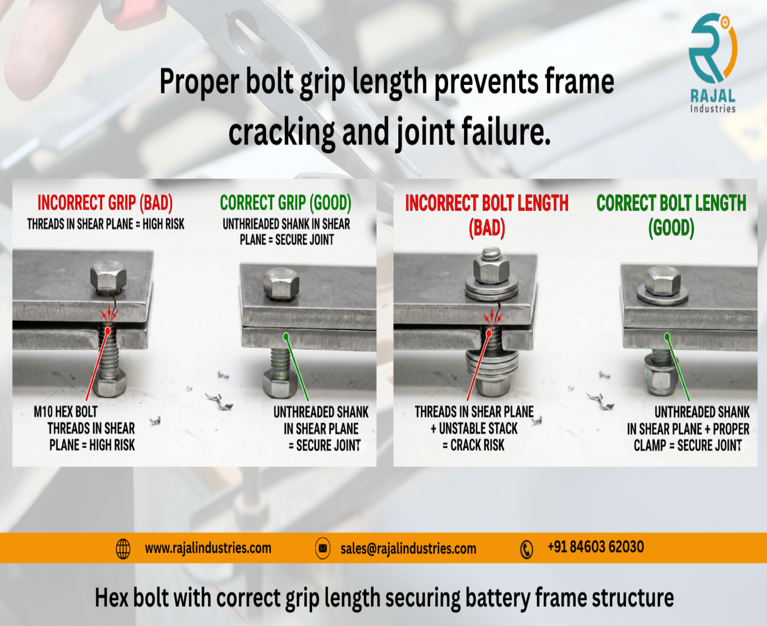
At a large battery storage site, small hairline cracks were found near the joint plates of a steel battery frame. Welds were intact. Material thickness was correct. But bolts protruded excessively beyond the nut.
Bolt used: M10 hex bolt
Bolt length: 80 mm
Actual required grip: 55 mm
The remaining threaded portion sat inside the joint.
After 9 months, crack developed around bolt hole.
This is a common but ignored problem in battery frame fasteners.
The diameter was correct.
The grade was correct.
But the bolt length was wrong.
Wrong grip length changes load transfer behavior.
Why Bolt Length Matters in Battery Frames
Battery frame fasteners must:
- • Clamp plates firmly
- • Keep shear load off threads
- • Maintain uniform preload
- • Prevent bending stress
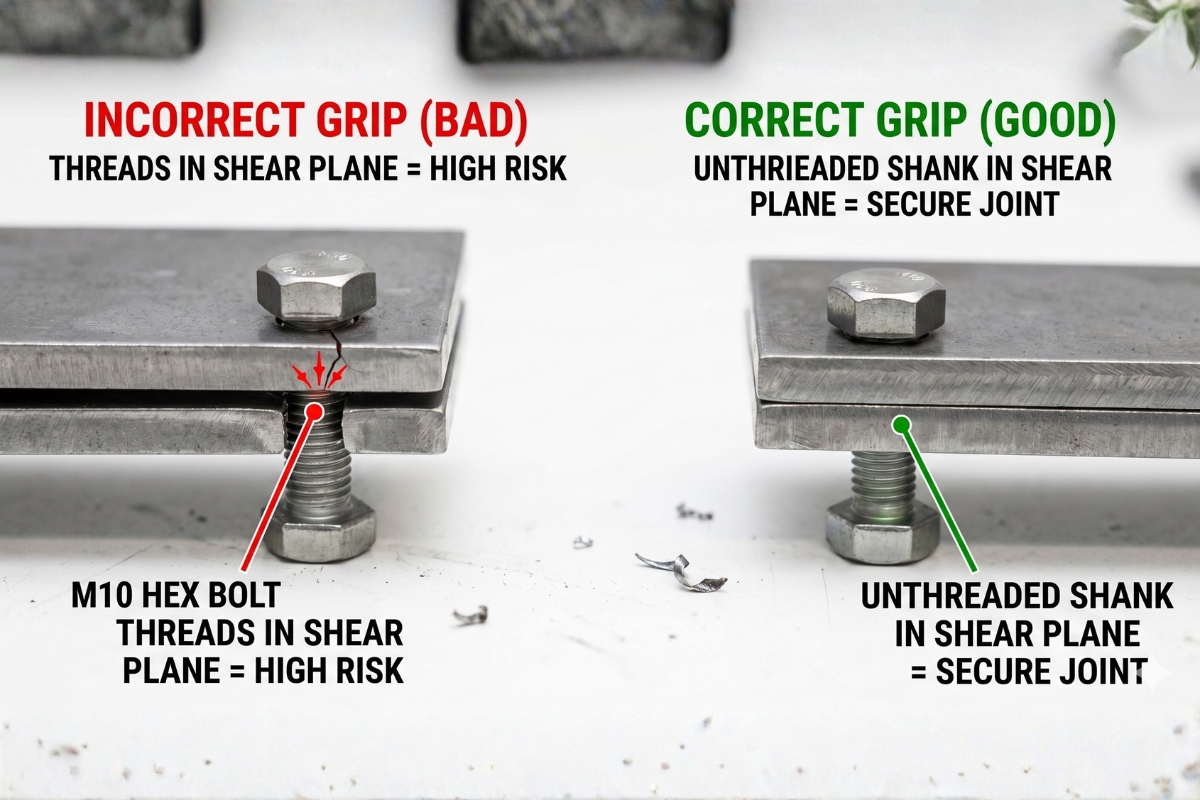
If threaded portion sits inside shear plane:
- • Threads carry shear load
- • Stress concentration increases
- • Micro movement begins
- • Crack starts at plate edge
Bolt length is not cosmetic.
It is structural.
What Is Grip Length?
Grip length = Total thickness of clamped material
Correct rule:
Unthreaded shank must pass fully through joint.
Only 2–3 threads should extend beyond nut.
If threads lie in shear zone → fatigue risk increases.
Grip Length Formula
Correct bolt length calculation:
Bolt Length = Grip Length + Washer Thickness + Nut Height + 2–3 Thread Allowance
Example:
Frame plate 1 = 8 mm
Frame plate 2 = 10 mm
Structural washer = 3 mm
Nut height (M10) ≈ 8 mm
Grip length = 8 + 10 = 18 mm
Bolt length = 18 + 3 + 8 + 3
= 32 mm
Correct bolt ≈ M10 × 35 mm
Using M10 × 80 mm bolt introduces excessive thread exposure and instability.
Case Study: Wrong Bolt Length Causing Crack
Observed:
- • Thread inside shear plane
- • No structural washer
- • Flat washer only
- • Torque correct
Problem was not torque.
It was incorrect grip.
Shear load transferred through threads instead of shank.
Thread root is weaker than shank.
Fatigue crack initiated at thread root.
Recommended Setup for Battery Frame Fasteners
Correct configuration:
- • M10 Hex Bolt with Correct Grip Length
- • Structural washer
- • Lock nut
- • Proper torque
You can review specifications for our
👉 M10 Hex Bolt for Battery Frame Applications
For vibration zones use:
👉 M10 Flange Bolt for Improved Load Distribution
For heavy frames use:
👉 M10 Structural Washer for Steel Plate Joints
Correct bolt stack improves joint rigidity.
Torque Recommendation for M10 Bolts
| Bolt Grade | Recommended Torque |
| M10 Grade 8.8 | 45–50 Nm |
| M10 Grade 10.9 | 65–70 Nm |
| M10 SS304 | 35–40 Nm |
Correct torque works only if grip length is correct.
Why Too Long Bolt Is Dangerous
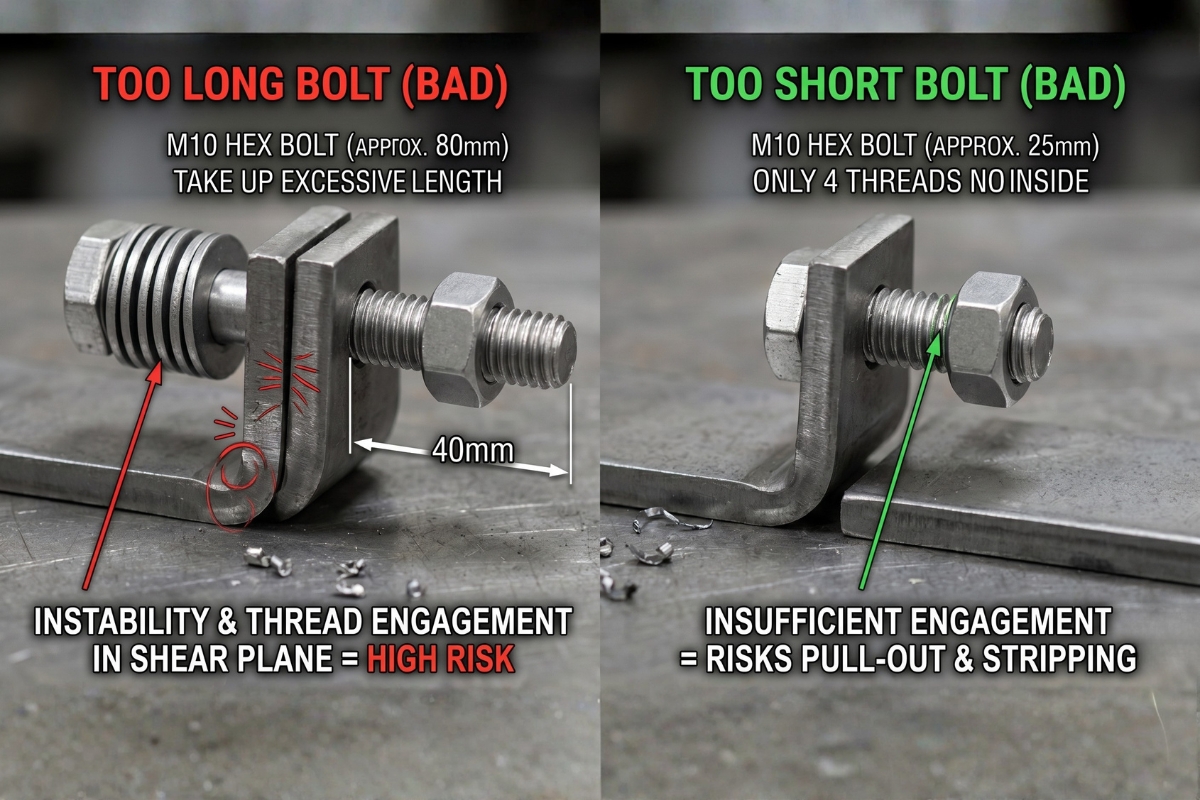
Excess length causes:
- • Thread engagement in shear plane
- • Nut seating instability
- • Uneven preload
- • Increased bending moment
Bolt must clamp, not act as cantilever.
Why Too Short Bolt Is Also Dangerous
Too short bolt causes:
- • Insufficient thread engagement
- • Nut stripping
- • Reduced clamp force
- • Risk of pull-out
At least 1 × diameter thread engagement recommended.
For M10 → minimum 10 mm thread engagement.
Comparison: Correct vs Incorrect Grip
| Parameter | Incorrect Grip | Correct Grip |
| Thread in Shear Plane | Yes | No |
| Preload Stability | Poor | Good |
| Fatigue Risk | High | Low |
| Frame Crack Risk | Possible | Minimal |
Battery frame fasteners must be selected based on grip formula.
Inspection Checklist
✔ Check thread location in joint
✔ Ensure unthreaded shank in shear zone
✔ Verify washer thickness
✔ Confirm nut engagement length
✔ Replace oversized bolts
✔ Check for crack signs near hole
Bolt length review must be part of design stage.
FAQ
Q1: Why do battery frame fasteners cause cracks near bolt holes?
If incorrect M10 hex bolt length is used, the threaded portion sits inside the shear plane. Threads are weaker than shank, leading to stress concentration and crack initiation in battery frame fasteners.
Q2: How to calculate correct bolt length for battery frame fasteners?
Use the grip length formula: total plate thickness + washer thickness + nut height + 2–3 thread allowance. Selecting correct M10 hex bolt ensures structural safety in battery frame applications.
Q3: Can flange bolt solve grip length issue?
M10 flange bolt improves load distribution but still requires correct bolt length calculation. Even high-grade battery frame fasteners fail if grip length is incorrect.
Q4: Is structural washer necessary in battery frame fasteners?
Yes. M10 structural washer distributes load and prevents plate embedding. It improves long-term preload stability in battery frame structures.
Q5: What happens if bolt is too long in battery frame joint?
Excessively long M10 hex bolt may cause thread shear load, uneven torque transfer, and eventual crack formation in battery frame fasteners.
Q6: Should lock nut be used in battery frame fasteners?
Yes. M10 lock nut prevents vibration loosening and maintains preload in industrial battery frames.
Conclusion
Battery frame fasteners fail not only due to grade or torque.
Wrong bolt length quietly weakens joint.
To prevent frame cracks:
- • Use correct M10 hex bolt length
- • Ensure full grip of unthreaded shank
- • Add structural washer
- • Use lock nut
- • Apply correct torque
Design detail prevents structural damage.
Need bolt length review for your battery frame project?
Contact our engineering team for correct fastener selection.
References
ISO 898-1 – Mechanical properties of bolts
VDI 2230 – Bolted joint calculation
EN 1993 – Structural steel design
Machinery’s Handbook – Thread engagement principles