

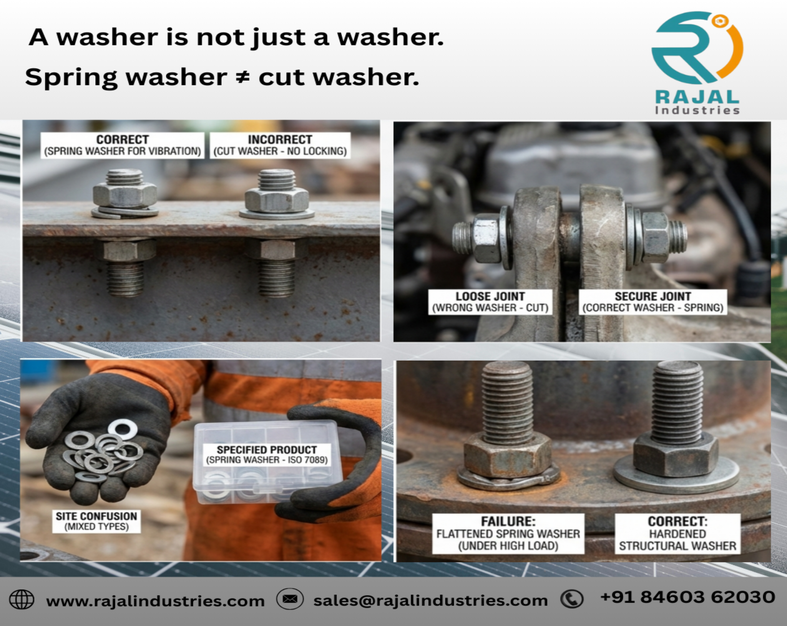
Why spring washer confusion keeps happening
Many BOQs simply say:
“Bolt, nut, washer.”
But which washer?
A spring washer?
A cut washer?
A structural washer?
On site, this vague wording creates confusion.
Wrong washers are used.
Joints loosen.
Inspections fail.
Time is wasted.
What a spring washer actually does
A spring washer applies elastic tension that resists loosening from vibration.
It is used for:
- Light vibration resistance
- General machinery
- Non-structural joints
It is not designed for structural load bearing.
What a cut washer is
A cut washer is a flat washer with a slit.
It spreads load but offers limited locking.
It is mainly used where:
- Slight flexibility is needed
- Surface damage must be avoided
- There is minor alignment tolerance
Why BOQs don’t match site practice
- 1. Generic wording
BOQs often use “washer” without type.
- 2. Cost assumptions
Procurement chooses cheaper washer.
- 3. Installer habits
Teams use what they have.
- 4. Lack of locking understanding
Locking and load spreading get mixed up.
How this causes failures
- Loose joints in vibration zones
- Incorrect clamping force
- Washer flattening under load
- Loss of preload
How to specify washers correctly
Mention washer type clearly
Mention standard (IS / ISO)
Mention washer OD and thickness
Mention locking requirement
Mention structural or non-structural use
Final thought
A washer is not just a washer.
Using the wrong type can turn a safe joint into a failure point.