

Introduction – The Charger Was Delivering Power, But Something Was Getting Hot
A charging network operator received repeated service alerts from a 180 kW DC fast charger.
The charger appeared to function normally.
Drivers could still charge vehicles.
The software reported no major faults.
The cooling system was operating correctly.
However, maintenance engineers noticed something unusual during a thermal inspection.
One terminal connection was operating at:
92°C
Nearby connections were operating between:
38°C and 45°C
The charger cabinet showed no visible damage.
The power module was functioning correctly.
The cable assembly was healthy.
The actual problem was hidden behind a protective cover.
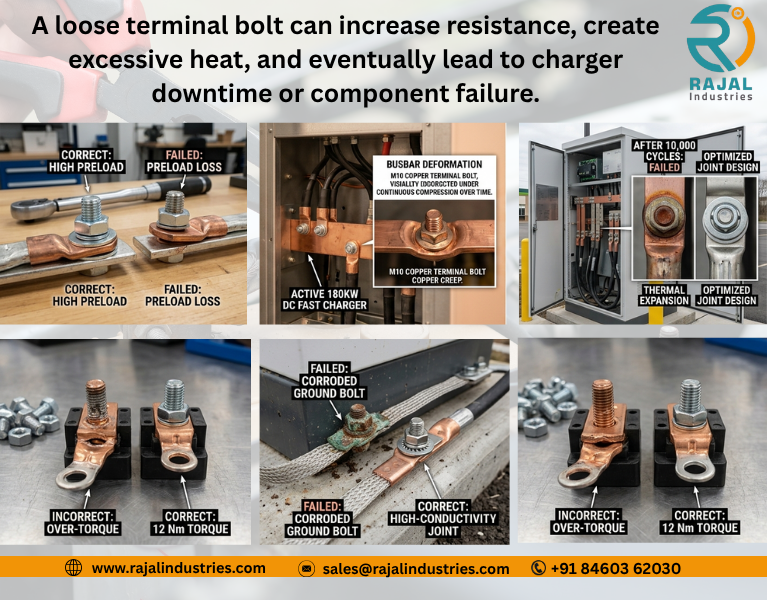
A single terminal bolt had gradually lost preload.
The result was:
- Increased Resistance
- Heat Generation
- Reduced Efficiency
- Potential Fire Risk
This issue is becoming increasingly common in:
- DC Fast Chargers
- Ultra-Fast Chargers
- EV Charging Stations
- Fleet Charging Systems
- Highway Charging Networks
- Commercial Charging Hubs
Many charger failures that appear electrical actually begin as fastener problems.
Quick Answer
Why do terminal bolts overheat in DC fast chargers?
Terminal bolts usually overheat because of preload loss, vibration, thermal expansion, improper torque, copper creep, oxidation, or incorrect hardware selection. As clamp force decreases, electrical resistance increases, generating excessive heat.
Why Terminal Bolts Are Critical in EV Chargers
Every DC fast charger contains multiple high-current electrical connections.
These include:
- DC Busbars
- Power Modules
- Output Terminals
- Grounding Systems
- Battery Connections
- Power Distribution Assemblies
All of these rely on terminal bolts.
A terminal bolt performs two jobs:
Mechanical Function
Creates clamp force.
Electrical Function
Maintains low-resistance electrical contact.
If either function is compromised, heating begins.
What Are EV Charger Terminal Bolts?
Terminal bolts are fasteners used to secure electrical conductors and busbars inside charging equipment.
Common hardware includes:
Terminal Fasteners
- M6 Terminal Bolts
- M8 Terminal Bolts
- M10 Terminal Bolts
- Flange Bolts
Electrical Hardware
- Copper Terminal Bolts
- Tin-Plated Copper Bolts
- Brass Bolts
Locking Components
- Belleville Washers
- Spring Washers
- Serrated Washers
- Lock Nuts
Grounding Hardware
- Grounding Bolts
- Ground Lugs
- Earth Bars
- Copper Grounding Straps
Among these, M8 terminal bolts and M10 terminal bolts are among the most common EV charger fasteners.
Failure #1 – Preload Loss
The most common cause of heating.
Many people assume a terminal bolt simply needs to be tight.
In reality:
The goal is creating:
Clamp Force
When preload decreases:
- Contact pressure decreases
- Resistance increases
- Heat generation increases
The bolt may still appear tight while the connection is already failing.
Why Clamp Force Matters
Electrical current does not flow through the entire connection surface.
It flows through microscopic contact points.
Higher clamp force creates:
✔ Larger contact area
✔ Lower resistance
✔ Lower operating temperature
When preload drops:
The effective contact area decreases dramatically.
Failure #2 – Copper Creep
Most charger busbars use copper.
Copper is softer than steel.
Under continuous compression:
Copper slowly deforms.
This phenomenon is called:
Copper Creep
As copper creeps:
- Joint thickness changes
- Clamp force reduces
- Resistance increases
This issue is commonly found in:
- DC Fast Chargers
- Power Cabinets
- Battery Storage Systems
- Switchgear Assemblies
Failure #3 – Thermal Expansion
DC fast chargers experience continuous heating and cooling.
Charging Session:
Current Increases
↓
Busbar Heats
↓
Metal Expands
↓
Charging Stops
↓
Cooling Begins
↓
Metal Contracts
This cycle repeats thousands of times.
Eventually:
Clamp force decreases.
Failure #4 – Improper Torque
Incorrect torque remains one of the biggest causes of charger terminal failures.
Under-Tightening
Creates:
- Low Clamp Force
- High Resistance
- Early Heating
Over-Tightening
Creates:
- Thread Damage
- Copper Distortion
- Reduced Joint Reliability
Both conditions increase long-term failure risk.
Real DC Fast Charger Example
A charging operator inspected:
75 DC Fast Chargers
after recurring temperature alarms.
Results:
18% of chargers
showed elevated temperatures at terminal connections.
Common findings:
- Loose M8 Terminal Bolts
- Missing Belleville Washers
- Reduced Clamp Force
- Oxidized Contact Surfaces
After corrective maintenance:
Average terminal temperatures decreased significantly.
Failure #5 – Missing Belleville Washers
Many chargers still use:
Flat Washers Only
However, they do not compensate for:
- Thermal Expansion
- Copper Creep
- Joint Settlement
Belleville washers act like springs.
They help maintain preload throughout the charger’s life.
Belleville Washer vs Spring Washer
| Parameter | Spring Washer | Belleville Washer |
| Preload Retention | Medium | High |
| Thermal Compensation | Medium | Excellent |
| High Current Applications | Good | Excellent |
| Charger Reliability | Good | Better |
| OEM Preference | Common | Increasing |
Many charger OEMs now specify Belleville washers in high-current terminals.
Failure #6 – Oxidized Contact Surfaces
A perfect bolt cannot compensate for a poor contact surface.
Common contaminants include:
- Oxidation
- Dirt
- Dust
- Grease
- Fingerprints
These contaminants reduce electrical contact area.
The result:
Higher resistance.
Higher temperatures.
Reduced efficiency.
Failure #7 – Poor Grounding Hardware
Grounding systems are often overlooked during inspections.
Common components include:
- Grounding Bolts
- Serrated Washers
- Ground Lugs
- Grounding Straps
A poor grounding connection can cause:
- Electrical Noise
- Fault Detection Problems
- Safety Risks
- Increased Maintenance
Grounding hardware should receive the same attention as power terminals.
Why Heating Increases So Quickly
Assume:
Current:
500 Amps
Joint Resistance:
100 Micro-ohms
Power Loss:
P = I²R
P = 500² × 0.0001
= 25 Watts
If preload loss doubles resistance:
200 Micro-ohms
Power Loss becomes:
50 Watts
Heat generation doubles.
The electrical load remains unchanged.
Only the terminal connection changes.
Common Terminal Fasteners Used in DC Fast Chargers
Large charger manufacturers regularly purchase:
Terminal Hardware
- M6 Terminal Bolts
- M8 Terminal Bolts
- M10 Terminal Bolts
- Copper Terminal Bolts
- Tin-Plated Copper Bolts
Structural Fasteners
- M6 Screws
- M8 Bolts
- M10 Bolts
- Flange Bolts
Grounding Hardware
- Grounding Bolts
- Serrated Washers
- Ground Lugs
- Earth Bars
Locking Components
These are among the most searched EV charger terminal fasteners used by OEMs worldwide.
Typical Fastener Consumption in a DC Fast Charger
A single charger may contain:
Cabinet Hardware
Terminal Connections
Grounding Hardware
- 10–30 Grounding Assemblies
Structural Fasteners
- 50–150 Bolts
Large charging networks consume millions of fasteners annually.
What Leading Charger OEMs Focus On
Modern EV charger manufacturers increasingly evaluate:
✔ Torque Retention
✔ Contact Resistance
✔ Thermal Performance
✔ Grounding Reliability
✔ Corrosion Resistance
✔ Preload Stability
✔ Field Serviceability
✔ Long-Term Maintenance Costs
The goal is not simply installing hardware.
The goal is maintaining performance for 10+ years.
Industries Most Affected
Terminal bolt heating commonly impacts:
- DC Fast Charger Manufacturers
- Ultra-Fast Charger OEMs
- EV Charging Station Manufacturers
- Charging Network Operators
- EV Infrastructure Developers
- Fleet Charging Companies
- Utility Charging Providers
- Renewable Energy EPC Companies
Inspection Checklist
Before charger commissioning:
✔ Verify torque values
✔ Check Belleville washer installation
✔ Inspect grounding hardware
✔ Clean contact surfaces
✔ Measure contact resistance
✔ Inspect copper busbars
✔ Verify terminal bolt material
✔ Conduct thermal imaging inspection
✔ Review maintenance schedules
Key Takeaways
- Most terminal heating problems begin with preload loss.
- Copper creep gradually reduces clamp force.
- Thermal expansion accelerates loosening.
- Belleville washers improve preload retention.
- Contact resistance directly affects operating temperature.
- Grounding hardware is critical for charger safety.
- A small terminal bolt can determine charger reliability.
FAQ
Why do EV charger terminal bolts overheat?
Heating usually occurs because of preload loss, increased resistance, oxidation, thermal cycling, or improper torque.
Which terminal bolt sizes are commonly used?
M6, M8, and M10 terminal bolts are commonly used in DC fast chargers and power distribution systems.
What is copper creep?
Copper creep is the gradual deformation of copper under load, which reduces clamp force over time.
Why are Belleville washers used in charger terminals?
They help maintain preload despite thermal expansion and copper creep, improving long-term connection reliability.
Can a loose terminal bolt cause charger failure?
Yes. It can create excessive heat, reduce efficiency, damage components, and potentially cause safety hazards.
Why is grounding hardware important?
Grounding hardware helps maintain electrical safety, fault protection, and stable charger operation.
How can operators detect terminal heating?
Thermal imaging inspections are one of the most effective methods for identifying overheating connections before failures occur.
Which industries commonly face terminal bolt issues?
DC fast charger manufacturers, charging station operators, EV infrastructure developers, and utility charging networks.
Conclusion
Most overheating problems inside DC fast chargers do not begin with power electronics.
They begin with connections.
A loose M8 or M10 terminal bolt can gradually increase resistance, generate heat, reduce efficiency, and create reliability problems long before a major failure occurs.
For DC fast charger OEMs, charging network operators, and EV infrastructure developers, terminal fasteners and grounding hardware are not small components.
They are critical reliability components that help keep high-power charging systems operating safely and efficiently.