

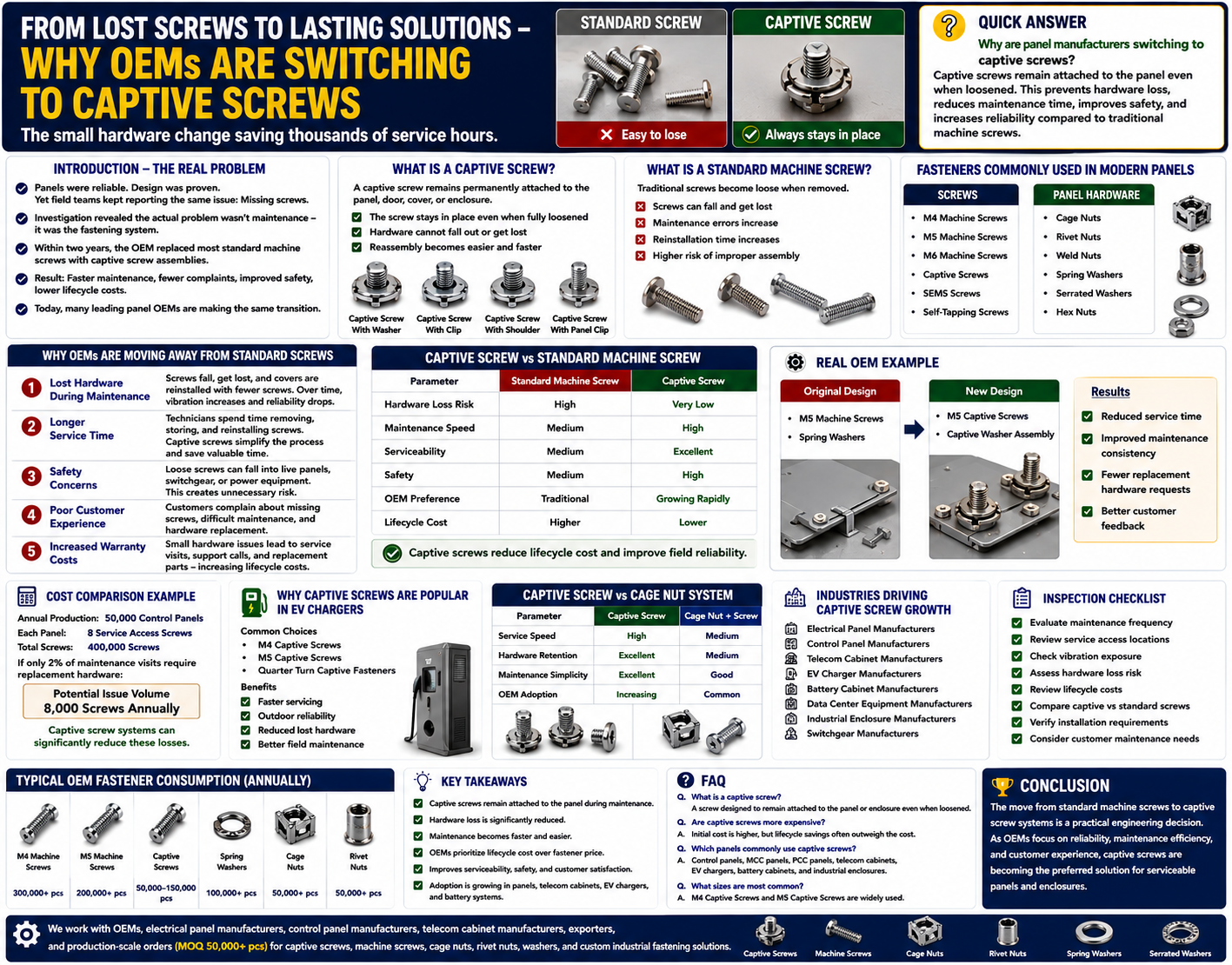
Introduction – The Small Hardware Change Saving Thousands of Service Hours
A major control panel manufacturer noticed a recurring problem.
The electrical panels were performing well.
The components were reliable.
The design was proven.
Yet field service teams kept reporting the same issue.
Missing screws.
Every maintenance visit seemed to create a new problem:
- Lost panel screws
- Missing cover screws
- Improper reassembly
- Loose access panels
- Longer maintenance time
The company initially blamed technicians.
However, a detailed investigation revealed the actual problem.
The issue wasn’t maintenance.
The issue was the fastening system.
Within two years, the OEM replaced most standard machine screws with captive screw assemblies.
The result?
- Faster maintenance
- Fewer service complaints
- Improved safety
- Lower lifecycle costs
Today, many leading panel OEMs are making the same transition.
Quick Answer
Why are panel manufacturers switching to captive screws?
Captive screws remain attached to the panel even when loosened. This prevents hardware loss, reduces maintenance time, improves safety, and increases reliability compared to traditional machine screws.
What Is a Captive Screw?
A captive screw is a fastening system designed so that the screw remains permanently attached to the panel, door, cover, or enclosure.
Even when fully loosened:
✔ The screw stays in place
✔ The hardware cannot fall out
✔ Reassembly becomes easier
Captive screws are commonly used in:
- Electrical Panels
- Control Panels
- MCC Panels
- PCC Panels
- Telecom Cabinets
- Battery Cabinets
- EV Charger Enclosures
- Data Center Equipment
What Is a Standard Machine Screw?
Traditional panel assemblies often use:
- M4 Machine Screws
- M5 Machine Screws
- M6 Machine Screws
- Self-Tapping Screws
- Sheet Metal Screws
When removed:
❌ The screw becomes loose
❌ Hardware can be lost
❌ Maintenance errors increase
❌ Reinstallation time increases
Fasteners Commonly Used in Modern Panel Assemblies
Most panel manufacturers use:
Screws
- M4 Machine Screws
- M5 Machine Screws
- M6 Machine Screws
- Captive Screws
- SEMS Screws
- Self-Tapping Screws
Panel Hardware
- Cage Nuts
- Rivet Nuts
- Weld Nuts
- Spring Washers
- Serrated Washers
- Hex Nuts
Why OEMs Are Moving Away from Standard Screws
The shift is not driven by cost.
It is driven by lifecycle performance.
Problem #1 – Lost Hardware During Maintenance
A technician removes:
- Door cover
- Terminal cover
- Access panel
Several screws fall.
One gets lost.
The cover is reinstalled with fewer screws.
Over time:
- Vibration increases
- Loosening begins
- Reliability decreases
Captive screws eliminate this problem.
Problem #2 – Longer Service Time
Maintenance teams spend time:
- Removing screws
- Storing screws
- Reinstalling screws
Captive screws simplify the process.
Many OEMs report significant maintenance time reductions.
Problem #3 – Safety Concerns
Loose screws can fall into:
- Live panels
- Switchgear assemblies
- Power distribution equipment
This creates unnecessary risk.
Captive screw systems help reduce these hazards.
Problem #4 – Poor Customer Experience
Customers often complain about:
- Missing screws
- Difficult maintenance
- Hardware replacement
Captive screw systems improve serviceability and customer satisfaction.
Problem #5 – Increased Warranty Costs
Small hardware issues create:
- Service visits
- Support calls
- Replacement parts
Many OEMs now view captive screws as a reliability upgrade.
Captive Screw vs Standard Machine Screw
| Parameter | Standard Machine Screw | Captive Screw |
| Hardware Loss Risk | High | Very Low |
| Maintenance Speed | Medium | High |
| Serviceability | Medium | Excellent |
| Safety | Medium | High |
| OEM Preference | Traditional | Growing Rapidly |
| Lifecycle Cost | Higher | Lower |
Real OEM Example
A control panel manufacturer supplying automation systems reviewed service records.
Most common complaint:
Missing panel screws after maintenance.
Original Design:
- M5 Machine Screws
- Spring Washers
New Design:
- M5 Captive Screws
- Captive Washer Assembly
Results:
✔ Reduced service time
✔ Improved maintenance consistency
✔ Fewer replacement hardware requests
✔ Better customer feedback
Cost Comparison Example
Assume:
Annual Production:
50,000 Control Panels
Each panel contains:
8 Service Access Screws
Total Screws:
400,000 Screws
If only 2% of maintenance visits require replacement hardware:
Potential issue volume:
8,000 screws annually
Captive screw systems can significantly reduce these losses.
Why Captive Screws Are Popular in EV Chargers
EV charger manufacturers increasingly use:
- M4 Captive Screws
- M5 Captive Screws
- Quarter Turn Captive Fasteners
Benefits:
✔ Faster servicing
✔ Outdoor reliability
✔ Reduced lost hardware
✔ Better field maintenance
Captive Screw vs Cage Nut System
| Parameter | Captive Screw | Cage Nut + Screw |
| Service Speed | High | Medium |
| Hardware Retention | Excellent | Medium |
| Maintenance Simplicity | Excellent | Good |
| OEM Adoption | Increasing | Common |
Both systems remain popular depending on application requirements.
Industries Driving Captive Screw Growth
The highest adoption is currently seen among:
- Electrical Panel Manufacturers
- Control Panel Manufacturers
- Telecom Cabinet Manufacturers
- EV Charger Manufacturers
- Battery Cabinet Manufacturers
- Data Center Equipment Manufacturers
- Industrial Enclosure Manufacturers
- Switchgear Manufacturers
Inspection Checklist
Before approving a panel fastening system:
✔ Evaluate maintenance frequency
✔ Review service access locations
✔ Check vibration exposure
✔ Assess hardware loss risk
✔ Review lifecycle costs
✔ Compare captive vs standard screws
✔ Verify installation requirements
✔ Consider customer maintenance needs
Typical OEM Fastener Consumption
A medium-sized panel OEM may consume annually:
- 300,000+ M4 Machine Screws
- 200,000+ M5 Machine Screws
- 50,000–150,000 Captive Screws
- 100,000+ Spring Washers
- 50,000+ Cage Nuts
- 50,000+ Rivet Nuts
Captive screw usage is increasing every year across industrial equipment.
Key Takeaways
- Captive screws remain attached to the panel during maintenance.
- Hardware loss is significantly reduced.
- Maintenance becomes faster and easier.
- OEMs increasingly prioritize lifecycle cost over fastener price.
- Captive screws improve serviceability and customer satisfaction.
- Adoption is growing in panels, telecom cabinets, EV chargers, and battery systems.
FAQ
What is a captive screw?
A captive screw is a screw designed to remain attached to a panel or enclosure even when fully loosened.
Why are OEMs replacing standard screws?
To reduce hardware loss, improve maintenance efficiency, and increase reliability.
Are captive screws more expensive?
The initial cost is typically higher, but many OEMs find that lifecycle savings outweigh the additional cost.
Which panels commonly use captive screws?
Control panels, MCC panels, PCC panels, telecom cabinets, EV chargers, battery cabinets, and industrial enclosures.
What sizes are commonly used?
M4 Captive Screws and M5 Captive Screws are among the most common choices.
Can captive screws improve maintenance speed?
Yes. Since the screw remains attached, technicians spend less time handling loose hardware.
Are captive screws suitable for outdoor applications?
Yes. Stainless steel captive screws are commonly used in outdoor enclosures and EV charging systems.
Why are captive screws becoming an OEM standard?
Because they improve serviceability, reduce errors, enhance safety, and lower long-term maintenance costs.
Conclusion
The move from standard machine screws to captive screw systems is not a trend.
It is a practical engineering decision.
As OEM manufacturers focus on reliability, maintenance efficiency, and customer experience, captive screws are becoming the preferred solution for serviceable panels and enclosures.
For electrical panel manufacturers, telecom cabinet manufacturers, EV charger OEMs, and battery enclosure manufacturers, the question is no longer whether captive screws work.
The question is whether continuing to use standard screws still makes sense.